
Health
Jowls: Causes, Prevention, Treatments, and What Actually Works


I think jowls are often misunderstood because they are treated online as if they were simply loose skin that can be tightened with one cream, exercise, or beauty device. In reality, the lower face changes with age through a combination of skin thinning, declining collagen and elastin, changes in facial fat, underlying structural changes, heredity, sun exposure, smoking, and the cumulative effects of aging. The American Society of Plastic Surgeons specifically lists jowls among the visible changes that occur when skin and facial tissues lose their youthful position.
From my perspective, the useful question is not simply, “How do I get rid of jowls?” It is, “What is actually creating the appearance of jowls in my face?” Someone with mild skin laxity and volume loss may need a very different approach from someone with substantial loose skin along the jaw and neck. Skin care can protect the skin and improve texture, fillers may help selected facial contours, energy-based treatments may provide modest tightening, and surgery can reposition tissues more substantially. None of those options should be presented as interchangeable.
This guide explains what jowls are, why they develop, whether they can be prevented, what creams and facial exercises can realistically accomplish, how nonsurgical treatments compare, when facelift or neck lift surgery may be considered, and which safety issues deserve particular attention.
Key Takeaways About Jowls
- Jowls are sagging or drooping tissues along the lower cheeks and jawline.
- They most commonly become more noticeable as the face ages.
- Loss of collagen and elastin contributes to thinner, less elastic skin.
- Changes in facial fat, skin laxity, heredity, sun exposure, smoking, and other aspects of aging can affect the jawline.
- Menopause can accelerate collagen loss and make jowls and slack skin more noticeable in some women.
- Sunscreen, moisturizer, smoking avoidance, and appropriate skin care can help reduce premature skin aging, but creams cannot physically reproduce a facelift.
- Evidence that facial exercises or “face yoga” reliably eliminate jowls remains insufficient.
- Ultrasound and radiofrequency treatments may produce modest skin tightening in selected people.
- Dermal fillers can restore lost facial volume, but injections are medical procedures with rare yet potentially serious complications.
- Facelift and neck lift surgery can address more substantial jowling and tissue laxity but involve surgery, recovery, scars, and potential complications.
- Gradually developing, symmetrical jowls are different from sudden one-sided facial drooping. Sudden facial weakness or drooping may indicate stroke and requires emergency attention.
What Are Jowls?
Jowls are areas of sagging tissue that become visible along the lower cheeks and jawline. They can soften a previously sharp jaw contour and create downward folds near the corners of the mouth or sides of the chin.
Cleveland Clinic describes jowls as drooping skin around the cheeks and jaw, while the American Society of Plastic Surgeons includes them among the visible signs that facelifts are designed to address.
I would not describe jowls as a disease. In most cases, they are part of normal facial aging and are primarily a cosmetic concern.
The appearance can vary substantially. One person may develop slight softness along the jaw in their forties, while another may retain a relatively defined jawline much later. Genetics, facial structure, skin quality, environmental exposure, smoking history, hormonal changes, weight changes, and the way facial tissues age can all contribute.
Where Jowls Usually Appear
Jowls normally appear on either side of the chin along the mandibular border, which is the lower edge of the jaw.
Someone may first notice:
- Less definition between the cheek and jaw
- Soft tissue hanging slightly below the jawline
- Deeper folds near the corners of the mouth
- Greater separation between the chin and lower cheek
- Loose skin continuing into the neck
- A less defined side profile
The changes are usually gradual.
That last point matters medically. A slowly changing jawline over several years is very different from sudden facial weakness.
What Causes Jowls?
I see jowl formation as a whole-face aging process rather than a single skin problem.
Skin sits over layers of fat, muscles, connective tissues, and bone. When several of these structures change over time, the lower face can begin to look heavier or more lax even if body weight has barely changed.
Loss of Collagen and Elastin
Collagen provides structural support within skin, while elastin contributes to its ability to stretch and return toward its original position.
The National Institute on Aging explains that aging skin becomes thinner and less elastic and that age-related losses in collagen and elastic fibers contribute to visible aging and increased fragility.
As those support systems decline, the skin may not remain as firm around the jawline.
I would compare it to fabric stretched over a structure. When the fabric becomes thinner and less resilient, it does not maintain exactly the same contour even if the framework underneath has not completely changed.
Changes in Facial Fat
Facial aging is not simply about gaining fat.
Some areas lose fullness while others can shift downward or become more prominent. The American Society of Plastic Surgeons notes that facial aging can involve fat that has fallen or disappeared, along with thinning skin and other changes.
This is why aggressively removing fat is not automatically a solution to jowls.
If someone already has facial volume loss, taking away additional volume in the wrong area could theoretically make the lower face look less supported rather than more youthful.
Gravity and Tissue Laxity
Gravity acts on facial tissues throughout life, but I would avoid blaming gravity alone.
A younger face also experiences gravity. The difference is that youthful skin, fat compartments, ligaments, and supporting tissues have different properties.
With aging, the combination of weaker structural support and time allows tissues to sit differently.
ASPS includes gravity among several factors involved in the loss of youthful facial contours, alongside heredity and environmental influences.
Genetics
Some people simply develop jowls earlier than others.
Facial bone structure, fat distribution, skin thickness, and inherited aging patterns can influence how the lower face changes.
Someone whose parents developed pronounced jowls relatively early may notice a similar pattern, although genetics never determines appearance with complete certainty.
Sun Exposure
Ultraviolet radiation accelerates skin aging.
The American Academy of Dermatology describes sun protection as the foundation of an anti-aging skin-care plan and explains that UV exposure accelerates visible aging.
Sun exposure cannot explain every case of jowls, but repeated UV damage can reduce skin quality and contribute to the overall aging process that makes laxity more noticeable.
Smoking
Smoking can accelerate visible skin aging.
AAD states that smoking speeds skin aging and contributes to loss of firmness, premature lines, wrinkles, and other changes.
If I were prioritizing modifiable risk factors rather than cosmetic treatments, smoking would therefore deserve much more attention than most trendy jawline devices.
Menopause and Hormonal Changes
Hormonal changes can affect skin, particularly around menopause.
AAD reports that women’s skin can lose substantial collagen during the first years of menopause, after which collagen loss continues more gradually. The organization specifically notes that decreasing collagen contributes to sagging and the appearance of jowls.
This helps explain why some women notice a relatively rapid change in lower-face firmness around midlife even when body weight has remained stable.
Weight Changes
Significant weight loss can change facial volume and reveal skin laxity that was less noticeable before.
Weight gain can also alter lower-face fullness.
I would not describe weight as the universal cause of jowls, though. Thin people develop jowls, and people at higher body weights can have well-defined jawlines.
Facial anatomy matters more than a single number on a scale.
Factors That Can Influence the Appearance of Jowls
The table below separates relatively fixed influences from factors people may be able to modify.
| Factor | Can You Change It? | How It May Affect Jowls |
|---|---|---|
| Natural aging | No | Skin, fat, and supporting tissues change over time |
| Genetics | No | Influences facial structure and aging patterns |
| Collagen and elastin decline | Not completely | Contributes to declining firmness and elasticity |
| Menopause | No | Hormonal changes can accelerate collagen loss |
| UV exposure | Yes, partly | Photoaging can worsen visible skin aging |
| Smoking | Yes | Can accelerate loss of skin quality and firmness |
| Major weight fluctuations | Sometimes | Can alter facial volume and skin laxity |
| Skin hydration | Yes | Can improve surface appearance but does not reposition deep tissues |
| Facial volume loss | Sometimes treatable | Can reduce structural support in parts of the face |
| Existing loose skin | Treatment-dependent | More advanced laxity may require procedural treatment for major change |
The practical lesson I draw from this table is that prevention and treatment are not the same thing. Sun protection may help preserve skin quality, but sunscreen cannot reposition an already sagging lower cheek.
Can Jowls Be Prevented?
No strategy can guarantee that jowls will never develop because aging and genetics cannot be eliminated.
What we can reasonably do is reduce avoidable skin damage and protect skin quality over time.
Use Daily Sun Protection
AAD recommends broad-spectrum sunscreen with SPF 30 or higher, along with shade and protective clothing, to reduce UV-related skin aging.
If I had to choose one basic skin-care habit for long-term aging prevention, consistent sun protection would rank very high.
It will not reshape the jaw overnight, but it addresses a well-established contributor to premature skin aging.
Avoid Smoking
Stopping or avoiding smoking has benefits far beyond appearance.
From a skin-aging perspective, reducing tobacco exposure also removes a factor associated with premature wrinkles and loss of firmness.
Use Moisturizer for Skin Quality
Moisturizer traps water in the skin and can make fine lines and dryness less noticeable.
That is useful, but it is not the same as lifting jowls.
Moisturizer improves the surface environment. It does not surgically reposition deeper facial tissues.
Consider Retinoids for Appropriate Skin Concerns
Retinoids can stimulate collagen production and improve fine lines and skin texture. AAD notes that retinoids have established anti-aging uses, although they can irritate the skin and are not suitable for everyone.
I would consider retinoids a skin-quality treatment, not a jowl-removal treatment.
That distinction prevents unrealistic expectations.
Can a Cream Tighten Jowls?
A cream may improve hydration, texture, fine lines, or certain signs of photoaging, but it cannot reproduce the structural effects of surgery.
AAD makes this distinction particularly clearly:
“You cannot get the results of a facelift from a cream.”
American Academy of Dermatology.
I think this quotation should be kept in mind whenever a product claims to “erase,” “reverse,” or “lift away” substantial jowls.
Cosmetics work primarily at or near the skin surface. A facelift can reposition deeper tissues and remove or redistribute excess skin. Those are fundamentally different interventions.
This does not make anti-aging skin care useless. Sunscreen, moisturizer, and appropriately selected active ingredients can improve skin quality. They simply should not be sold as substitutes for procedures capable of physically repositioning tissue.
Do Facial Exercises or Face Yoga Get Rid of Jowls?
The evidence is not strong enough for me to promise that facial exercises eliminate jowls.
A 2014 systematic review found the available evidence insufficient to determine whether facial exercises effectively rejuvenate the face.
Research has continued. A small 2018 study suggested certain facial-exercise routines might improve some aspects of perceived facial appearance, and a small 2025 pre-experimental study reported measurable changes in facial muscle properties. However, these studies were limited by factors such as small samples and study design.
A 2025 systematic review of facial exercises, massage, and related mechanical approaches concluded that although some localized improvements have been reported, current evidence remains insufficient to establish effectiveness confidently.
In practical terms, face yoga may be inexpensive and appealing to some people, but I would not present it as a proven alternative to skin tightening or surgery for established jowls.
What Nonsurgical Treatments Can Help Jowls?
The appropriate nonsurgical option depends on what is creating the lower-face appearance.
Some treatments address skin laxity. Others restore volume. Others reduce fat in specific areas.
That is why a proper facial assessment matters.
Dermal Fillers
Fillers restore lost fullness in selected facial areas.
AAD explains that fillers can restore facial volume and reduce some signs of aging, often with immediate or near-immediate visible changes.
For jowls, an experienced physician may sometimes use filler strategically around the chin, jawline, or areas of volume loss to improve contour.
I would not describe filler as physically removing a jowl. It modifies proportions and support.
Trying to correct significant skin laxity simply by adding more and more filler can also produce an overfilled appearance rather than a naturally sharper jaw.
Filler Safety Requires Serious Attention
Filler injections are medical procedures, not casual beauty services.
FDA states:
“The most concerning risk associated with the use of dermal fillers is unintentional injection into a blood vessel.”
U.S. Food and Drug Administration.
Although serious vascular complications are uncommon, the FDA explains that accidental intravascular injection can cause tissue death, vision abnormalities including blindness, or stroke.
For that reason, I would never choose a filler provider solely because of a discount.
AAD recommends having fillers performed in a medical setting by a properly trained licensed physician.
Radiofrequency Skin Tightening
Radiofrequency treatments heat tissues beneath the skin.
AAD states that some noninvasive radiofrequency treatments can produce tightening and that optimal changes may take months as collagen production develops. Results are generally more modest than surgical lifting.
This may make radiofrequency more appropriate for someone with mild laxity who accepts subtle change.
It is less realistic for someone expecting the transformation associated with a facelift.
Ultrasound Skin Tightening
Certain ultrasound devices also deliver energy beneath the skin to stimulate collagen-related tightening.
AAD describes the visible lifting from noninvasive ultrasound as modest and developing gradually over several months.
That word, modest, is important.
Advertising photos can create expectations that exceed what conservative skin-tightening procedures typically achieve.
Laser Treatments
Some laser procedures improve texture, pigmentation, wrinkles, and aspects of skin quality.
Certain lasers can also deliver heat beneath the skin for tightening. AAD notes that these approaches may require several treatments and that results develop gradually.
Again, lasers cannot mechanically recreate the tissue repositioning of a facelift.
How Treatment Options for Jowls Compare
The following comparison focuses on what each approach can realistically target rather than ranking treatments as universally better or worse.
| Approach | Best Suited To | Expected Degree of Change | Main Limitations |
|---|---|---|---|
| Sunscreen and skin care | Prevention and skin quality | Subtle | Cannot reposition established sagging tissue |
| Retinoid or retinol | Fine lines, texture, photoaging | Subtle and gradual | Irritation possible, does not remove jowls |
| Facial exercises | People seeking a no-cost conservative approach | Uncertain | Evidence remains insufficient |
| Dermal filler | Selected volume loss and contour concerns | Mild to moderate in appropriate anatomy | Temporary, injection risks, does not remove excess skin |
| Noninvasive radiofrequency | Mild skin laxity | Modest | Results vary and develop gradually |
| Ultrasound tightening | Mild laxity | Modest | Cannot match surgical lifting |
| Laser treatment | Skin texture plus selected tightening concerns | Modest | Often requires multiple sessions |
| Neck lift | Lower-face and neck laxity | More substantial | Surgery, scars, recovery, complications |
| Facelift | Moderate to substantial facial jowling and laxity | Most substantial structural change | Surgery, cost, downtime, medical risks |
I think this table illustrates why the severity and cause of jowls matter so much. A person with mild early laxity might be satisfied with modest improvement. Someone with heavy, hanging tissue may find a nonsurgical approach disappointing if their expectation is a sharply restored jawline.
READ: Hemp Gummies for Soothing Relief 750mg / 30 Count: Facts, Safety, Ingredients, and Evidence
When a Facelift May Be Considered for Jowls
A facelift, medically called rhytidectomy, is designed to improve visible aging in the face and neck.
ASPS specifically lists jowls as one of the changes facelifts can address. During traditional facelift surgery, facial tissues are repositioned, fat may be sculpted or redistributed, and excess skin can be redraped and removed.
This is why surgery generally produces a level of correction that creams and noninvasive devices cannot.
The American Society of Plastic Surgeons summarizes the limitation well:
“A facelift does not change your fundamental appearance and cannot stop the aging process.”
American Society of Plastic Surgeons.
I consider that an important expectation-setting point.
Facelift surgery can reposition aging tissues, but the face continues to age afterward.
When a Neck Lift May Help
Some people describe their concern as jowls when the problem actually extends substantially into the neck.
ASPS says a neck lift can address excess lower-face skin and fat that creates jowls, loose neck skin, fat beneath the chin, and certain neck muscle contours.
A neck lift may therefore be considered when the lower jaw and neck are the dominant concerns.
Facelift and neck lift techniques also overlap in many surgical plans because the jawline, face, and neck are anatomically connected.
What Are the Risks of Facelift and Neck Lift Surgery?
Cosmetic surgery should never be presented as risk-free.
ASPS lists potential facelift complications including bleeding, infection, anesthesia complications, nerve injury, changes in sensation, fluid accumulation, poor wound healing, skin loss, prolonged swelling, unfavorable scarring, and unsatisfactory results.
Neck lift risks similarly include bleeding, infection, asymmetry, fluid accumulation, altered sensation, scarring, skin loss, and rare nerve injury.
The appropriate choice therefore depends not only on desired appearance but also on health, smoking status, healing capacity, medications, expectations, and willingness to accept downtime and surgical risk.
How Long Does Facelift Recovery Take?
Recovery varies by technique and individual patient.
ASPS reports that many facelift patients are presentable publicly within approximately 10 to 14 days, while facial texture, sensation, and tightness may take two to three months to feel closer to normal.
Swelling and bruising generally improve gradually rather than disappearing overnight.
Neck lift recovery can also involve bandages, swelling, bruising, drains in some cases, and specific restrictions provided by the surgeon.
I would base planning on the surgeon’s individualized recovery estimate rather than social-media claims about “weekend facelifts.”
How I Would Choose a Treatment for Jowls
A sensible decision process begins with diagnosis of the cosmetic problem rather than selection of a trendy treatment.
Step 1: Decide What Actually Bothers You
Is the problem:
- Loose skin?
- Loss of jaw definition?
- Hollow cheeks?
- A small or recessed chin?
- Fat under the chin?
- Neck laxity?
- Skin texture?
- A combination of several changes?
A photograph from the front and side can help clarify this, although professional examination is much more informative.
Step 2: Decide How Much Change You Want
Someone seeking a subtle improvement and no surgical downtime should not choose treatment based on dramatic facelift photographs.
Conversely, a person seeking major lifting should not expect a moisturizer or one energy treatment to provide a surgical result.
Step 3: Match the Treatment to the Anatomy
Volume loss may respond to a different strategy from excess skin.
Mild laxity may respond differently from advanced laxity.
A properly trained dermatologist or plastic surgeon can assess the entire face rather than simply injecting or treating the most obvious fold.
Step 4: Understand Whether Results Are Temporary
Many fillers require maintenance because their effects are temporary. AAD notes that duration varies substantially depending on the filler material.
Energy-based treatment results can also evolve and change as the skin continues aging.
Surgical effects are more substantial and generally longer lasting, but surgery does not stop future aging.
Step 5: Compare Risks, Not Just Results
Before undergoing filler, I would want to know how the provider handles vascular complications.
Before surgery, I would want to understand anesthesia, bleeding, nerve injury, scarring, infection, recovery, and revision risks.
Before an energy treatment, I would want to understand which device is being used, expected improvement, potential side effects, and whether the treatment suits my skin type.
Step 6: Check Provider Qualifications
ASPS recommends choosing an appropriately board-certified plastic surgeon for neck lift surgery and provides specific questions patients can ask about training, facility accreditation, risks, recovery, and realistic results.
For fillers and dermatologic procedures, AAD similarly emphasizes appropriate medical training and a proper medical setting.
Common Myths About Jowls
Myth 1: Chewing Gum Will Eliminate Jowls
Chewing exercises jaw muscles, but jowls involve skin, fat, connective tissues, and broader facial aging.
There is no strong clinical evidence showing that chewing gum reverses established jowls.
Myth 2: Face Yoga Is Proven to Lift the Jawline
Research is interesting but still limited.
Recent reviews continue to describe the evidence as insufficient for confident conclusions about facial rejuvenation techniques involving exercise and massage.
Myth 3: Losing Weight Always Removes Jowls
Weight loss changes facial fat but does not necessarily tighten loose skin.
In some cases, substantial weight loss may actually make lax skin more visible.
The correct approach depends on facial anatomy rather than body weight alone.
Myth 4: Expensive Creams Work Better
AAD cautions consumers that higher price does not necessarily mean better anti-aging results and advises realistic expectations for topical products.
No topical cream can surgically reposition facial tissue.
Myth 5: Filler Is Always the Best Nonsurgical Fix
Filler can be very useful when volume loss or proportions contribute to a person’s concerns.
It can also be the wrong tool if the dominant problem is significant loose skin.
More filler is not automatically more lift.
Myth 6: Facelift Results Are Permanent
Facelift results can be long lasting, but natural aging continues.
ASPS specifically says facelifts do not stop the aging process.
When Jowls Are Not Just a Cosmetic Concern
Typical jowls develop gradually and generally affect both sides of the lower face.
A sudden change is different.
If one side of someone’s face suddenly droops or becomes weak, especially with arm weakness, speech difficulty, confusion, vision problems, dizziness, or severe headache, it may indicate a stroke.
CDC identifies sudden facial weakness, particularly on one side, as a stroke warning sign and advises calling 911 immediately when stroke symptoms occur.
I would never assume sudden facial drooping is simply “jowls.”
That difference between gradual cosmetic aging and acute neurological symptoms can be medically critical.
My Practical Recommendations for Managing Jowls
For people who are only beginning to notice lower-face aging, I would focus first on protecting skin quality.
That means daily sun protection, avoiding smoking, using a moisturizer suitable for the skin, and considering evidence-based anti-aging ingredients such as retinoids when medically appropriate.
If the concern remains mild but visible, a board-certified dermatologist or plastic surgeon can explain whether volume correction, skin tightening, or no procedure at all makes sense.
For moderate jowls, I would be particularly cautious about chasing repeated treatments without understanding the underlying anatomy. Several small interventions can eventually cost substantial money while still failing to produce the structural change a person actually wants.
When laxity becomes substantial, a surgical consultation may provide the clearest explanation of what is realistically achievable, even if the person ultimately decides against surgery.
I also think people should give themselves permission not to treat jowls at all.
They are a common feature of aging, not a medical defect. Cosmetic treatment is optional, and the best decision is the one based on informed expectations rather than pressure to look permanently young.
Conclusion
I see jowls as a normal consequence of a complex aging process rather than a problem caused by one weak muscle or one missing skin-care product. Collagen and elastin decline, facial fat changes, heredity, sun exposure, smoking, hormonal changes, tissue laxity, and facial structure can all influence how clearly the lower jaw changes with age.
The most important practical lesson is to match expectations with anatomy. Sunscreen and good skin care can protect skin quality, but they cannot reposition established sagging tissues. Facial exercises remain insufficiently proven for eliminating jowls. Fillers and noninvasive tightening procedures may produce useful improvements in properly selected patients, although their effects are more limited than surgery. Facelift and neck lift procedures offer more substantial structural correction but require serious consideration of recovery and medical risk.
If jowls bother me enough to consider treatment, my next step would be an assessment with a qualified dermatologist or board-certified plastic surgeon who can identify whether the dominant issue is volume loss, skin laxity, fat distribution, neck aging, or a combination of these factors.
Frequently Asked Questions
What Are Jowls?
Jowls are sagging tissues that develop along the lower cheeks and jawline, usually as part of facial aging. They can make the jaw look less defined and may become more noticeable as skin loses elasticity and facial tissues change position. Cleveland Clinic and the American Society of Plastic Surgeons both recognize drooping tissue around the jaw as a typical feature of facial aging. Jowls are generally cosmetic rather than a disease when they appear gradually and symmetrically.
At What Age Do Jowls Start?
There is no single age when jowls begin. Some people notice mild lower-face laxity in their thirties or forties, while others maintain a defined jawline considerably longer. Genetics, skin quality, sun exposure, smoking, facial structure, weight changes, and hormonal factors all influence timing. Menopause can accelerate collagen loss in women and make slack skin or jowls more noticeable. I would therefore focus less on age and more on the individual’s anatomy and degree of tissue change.
Can You Get Rid of Jowls Naturally?
There is no well-established natural method that reliably reverses significant established jowls. Sun protection, avoiding smoking, appropriate skin care, and maintaining general health can support skin quality and reduce premature aging, but they do not mechanically reposition loose facial tissues. Facial exercises have attracted attention, but recent reviews still find insufficient evidence to conclude confidently that they provide meaningful facial rejuvenation or eliminate jowls.
Can Retinol Tighten Jowls?
Retinol can improve aspects of skin aging but should not be expected to remove jowls. Retinoids can support collagen production and help improve fine lines, uneven pigmentation, and skin texture. Those benefits can make aging skin look healthier, but topical retinoids do not physically reposition sagging lower-face tissues. I would consider retinol useful for skin quality rather than a substitute for a lifting procedure. People with sensitive skin or certain medical circumstances should discuss appropriate retinoid use with a dermatologist.
Do Jaw Exercises Work for Jowls?
Current evidence does not establish jaw or facial exercises as a reliable treatment for jowls. Some small studies have reported changes in facial muscles or perceived appearance, but reviews have highlighted small sample sizes, inconsistent methods, and limited controlled research. Facial exercise may appeal to people seeking a low-cost approach, but I would not expect it to produce the same structural changes as medical skin-tightening procedures or surgery.
Can Fillers Improve Jowls?
Fillers may improve the appearance of jowls in selected people by restoring volume or improving the contour around the chin and jawline. They do not literally remove excess loose skin. AAD describes fillers as treatments that restore lost facial fullness, while the FDA emphasizes that filler injections carry medical risks. Treatment should therefore be individualized and performed by a properly trained medical professional rather than chosen simply because filler is marketed as a nonsurgical facelift.
What Is the Best Treatment for Jowls?
There is no single best treatment for everyone. Mild skin laxity may be approached with noninvasive radiofrequency or ultrasound, while volume loss may sometimes benefit from carefully placed filler. More substantial sagging may respond more predictably to facelift or neck lift surgery. In my view, the best option is the least invasive treatment capable of realistically producing the amount of correction a particular person wants, provided its risks are acceptable.
Can Weight Loss Make Jowls Worse?
Weight loss can sometimes make jowls or loose facial skin more noticeable, especially after substantial loss of facial volume. It does not happen to everyone because skin elasticity, genetics, age, and facial structure vary. I would avoid losing weight specifically to treat jowls unless weight loss is otherwise appropriate for health reasons. The jawline is affected by more than facial fat, so reducing body weight does not guarantee tighter skin or a more defined lower face.
Are Jowls Dangerous?
Gradually developing jowls are usually a cosmetic sign of aging rather than a dangerous medical condition. Sudden facial drooping is different. If one side of the face suddenly becomes weak or droops, particularly with arm weakness, slurred speech, confusion, dizziness, vision changes, or severe headache, CDC recommends treating it as a potential stroke and calling 911 immediately. A sudden neurological change should never be assumed to be ordinary facial aging.
Sources and References
- National Institute on Aging, information on skin aging, collagen, elastin, and age-related skin changes.
- American Society of Plastic Surgeons, facelift information, causes of facial aging, jowls, procedures, and limitations.
- American Academy of Dermatology, anti-aging skin care, sun protection, retinoids, fillers, and skin tightening.
- U.S. Food and Drug Administration, dermal filler safety and vascular complications.
- PubMed-indexed systematic reviews and clinical research examining facial exercises and mechanical facial rejuvenation.
- American Society of Plastic Surgeons, facelift and neck lift risks, recovery, and patient guidance.
- Centers for Disease Control and Prevention, current stroke signs and emergency guidance.
Disclaimer
This article is provided for general educational information and is not individualized medical advice, diagnosis, or a recommendation to undergo a cosmetic procedure. Jowls are usually a normal cosmetic feature of aging, but sudden facial drooping or weakness can have a different medical cause and may require emergency care. Cosmetic procedures such as dermal fillers, energy-based treatments, facelifts, and neck lifts carry potential risks and may not be appropriate for everyone. Treatment decisions should be made with a suitably qualified healthcare professional who can review facial anatomy, medical history, medications, expectations, and individual risk factors.

I think finding a therapist for anxious attachment style becomes much easier once we stop looking for someone who merely uses the phrase “attachment expert” and start asking what that therapist actually understands, how they work, and whether the therapeutic relationship feels safe enough to explore difficult patterns.
Anxious attachment can show up as fear of abandonment, repeated reassurance seeking, overthinking changes in a partner’s behavior, feeling distressed by emotional distance, interpreting delayed replies as rejection, or struggling to feel secure even when a relationship is going relatively well. Cleveland Clinic describes anxious attachment as an insecure attachment pattern characterized by a desire for close relationships alongside fear of rejection or abandonment and a strong need for reassurance.
Those patterns can be painful, but I would not treat “anxious attachment style” as a permanent identity or a formal psychiatric diagnosis. Attachment is a framework for understanding relationship patterns. Research also suggests that attachment security can change, including during psychotherapy. A systematic review found that attachment security tended to increase and attachment anxiety tended to decrease during psychological therapy, although the authors emphasized that stronger controlled research was still needed.
That possibility is important. The goal of therapy is not to turn someone into a person who never needs reassurance, never fears loss, or becomes completely emotionally independent. Healthy relationships still involve dependence, vulnerability, comfort, and reassurance. In my view, the goal is greater flexibility: noticing attachment anxiety, understanding what activates it, regulating the emotional response, communicating needs more directly, and choosing behavior based on the present relationship rather than automatically reacting to feared rejection.
Key Takeaways When Looking for a Therapist for Anxious Attachment Style
The right therapist does not need one magical job title. What matters more is relevant clinical training, legal credentials where required, experience with relationship and anxiety patterns, a coherent treatment approach, and a therapeutic relationship in which you can discuss closeness, fear, boundaries, dependence, conflict, and reassurance without shame.
- Look for a licensed mental health professional with experience in attachment, relationships, anxiety, trauma, or interpersonal patterns.
- Ask what “attachment-informed” means in their actual clinical work rather than relying on a directory label.
- Individual therapy may be appropriate even when attachment anxiety mainly appears in romantic relationships.
- Couples therapy can be useful when both partners want to change a repeating relationship cycle.
- Attachment-informed, relational, psychodynamic, interpersonal, cognitive behavioral, and emotionally focused approaches may each address different parts of the problem.
- No single psychotherapy has been established as the universal treatment for everyone who identifies with anxious attachment.
- A strong therapeutic alliance matters. Large meta-analyses consistently link a better therapy relationship with better psychotherapy outcomes.
- Good therapy should increase your capacity for secure relationships, not encourage permanent dependence on the therapist.
- Attachment language should help explain patterns, not excuse harmful behavior or label every relationship problem as childhood trauma.
- Progress may include less catastrophic thinking, better emotional regulation, clearer communication, healthier boundaries, greater tolerance of uncertainty, and more deliberate relationship choices.
- If severe anxiety, depression, trauma symptoms, obsessive thinking, self-harm thoughts, or another mental health condition is present, treatment should address those concerns directly rather than assuming attachment style explains everything.
One sentence from the National Institute of Mental Health is especially relevant when choosing someone:
“Rapport and trust are essential.”
National Institute of Mental Health
I would take that seriously. A therapist’s training matters, but therapy for relationship insecurity is particularly difficult when the client does not feel respected, understood, or safe enough to discuss what is happening between them and the therapist.
What Anxious Attachment Style Means
Attachment theory began as a framework for understanding bonds between children and caregivers, but researchers later extended attachment concepts to adult relationships.
In adults, attachment is often discussed through dimensions such as attachment anxiety and attachment avoidance rather than treating everyone as fitting perfectly into one box. Attachment anxiety is associated with concerns about rejection, abandonment, availability, and whether another person truly cares.
Cleveland Clinic explains that people with an anxious attachment pattern may seek validation externally and experience fear of rejection or abandonment. It also notes that inconsistent or unpredictable caregiving is one possible developmental pathway, while later experiences such as relational loss, trauma, or being ghosted may also influence attachment patterns.
That nuance matters because I would avoid assuming that every person with attachment anxiety had the same childhood.
Some people remember inconsistent caregiving.
Others describe loving and generally stable families but developed strong insecurity after betrayal, abandonment, traumatic relationships, or repeated rejection.
Still others may use attachment language to describe experiences that are better understood through another clinical lens, such as generalized anxiety, obsessive-compulsive symptoms, trauma, depression, personality difficulties, or current relationship instability.
A thoughtful therapist should therefore explore the whole picture rather than deciding the cause before assessment begins.
Anxious Attachment Is Not the Same as an Anxiety Disorder
The words sound similar, but they are not interchangeable.
Anxious attachment describes a pattern of relating, particularly around closeness, security, separation, and rejection. An anxiety disorder is a diagnosable mental health condition defined through specific clinical criteria.
The two can overlap.
A large meta-analysis of 224 studies involving nearly 80,000 participants found that higher attachment anxiety and avoidance were associated with poorer mental health indicators, including anxiety, depression, loneliness, and lower positive well-being. The study demonstrated association, not proof that attachment insecurity directly causes those conditions.
A separate systematic review found a strong pattern of association between insecure attachment, particularly attachment anxiety, and social anxiety. The researchers also cautioned that the available evidence did not establish the direction of causation.
This distinction affects therapist selection.
If your main difficulty is fear that a partner will leave, you may benefit from attachment-focused relationship work.
If you also experience panic attacks, disabling generalized anxiety, obsessive checking, major depression, trauma symptoms, or another condition, you may need a therapist who can treat those symptoms using evidence-based methods in addition to exploring attachment.
When a Therapist for Anxious Attachment Style May Help
I would consider therapy when attachment-related patterns repeatedly interfere with relationships, emotional stability, decision-making, or daily life.
Imagine a hypothetical situation. Your partner takes three hours to answer a message. One part of you knows they may simply be busy. Another part immediately predicts that they are losing interest. Anxiety rises, you check their online activity, send several additional messages, then feel ashamed and angry. When they finally respond, you either demand reassurance or withdraw to test whether they will pursue you.
One incident does not establish an attachment style.
But if similar cycles happen repeatedly across relationships, therapy can provide a place to slow them down.
A therapist might help you identify the sequence as:
Trigger → interpretation → physical anxiety → urge → protective behavior → partner reaction → increased insecurity
The work then becomes more specific.
Instead of asking, “How do I stop being anxiously attached?” therapy can examine questions such as: What does silence mean to me? What sensations tell me that my attachment system is activated? Which interpretations do I treat as facts? Which behaviors temporarily reduce anxiety but create longer-term relationship problems? How can I ask for reassurance without demanding certainty another person cannot provide?
Those questions give therapy something concrete to work with.
What a Therapist for Anxious Attachment Style Actually Does
An effective therapist does more than explain attachment theory.
Education can be useful at first, but recognizing a pattern is not the same as changing it.
Therapy may involve exploring earlier and current relationships, learning to recognize activation, examining beliefs about rejection, improving emotional regulation, practicing direct communication, developing boundaries, tolerating temporary uncertainty, processing painful relationship experiences, and noticing what happens inside the therapy relationship itself.
Research on attachment-informed psychotherapy identifies several recurring themes, including changing internal relationship expectations, using the therapeutic relationship as a secure base, processing relationship experiences, handling boundaries and endings thoughtfully, and adapting treatment to different attachment patterns.
That last point is especially interesting.
Someone with strong abandonment fears may experience ordinary therapy events intensely. A therapist taking vacation can feel like rejection. A session ending on time can feel like withdrawal. A delayed response to scheduling email may activate worry. Disagreement with the therapist may create fear that the relationship has been damaged permanently.
A good therapist does not ridicule those reactions or automatically gratify every request for reassurance.
Instead, therapy can make the reaction discussable.
That creates an opportunity to experience discomfort, understand its meaning, communicate about it, and discover that a relationship can survive boundaries, separations, misunderstandings, and repair.
Which Types of Therapists Can Treat Anxious Attachment?
Several licensed professions provide psychotherapy. In the United States, these may include psychologists, licensed clinical social workers, licensed professional counselors, licensed mental health counselors, marriage and family therapists, psychiatrists who practice psychotherapy, and other appropriately credentialed clinicians depending on the state.
NIMH specifically lists psychologists, psychiatrists, social workers, counselors, and psychiatric nurses among professionals who may provide psychotherapy. It recommends asking prospective therapists about their credentials, specialty, treatment approach, experience, goals, progress assessment, confidentiality, and fees.
The letters after a therapist’s name matter less to me than three questions.
Are they legally qualified to provide the care they advertise?
Do they have relevant training and experience?
Can they explain what they plan to do and why?
A directory profile filled with phrases such as “attachment healing,” “inner child work,” and “relationship transformation” does not answer those questions by itself.
Therapy Approaches That May Help With Anxious Attachment
There is no universally established “anxious attachment therapy” that every client should receive.
Different approaches can target different mechanisms.
Attachment-Informed Therapy
Attachment-informed therapy uses attachment theory to understand expectations of closeness, trust, dependence, abandonment, and emotional availability.
A therapist may explore how past and present relationships shape beliefs such as:
“If I am not constantly connected to someone, they will leave.”
“I need reassurance immediately before I can calm down.”
“Conflict means the relationship is ending.”
“If someone really loves me, they should know what I need without being told.”
Attachment-informed therapy may be practiced within several broader therapeutic traditions rather than functioning as one standardized treatment manual.
Research is encouraging but should not be overstated. A meta-analysis of psychotherapy research found that increased attachment security during treatment may coincide with better outcomes and suggested that clients with low attachment security could particularly benefit when therapy addresses interpersonal relationships.
The researchers summarize one of their findings this way:
“improvements in attachment security during therapy may coincide with better treatment outcome.”
Levy, Kivity, Johnson and Gooch, Journal of Clinical Psychology
I would read “may coincide” carefully. That is evidence supporting clinical relevance, not proof that changing an attachment score is the only mechanism that makes therapy work.
Cognitive Behavioral Therapy
CBT can be useful when attachment anxiety includes strong automatic thoughts, catastrophic predictions, checking, reassurance-seeking behaviors, or anxiety symptoms.
NIMH describes CBT as an approach that helps people recognize inaccurate or harmful automatic thinking, examine how those thoughts influence emotions and behavior, and change unhelpful patterns.
Consider the thought:
“My partner didn’t reply for two hours, so they are probably losing interest.”
A CBT-oriented therapist may help separate the observable fact from the interpretation.
Fact: no reply for two hours.
Interpretation: abandonment is beginning.
Emotion: panic.
Behavior: send repeated messages.
Short-term result: temporary relief if reassurance arrives.
Long-term result: stronger dependence on reassurance and possibly more relationship conflict.
This does not mean arguing yourself out of every emotion. The purpose is to create space between fear and action.
Relational or Psychodynamic Therapy
Relational and psychodynamic approaches often examine recurring interpersonal expectations, defenses, emotional conflicts, and patterns that emerge both outside and inside therapy.
For someone with anxious attachment, the therapeutic relationship itself may become clinically useful.
You may fear disappointing the therapist.
You may worry that the therapist secretly dislikes you.
You may feel rejected when a session ends.
You may hesitate to express anger because conflict feels dangerous.
Discussing those reactions can provide a real-time way to understand how attachment expectations shape relationships.
Attachment theory has long been integrated into individual psychotherapy research, with studies linking adult attachment to therapy behavior, alliance development, and outcomes.
Interpersonal Therapy and Interpersonal-Focused Work
Anxious attachment is fundamentally relational, so approaches that explicitly examine current relationships can be useful.
Therapy might focus on communicating needs, setting boundaries, navigating role changes, grieving losses, handling conflict, and distinguishing supportive relationships from destabilizing ones.
The 2018 psychotherapy meta-analysis on attachment suggested that patients with lower attachment security may particularly benefit when therapy incorporates attention to close relationships and interpersonal interaction.
Emotionally Focused Couples Therapy
When attachment anxiety is part of a repeating cycle between partners, couples therapy may be appropriate.
Emotionally Focused Couples Therapy, or EFCT, explicitly uses attachment concepts in work with distressed couples.
Research has found that emotionally focused couples therapy can improve relationship satisfaction, although results vary and the evidence base should not be interpreted as a guarantee for any couple. One meta-analysis of randomized trials reported meaningful post-treatment improvements in relationship satisfaction for both emotionally focused and behavioral couples therapies.
A separate study examining attachment changes during EFCT found decreases in relationship-specific attachment avoidance and, among some couples completing a key therapeutic process, decreases in attachment anxiety.
Couples therapy is especially relevant when both people contribute to a cycle such as:
One partner fears abandonment and pursues contact.
The other feels overwhelmed and withdraws.
Withdrawal increases the first partner’s anxiety.
Greater pursuit increases the second partner’s withdrawal.
The treatment target then becomes the cycle rather than declaring one partner “the anxious one” and the other “the problem.”
Comparing Therapy Options for Anxious Attachment
The following table shows how different approaches may address different concerns. It is not a ranking, and many therapists integrate more than one approach.
| Therapy Approach | May Be Useful When | Typical Focus | Important Limitation |
|---|---|---|---|
| Attachment-informed therapy | Relationship insecurity is central | Attachment expectations, safety, relational patterns | Not one standardized treatment |
| CBT | Catastrophic thinking and reassurance cycles are prominent | Thoughts, behaviors, anxiety regulation | May feel incomplete if deeper relational history is ignored |
| Relational/psychodynamic therapy | Patterns repeat across relationships | Emotional history, defenses, therapy relationship | Often less structured than skills-based treatment |
| Interpersonal approaches | Current relationship functioning is the main problem | Communication, loss, conflict, relationship roles | Specific methods vary |
| Emotionally Focused Couples Therapy | A couple is caught in a pursue-withdraw cycle | Attachment needs and couple interaction | Requires participation from both partners |
| Integrative therapy | Several factors are involved | Combines compatible methods | Quality depends heavily on therapist competence |
The biggest lesson from this comparison is that the therapy label should match the actual problem.
A person whose main issue is intrusive relationship checking may need different emphasis from someone processing betrayal trauma, even if both describe themselves as anxiously attached.
Why the Therapeutic Relationship Matters So Much
I would pay unusual attention to therapist fit for attachment-related work.
A 2018 meta-analysis covering 295 studies and more than 30,000 psychotherapy patients found a consistent positive relationship between therapeutic alliance and treatment outcome across treatment approaches and patient characteristics.
Another analysis found that the relationship remained meaningful even after accounting for several patient and treatment variables.
Attachment insecurity itself can influence that alliance. A meta-analysis of individual psychotherapy found that greater attachment security was associated with a stronger therapeutic alliance, while insecurity was associated with a weaker one.
That does not mean anxiously attached clients are “bad at therapy.”
It means the therapeutic relationship may activate some of the very concerns treatment is addressing.
A therapist who understands this will usually be willing to discuss ruptures.
If you say, “When you rescheduled the session, I immediately thought you were tired of working with me,” a useful response is neither humiliation nor endless reassurance.
The therapist may become curious about what happened emotionally, help distinguish present reality from attachment expectation, reassure where appropriate, maintain healthy boundaries, and explore what the experience teaches both of you.
What to Look for in a Therapist for Anxious Attachment Style
I would evaluate therapists across several dimensions rather than searching for one perfect credential.
Appropriate Professional Credentials
Confirm licensure or another appropriate regulated credential in your jurisdiction.
Titles and licensing rules vary by country and state, so use the relevant professional licensing authority where possible.
Experience With Attachment and Relationships
Ask whether the clinician regularly works with attachment insecurity, relationship anxiety, abandonment fears, reassurance seeking, relationship trauma, or recurring interpersonal patterns.
Someone does not need to market themselves exclusively as an “attachment therapist” to have strong relevant experience.
An Approach They Can Explain Clearly
A competent therapist should be able to answer:
How do you understand anxious attachment?
What would treatment involve?
How will we know whether it is helping?
What would we do if I become very attached to therapy itself?
How do you handle boundaries and communication between sessions?
Comfort With Emotional Intensity
Attachment work can involve shame, panic, jealousy, anger, longing, grief, or strong dependence needs.
A therapist should be able to remain steady without shaming those emotions or encouraging unnecessary dependency.
Respect for Boundaries
Good boundaries are especially important in attachment-oriented therapy.
The purpose is not to prove that a caring therapist is available every moment.
The purpose is to develop a relationship that is caring, predictable, professional, and safe enough to tolerate realistic limits.
Ability to Treat Other Conditions
If you also experience depression, OCD, trauma, panic, eating problems, substance use, or another concern, ask whether the therapist has appropriate competence or collaborates with clinicians who do.
Questions to Ask Before Starting Therapy
A first consultation does not need to feel like a job interview, but asking specific questions can save time and money.
NIMH recommends asking prospective therapists about credentials, experience, treatment rationale, goals, expected progress, confidentiality, and what happens if treatment is not helping.
For attachment concerns, I would add questions such as: How do you work with fear of abandonment? Do you see attachment style as fixed or changeable? How do you respond when a client needs reassurance? Do you work primarily with present-day behavior, childhood experiences, or both? How do you handle contact between sessions? How would you distinguish anxious attachment from an anxiety disorder? When would you recommend couples therapy instead of individual therapy?
The answers do not have to match one script.
What matters is whether the therapist sounds thoughtful, grounded, and able to explain the purpose behind their approach.
Green Flags and Red Flags When Choosing a Therapist
This table is useful because “attachment specialist” is not, by itself, a quality guarantee.
| Encouraging Sign | Concerning Sign |
|---|---|
| Explains credentials and training clearly | Avoids explaining professional qualifications |
| Treats attachment as a flexible pattern | Says your attachment style permanently defines you |
| Sets predictable professional boundaries | Encourages excessive personal dependence |
| Discusses evidence and limitations | Promises guaranteed or instant attachment healing |
| Welcomes questions about treatment | Treats questions as resistance or disloyalty |
| Assesses anxiety, trauma, depression, and other concerns | Attributes every problem to attachment |
| Encourages direct communication | Encourages manipulation or “testing” partners |
| Helps you build autonomy and secure relationships | Implies only the therapist can understand or regulate you |
| Reviews progress collaboratively | Keeps treatment indefinite without discussing goals |
| Supports appropriate outside relationships | Tries to isolate you from other sources of support |
One red flag deserves special attention: a therapist who uses attachment language to justify blurred boundaries.
Secure attachment is not created by making professional boundaries disappear. A predictable therapeutic frame can actually become part of learning that relationships can remain meaningful even when they contain limits.
What Progress in Therapy May Look Like
Progress is not necessarily feeling completely calm every time a relationship becomes uncertain.
I would look for changes in the sequence between trigger and reaction.
At first, a delayed text might produce immediate panic followed by repeated checking.
Later, you may still feel the first wave of anxiety but recognize it as activation rather than evidence.
Eventually, you may be able to wait, regulate, consider several explanations, and ask directly for what you need when appropriate.
Other signs of progress may include tolerating a partner’s independent activities, reducing reassurance-seeking rituals, communicating boundaries without threats, leaving genuinely unhealthy relationships more easily, recognizing incompatibility without interpreting it as proof of personal worthlessness, recovering faster after disagreements, and accepting that secure relationships still contain uncertainty.
The shift is often from:
“I need this person to remove my anxiety immediately.”
toward:
“I can notice my anxiety, care for myself, evaluate the situation realistically, and communicate without abandoning myself or controlling the other person.”
That is a much more meaningful goal than becoming emotionally detached.
How Long Does Therapy for Anxious Attachment Take?
There is no evidence-based universal number of sessions for “anxious attachment treatment.”
Duration depends on the severity of the problem, therapy approach, other mental health conditions, relationship environment, treatment goals, frequency of sessions, and individual response.
Someone seeking help after one destabilizing breakup may need a different amount of treatment from someone who has experienced decades of relationship trauma and multiple co-occurring conditions.
NIMH recommends asking a therapist about expected time frames, therapy goals, how progress will be assessed, and what happens if improvement is not occurring.
I would be skeptical of anyone promising to “convert anxious attachment to secure attachment” in a fixed number of sessions.
A structured therapist can still give you a treatment plan.
That plan should simply leave room for reality.
Can Anxious Attachment Become More Secure?
Research suggests that attachment patterns can change.
Cleveland Clinic notes that people can work toward more secure attachment by reframing old patterns and that therapy can help with that process.
A systematic review of psychological therapy found evidence suggesting that attachment security can increase and attachment anxiety can decrease during therapy, though researchers called for stronger controlled studies.
This concept is sometimes described informally as “earned security.”
I would not interpret security as never needing anyone.
Secure relationships involve trust, interdependence, emotional expression, support seeking, communication, and the ability to tolerate both closeness and reasonable independence.
The goal is not emotional self-sufficiency.
It is a more flexible relationship with closeness and uncertainty.
Individual Therapy or Couples Therapy?
Individual therapy may be the better starting point when the attachment pattern appears across relationships, when your partner is unwilling to attend, when you want to understand your own history and reactions, or when there are significant individual mental health concerns.
Couples therapy may be useful when both partners want to address a repeating interaction cycle.
For example, one partner may become distressed and pursue reassurance while the other withdraws under pressure. Each person’s protection strategy reinforces the other’s fear.
Emotionally Focused Couples Therapy is one evidence-supported option for relationship distress and draws explicitly on attachment concepts. Meta-analytic evidence supports benefits for relationship satisfaction, although outcomes vary and research has limitations.
There are also situations in which ordinary couples therapy may not be appropriate, particularly when there is ongoing coercive control or abuse. Safety assessment should come before treating a dangerous pattern as a mutual “communication cycle.”
Can Online Therapy Help With Anxious Attachment?
Online psychotherapy can be a reasonable option when it provides access to a qualified therapist who is licensed or otherwise legally authorized to practice where required.
NIMH recognizes telehealth as one route for accessing mental health treatment, especially where in-person care is difficult to obtain.
For attachment work, the same selection principles apply.
Check credentials.
Ask about attachment and relationship experience.
Understand emergency procedures.
Clarify communication rules.
Ask how privacy is protected.
Find out whether the therapist can continue treatment if you travel or move, since licensing restrictions may apply across jurisdictions.
I would choose a strong therapist online over a poor-fit therapist locally merely because one is physically closer.
What If Therapy Activates More Attachment Anxiety?
This can happen.
Starting a meaningful therapeutic relationship may itself activate fears about approval, dependence, abandonment, rejection, or whether the therapist cares.
That does not automatically mean therapy is failing.
It may provide useful material if the relationship remains safe and professionally managed.
For example, you may notice that you spend the day before therapy worrying that you have nothing valuable to say. You may analyze the therapist’s facial expressions. You may fear they prefer other clients. You may panic about an upcoming vacation.
Discussing those experiences can be part of treatment.
The important distinction is between productive activation and a genuinely unsafe therapeutic relationship.
Therapy can feel emotionally uncomfortable while still being respectful and helpful.
It should not involve exploitation, humiliation, sexual boundary violations, intimidation, or manipulation.
How to Support Therapy Outside Sessions
Therapy works best when insights begin affecting everyday choices.
A therapist may encourage practices such as observing triggers, tracking reassurance-seeking patterns, practicing grounding, delaying impulsive communication, identifying needs before expressing them, improving sleep and stress regulation, strengthening friendships, setting relationship boundaries, or noticing when attraction is being confused with emotional unpredictability.
One useful exercise is to separate three categories after an attachment trigger:
What I know.
What I fear.
What I need.
Suppose someone cancels a date.
What I know: they canceled and said they were sick.
What I fear: they have lost interest and are preparing to leave.
What I need: clarity about when we will reconnect and help managing the anxiety until then.
This does not force you to deny intuition or remain in unhealthy relationships.
It simply helps prevent fear from automatically becoming fact.
Conclusion
Finding a therapist for anxious attachment style is less about locating someone with the perfect marketing label and more about finding a qualified clinician who understands how relationship insecurity, anxiety, emotional regulation, communication, and past experiences interact.
I would prioritize licensure or appropriate professional credentials, relevant experience, a clear treatment rationale, healthy boundaries, and a therapeutic relationship where difficult attachment reactions can be discussed without shame. Attachment-informed, cognitive behavioral, relational, interpersonal, and couples approaches can all contribute depending on the actual problems that need attention.
Research gives genuine reason for optimism. Attachment patterns are not necessarily fixed, and studies suggest that greater attachment security can develop during psychotherapy. At the same time, no responsible therapist should promise an instant or guaranteed transformation.
The practical next step is to speak with two or three qualified therapists and ask how they would understand your concerns, what treatment would involve, and how progress would be measured. The right therapy should gradually expand your ability to tolerate uncertainty, communicate directly, choose healthier relationships, and feel secure without requiring constant proof that you are safe.
READ: Kamado Grill vs Offset Smoker Comparison: Which Is Better in 2026?
Frequently Asked Questions
What Kind of Therapist Is Best for Anxious Attachment?
The best therapist is usually a licensed mental health professional with relevant experience in attachment, relationships, anxiety, trauma, or interpersonal patterns. Psychologists, clinical social workers, professional counselors, marriage and family therapists, and some psychiatrists can all provide appropriate psychotherapy depending on their training. I would focus less on one professional title and more on competence, therapeutic fit, treatment rationale, and experience with the specific problems you want to change. NIMH recommends asking therapists directly about their credentials, specialties, methods, goals, and evidence base.
Can a Therapist Help With Anxious Attachment Style?
Yes, psychotherapy may help people understand and change patterns associated with attachment anxiety. Research suggests that attachment security can increase and attachment anxiety can decrease over the course of therapy, although stronger controlled research is still needed. Therapy may focus on emotional regulation, reassurance seeking, beliefs about abandonment, communication, relationship patterns, boundaries, and painful past experiences. A therapist for anxious attachment style should also assess whether anxiety, trauma, depression, OCD, or another condition requires specific treatment rather than assuming attachment explains every symptom.
Is Anxious Attachment a Mental Illness?
Anxious attachment style is not itself a formal psychiatric diagnosis. It is an attachment concept describing patterns involving closeness, reassurance, rejection, and abandonment fears. Attachment anxiety can coexist with diagnosable conditions such as anxiety or depression, and large research reviews have found associations between insecure attachment and poorer mental health outcomes. Association does not mean anxious attachment necessarily causes a mental disorder. A qualified clinician can assess whether your difficulties primarily involve relationship patterns or whether another condition also needs treatment.
Does CBT Work for Anxious Attachment?
CBT can be useful for some aspects of anxious attachment, particularly catastrophic interpretations, reassurance seeking, checking behavior, anxiety, and beliefs about rejection. However, research does not establish CBT as the single universal treatment specifically for an anxious attachment style. Some people benefit from combining cognitive and behavioral work with deeper exploration of relationship experiences and emotional patterns. NIMH describes CBT as helping people identify inaccurate or harmful automatic thoughts and understand how thoughts influence emotions and behavior.
How Do I Find a Therapist for Anxious Attachment Style Near Me?
Start with reputable professional directories, your insurer’s provider directory, local medical systems, or mental health professional organizations. NIMH lists resources including the American Psychological Association locator, Association for Behavioral and Cognitive Therapies, American Association for Marriage and Family Therapy, National Register of Health Service Psychologists, and other professional directories. After identifying candidates, contact them and ask directly about attachment, relationship anxiety, relevant training, fees, insurance, treatment approach, and availability. A directory keyword should be the beginning of your evaluation, not the final decision.
How Long Does It Take to Heal Anxious Attachment?
There is no reliable universal timeline. Treatment length varies according to how entrenched the pattern is, whether trauma or another mental health condition is present, the quality of the current relationship environment, therapy frequency, goals, and individual response. Someone working on a recent relationship pattern may have different needs from someone with longstanding relational trauma. A therapist should be able to discuss expected goals and regularly evaluate progress, but promises to permanently “heal attachment” within an exact number of sessions should be treated cautiously.
Can Anxious Attachment Become Secure Attachment?
Attachment patterns appear capable of change. Research reviewing psychological therapy has found increases in attachment security and decreases in attachment anxiety across different treatment settings and approaches, although the evidence is not definitive enough to guarantee a particular result for an individual. Cleveland Clinic also notes that people can work toward greater security by changing established thought and relationship patterns. I would think of the goal as becoming more secure and flexible rather than achieving a permanent personality label.
Should I Choose Individual or Couples Therapy for Anxious Attachment?
Individual therapy is often useful when attachment anxiety appears across several relationships or when you want to work on your own emotional responses and history. Couples therapy can be appropriate when both partners are caught in a repeating interaction pattern and want to change it together. Emotionally Focused Couples Therapy is one established approach for relationship distress that uses attachment concepts. Research supports its effectiveness for relationship satisfaction, although it is not appropriate or necessary for every couple.
What Should I Tell My Therapist About Anxious Attachment?
You can describe the actual situations that concern you rather than trying to prove that you fit an attachment category. Explain what tends to trigger you, what you think in those moments, how your body reacts, what you do to feel safer, how partners respond, and whether the pattern has appeared in previous relationships. If you have taken an online attachment quiz, you can mention it, but a good therapist will usually want to understand your broader relationship and mental health history rather than treating a quiz score as a diagnosis.
Sources
- National Institute of Mental Health, Psychotherapies: Guidance on psychotherapy, therapist credentials, treatment approaches, therapeutic trust, questions to ask prospective clinicians, and therapist-finding resources.
- Cleveland Clinic, Anxious Attachment Style: Clinical explanation of anxious attachment, common characteristics, possible developmental influences, and movement toward greater security.
- Levy et al., Journal of Clinical Psychology: Meta-analysis examining adult attachment as a predictor and moderator of psychotherapy outcomes.
- Taylor et al., Psychotherapy Research: Systematic review examining changes in adult attachment during psychological therapy.
- Flückiger et al., Psychotherapy: Large meta-analysis examining the relationship between therapeutic alliance and psychotherapy outcomes.
- Diener and Monroe, Psychotherapy: Meta-analysis examining attachment style and the therapeutic alliance in individual psychotherapy.
- Berry and Danquah, Psychology and Psychotherapy: Review of attachment-informed psychotherapy principles and clinical strategies.
- Rathgeber et al., Journal of Marital and Family Therapy: Meta-analysis of Emotionally Focused Couples Therapy and behavioral couples therapy.
Disclaimer
This article provides general educational information and is not a diagnosis, individualized psychotherapy recommendation, or substitute for care from a qualified mental health professional. Attachment style questionnaires and online descriptions cannot determine whether someone has an anxiety disorder, trauma-related condition, depression, obsessive-compulsive disorder, personality disorder, or another mental health condition. Treatment choices should be based on an individualized assessment. If relationship anxiety is accompanied by thoughts of self-harm, suicide, immediate danger, or abuse, seek urgent local professional or emergency support rather than relying solely on attachment self-help information.

I approach Hemp Gummies for Soothing Relief 750mg / 30 Count differently from a typical supplement review because the name itself can create several assumptions that need checking. The product currently corresponds to Alchemy Naturals’ full-spectrum Relief gummies with CBD, CBG, ginger, and a small amount of THC. The 750mg figure refers to CBD across the 30-gummy package, which works out to 25mg of CBD in each gummy. The manufacturer’s current product information also lists CBG, ginger, and THC as parts of the formula.
What interests me most is the gap between a phrase such as “soothing relief” and what clinical evidence can actually establish. A product name can describe the intended wellness positioning, but it does not prove that the finished gummy treats pain, arthritis, inflammation, or another medical condition. Federal evidence reviews remain cautious about CBD for chronic pain, research on CBG in people is still relatively limited, and the National Center for Complementary and Integrative Health says evidence for ginger in several musculoskeletal pain conditions remains uncertain.
There is also an unusually important timing issue in 2026. The current gummies contain THC according to the manufacturer, while a federal statutory change scheduled to take effect on November 12, 2026 introduces a new 0.4mg-per-container threshold for total THC and certain similar cannabinoids in final hemp-derived cannabinoid products. That means someone researching this exact product today needs to understand not only the label and health evidence, but also how quickly its federal hemp status may change.
Key Takeaways About Hemp Gummies for Soothing Relief 750mg / 30 Count
- The 750mg figure refers to total CBD in the package, not 750mg in a single gummy.
- Thirty gummies containing 25mg CBD each equal 750mg CBD.
- The current 750mg formula is described as full-spectrum and includes 10mg CBG, 10mg ginger, and approximately 0.75mg THC per gummy.
- At 0.75mg THC per gummy, a 30-count package contains approximately 22.5mg THC in total.
- The exact finished product has not been established in the sources I reviewed as a clinically proven treatment for pain or inflammation.
- AHRQ’s 2024 evidence review found that purified oral CBD alone was not associated with improved pain intensity or function compared with placebo in the reviewed chronic-pain studies.
- CBD can cause side effects and interact with medications. FDA and CDC guidance identifies concerns including liver injury, drowsiness, gastrointestinal symptoms, and drug interactions.
- FDA advises avoiding CBD during pregnancy and breastfeeding.
- Because this product contains THC, it may create drug-testing concerns.
- A new federal hemp definition is scheduled to take effect November 12, 2026 and excludes certain final hemp-derived cannabinoid products containing more than 0.4mg combined total THC and similar cannabinoids per container.
What Hemp Gummies for Soothing Relief 750mg / 30 Count Actually Contain
The official Alchemy Naturals page currently describes its Relief product as full-spectrum CBD gummies made with CBG and ginger. It offers a 750mg / 30 count option alongside higher-strength and sample-size versions. The manufacturer lists CBD at either 25mg or 50mg per gummy depending on strength, CBG at 10mg, THC at either 0.75mg or 1.5mg, and ginger at 10mg.
For the 750mg version, 25mg is the relevant CBD strength. Thirty pieces multiplied by 25mg equals 750mg. Retail listings for this specific version also identify the 750mg / 30-count format as 25mg CBD per gummy and pair that strength with approximately 0.75mg THC.
What the 750mg Label Means Per Gummy
This table is the easiest way I have found to interpret the label without confusing package totals with individual-piece amounts.
| Label Component | Approximate Amount Per Gummy | Approximate Amount Per 30-Count Package | What It Means |
|---|---|---|---|
| CBD | 25mg | 750mg | The headline 750mg number refers to CBD across the package |
| CBG | 10mg | 300mg | A separate minor cannabinoid |
| THC | 0.75mg | 22.5mg | Important for sensitivity, drug testing, and legal classification |
| Ginger | 10mg | 300mg | Botanical ingredient included separately from cannabinoid totals |
| Count | 1 gummy | 30 gummies | Number of individual pieces |
These figures come from the manufacturer’s listed formula and the arithmetic of the 750mg / 30-count format. Formulations can change, which is why I would still check the physical package and its batch-specific laboratory certificate rather than relying permanently on an online description.
One especially important distinction is that the 750mg number does not include all active ingredients added together. It represents CBD. Someone comparing this product with another gummy should therefore compare CBD per piece, THC per piece, other cannabinoids, serving definitions, and the laboratory report rather than comparing only the largest number printed on the front.
What Full-Spectrum Means for This Product
Alchemy Naturals describes the Relief gummies as a full-spectrum CBD product. In this particular case, that distinction matters because the formula is not THC-free. The manufacturer’s product page specifically lists either 0.75mg or 1.5mg THC depending on strength.
CBD itself is not considered intoxicating in the way THC is. CDC describes CBD as non-impairing, but it also warns consumers not to confuse CBD-only products with products containing THC.
I would therefore avoid saying that these specific full-spectrum gummies are simply “non-psychoactive.” The CBD component does not create the typical THC high, but the finished product includes THC. Individual sensitivity to THC varies, and multiple factors can influence how an edible affects someone.
That difference also matters for anyone who deliberately wants to avoid THC for employment, athletic testing, personal preference, legal, or other reasons. A broad-spectrum or isolate product may have a different cannabinoid profile, although even products claiming to contain no THC still deserve batch-level verification.
Are Hemp Gummies for Soothing Relief 750mg / 30 Count Proven to Relieve Pain?
I would not describe these gummies as clinically proven pain treatment.
The name “Soothing Relief” and the brand’s marketing language position the product around comfort and discomfort. However, a product name or ingredient rationale is not equivalent to evidence from randomized clinical trials evaluating the exact finished product.
A major federal evidence review provides useful context. The Agency for Healthcare Research and Quality updated its living systematic review of cannabis and other plant-based treatments for chronic pain in 2024. Its conclusions varied according to the THC-to-CBD ratio and formulation being studied. Some cannabinoid preparations containing more THC showed small improvements in certain pain outcomes but also increased adverse effects such as dizziness and sedation. Purified oral CBD alone performed differently.
This finding is especially relevant:
“Synthetic or purified oral CBD alone was not associated with decreased pain intensity”
Agency for Healthcare Research and Quality.
In my reading, this does not prove that every CBD-containing commercial gummy has no effect. The reviewed studies involved specific formulations and populations, and this Alchemy Naturals product contains CBD plus CBG, THC, and ginger rather than purified CBD alone. It does mean that broad claims such as “CBD reliably relieves pain” go beyond what this federal evidence review supports.
The Evidence for CBG Is Still Developing
CBG, or cannabigerol, is another cannabinoid included at 10mg per gummy.
Human research exists, but it is far less developed than the commercial popularity of CBG might suggest. A 2024 double-blind, placebo-controlled crossover trial studied 20mg hemp-derived CBG in 34 healthy adults and primarily examined anxiety, stress, mood, subjective effects, memory, and impairment. It was not a clinical trial proving that CBG treats chronic pain.
More recently, a 2026 study evaluated oral CBG pharmacokinetics, pharmacodynamics, and safety across several doses in just 12 healthy adults. That research adds useful information about how CBG behaves in the human body, but it still does not establish the effectiveness of 10mg CBG in this specific gummy for pain.
A separate pilot trial has investigated a combination of CBD and CBG for delayed-onset muscle soreness, and some outcomes favored the tested formulation. That product and study design were not the same as Alchemy Naturals Relief gummies, so I would not transfer those results directly to this product.
The practical point is simple: the presence of CBG makes the formula different from a CBD-only gummy, but it does not automatically make the product a clinically validated pain treatment.
What the Research Says About Ginger
Ginger has a long history of culinary and traditional use, and there is legitimate research examining it for several health purposes. That still does not mean every ginger-containing product provides clinically meaningful pain relief.
NCCIH summarizes the evidence cautiously, stating that it remains unclear whether ginger supplementation is beneficial for rheumatoid arthritis, osteoarthritis, or joint and muscle pain.
Research also commonly evaluates specific ginger preparations and quantities rather than 10mg of ginger extract combined with cannabinoids in a commercial gummy.
I therefore view the ginger as a defined component of the formulation rather than proof of an anti-inflammatory treatment effect.
Marketing Claims and Research Evidence Are Not the Same
When I evaluate wellness products, I like separating what the manufacturer says from what independent evidence establishes.
| Question | What the Product Information Shows | What Independent Evidence Supports |
|---|---|---|
| Does it contain CBD? | Yes, 25mg per gummy in the 750mg format | CBD is a real cannabinoid with established pharmacological activity |
| Does it contain CBG? | Yes, 10mg per gummy | Human CBG research exists but remains limited |
| Does it contain ginger? | Yes, 10mg per gummy | Ginger has been researched, but evidence for joint and muscle pain remains uncertain |
| Does it contain THC? | Yes, about 0.75mg per lower-strength gummy | THC has psychoactive properties and creates separate safety and legal considerations |
| Is the exact gummy proven to treat chronic pain? | The brand markets it around comfort and relief | I did not identify evidence establishing this finished formulation as an approved or proven pain treatment |
| Is CBD risk-free? | Wellness marketing may emphasize benefits | FDA and CDC identify meaningful safety risks and unknowns |
| Is the product FDA-approved as a pain medicine? | No such approval is shown | FDA has approved one CBD prescription medicine for specific seizure disorders, not retail CBD gummies for pain |
For me, this comparison is the heart of an evidence-based review. An ingredient can be biologically active without making every commercial formulation an effective medicine.
CBD Safety Matters Even When the Product Is Sold as Hemp
The word “hemp” can sound mild, but it should not be treated as a synonym for risk-free.
CDC makes that point unusually clearly:
“Using CBD products is not risk free.”
Centers for Disease Control and Prevention.
That statement matters because CBD wellness products are often presented as gentle plant-based options. Plant origin does not eliminate pharmacological effects, side effects, contamination concerns, or interactions.
FDA guidance identifies potential CBD risks that include liver injury, interactions with other medicines, drowsiness, gastrointestinal effects, and changes in alertness or mood. The agency notes that some harms may develop before a consumer is aware of them.
CBD Can Interact With Medications
Drug interactions are one of the strongest reasons I would involve a pharmacist or other qualified healthcare professional before using CBD when someone already takes prescription or over-the-counter medicines regularly.
FDA explains that CBD may change how other drugs work, and other medicines can also affect CBD exposure. The consequences can include stronger side effects or reduced effectiveness of another medication.
This matters particularly because a product labeled “wellness” may not feel like something consumers need to mention during a medication review.
I would mention it.
Drowsiness and Alertness Should Not Be Ignored
CBD can cause sleepiness, and this particular product also contains THC.
That combination makes me cautious about assuming a person will remain unaffected simply because the THC quantity appears small. Individual responses to edible cannabinoids vary.
FDA also notes that combining CBD with alcohol or other drugs that slow brain activity can increase sedation and drowsiness.
For that reason, I would not make confident claims about driving, operating equipment, or performing safety-sensitive work after taking a new cannabinoid product until its effects and applicable warnings are understood.
Pregnancy and Breastfeeding Require Particular Caution
FDA strongly advises against CBD, THC, and marijuana use during pregnancy and while breastfeeding. The agency says there is not comprehensive research establishing CBD safety for the developing fetus or breastfed infant and identifies additional concerns about product contamination and transfer through breast milk.
This is one area where I would not rely on online testimonials, wellness marketing, or assumptions that hemp-derived substances are automatically safer.
Pregnant or breastfeeding consumers should discuss health products with their healthcare team rather than treating an over-the-counter cannabinoid gummy as an ordinary candy or vitamin.
THC in the 750mg / 30 Count Version Deserves Attention
The lower-strength version is listed at approximately 0.75mg THC per gummy. Across 30 gummies, that equals about 22.5mg THC in the package.
That does not mean one gummy contains 22.5mg. Package totals and per-gummy quantities should not be confused.
Even at a relatively small amount per piece, THC matters for several reasons.
First, sensitivity differs between individuals. Second, the product is an edible, so its experience cannot simply be compared with inhaled cannabinoids. Third, THC has consequences for drug testing and workplace policies. Fourth, its container-level quantity is becoming particularly important because of the federal hemp definition scheduled for November 2026.
Can Hemp Gummies Cause a Positive Drug Test?
A THC-containing full-spectrum product can create a meaningful drug-testing concern.
SAMHSA has warned that even some commercial CBD products marketed without THC can lead to positive marijuana screens when they contain unexpected THC. Its advisory notes that pure CBD itself is unlikely to cause a positive urine marijuana test, while THC contamination or exposure can.
The Hemp Gummies for Soothing Relief formula presents an even clearer consideration because THC is not merely an accidental possibility. It is listed as an ingredient.
I would therefore avoid promising anyone that this product is “drug-test safe.” Detection depends on numerous factors, including the actual product composition, exposure pattern, test type, cutoff, metabolism, and timing.
Someone subject to strict employment, athletic, military, probation, medical, or other drug-testing requirements should treat the presence of THC as a material issue.
Why a Batch Certificate of Analysis Matters
Alchemy Naturals maintains a page for independent third-party laboratory testing and also states in its educational materials that a package QR code can provide access to laboratory information for the relevant batch.
For me, a current certificate of analysis, commonly called a COA, is more useful than a generic “lab tested” badge.
I would check whether the report corresponds to the exact lot or batch printed on the package. Then I would compare the measured CBD and THC values with the label. I would also look for contaminant testing covering relevant categories such as pesticides, heavy metals, residual solvents, and microorganisms when those panels are available.
The reason is straightforward. NCCIH notes that some commercial cannabinoid products have contained cannabinoid quantities substantially different from their labels, while CDC warns that CBD products may contain THC or contaminants such as pesticides, heavy metals, bacteria, or fungi.
A COA cannot guarantee that a product is appropriate for a particular person’s health situation, but it can answer an important preliminary question: does the tested batch appear to match what the package says?
How I Would Check the Product Before Considering It
I would use a verification process rather than making a decision from the words “750mg” and “soothing relief” alone.
1. Confirm the Exact Strength
The package should say 750mg / 30 count if that is the version being evaluated.
I would then confirm that the per-gummy CBD amount is 25mg rather than assuming the whole 750mg belongs to one serving.
2. Read the Entire Cannabinoid Panel
CBD is not the only relevant cannabinoid.
For this formulation, I would specifically look for CBG and THC because both appear in the current product information.
3. Check the Batch COA
I would match the lot number or QR-linked laboratory report with the physical package rather than reading only a generic test from a different production run.
4. Review Medications and Health Considerations
Because CBD can interact with medicines and affect the liver, I would discuss the product with a healthcare professional when medication interactions or medical conditions are relevant.
5. Consider THC Sensitivity and Drug Testing
The product is not THC-free.
Someone who must avoid THC should understand that before considering the product rather than discovering it after a workplace or athletic test.
6. Check Current State and Federal Rules
Cannabinoid law is changing quickly. A statement about federal hemp law written earlier in 2026 may be outdated after November 12.
This is especially important for this particular formulation because the scheduled federal rule change focuses on container-level THC.
The Current Federal CBD Regulatory Issue
There are several different legal questions around hemp-derived CBD, and I think they are too often compressed into a misleading claim that “hemp CBD is federally legal.”
Removing hemp from the federal Controlled Substances Act definition of marijuana under the 2018 framework did not automatically authorize every CBD product under federal food and drug law.
FDA states:
“It is currently illegal to market CBD by adding it to a food or labeling it as a dietary supplement.”
U.S. Food and Drug Administration.
That is particularly relevant to edible gummies.
The federal regulatory picture therefore involves more than THC percentage. Controlled-substance classification, FDA food and drug law, product claims, and state rules can produce different legal questions.
I would not describe a retail CBD gummy as universally “FDA legal” merely because the hemp from which its CBD was derived satisfied a THC definition.
A Major Federal Hemp Change Is Scheduled for November 12, 2026
The upcoming legal change is especially important for Hemp Gummies for Soothing Relief 750mg / 30 Count because of its THC content.
Public Law 119-37 changed the federal statutory definition of hemp. According to the Congressional Research Service, the revised definition is scheduled to take effect on November 12, 2026. Among other provisions, the new definition excludes final hemp-derived cannabinoid products containing more than 0.4mg combined total per container of total THC and certain other cannabinoids with similar effects.
The current 750mg Relief formulation is listed at approximately 0.75mg THC per gummy. With 30 gummies, that equals approximately 22.5mg THC per container.
If both the formulation and the law remain unchanged, 22.5mg is far above a 0.4mg-per-container threshold.
CRS explains that after the new definition takes effect, products excluded under those provisions would no longer be treated as hemp under federal law and instead would be subject to regulation under the Controlled Substances Act as marijuana.
This does not mean I can predict exactly what Alchemy Naturals will sell after November 12, 2026. The company could reformulate, packaging could change, the law could be amended, federal implementation could develop, or product availability could differ across states.
It does mean that any article describing the current formula as simply “federally legal hemp” without discussing the scheduled November 2026 change would have a very short shelf life.
What the Scientific Evidence Can and Cannot Tell Us
I think the fairest interpretation is neither “CBD is proven relief” nor “CBD does nothing.”
The research depends strongly on formulation, cannabinoid ratios, medical condition, dose, study duration, route of administration, and outcome being measured.
AHRQ found some short-term pain benefits from certain cannabinoid formulations containing meaningful THC, while also finding increased dizziness, sedation, and nausea. For low-THC products, including purified oral CBD, evidence did not show improved pain and function over placebo in the reviewed trials.
Commercial products create an additional problem: a full-spectrum CBD + CBG + ginger gummy cannot automatically inherit the results from a clinical trial that tested purified CBD, a THC/CBD prescription-style spray, isolated CBG, or another combination.
That is why I avoid writing statements such as “these gummies reduce inflammation” as established fact.
The stronger language is that the product is marketed for comfort, includes cannabinoids and ginger that are subjects of ongoing research, and should not be confused with an FDA-approved pain treatment.
Common Misconceptions About the 750mg Relief Gummies
“Each Gummy Has 750mg of CBD”
It does not.
The package contains 750mg of CBD across 30 gummies. That works out to 25mg CBD per piece.
This simple distinction matters because package potency can sound dramatically larger than the amount in one gummy.
“Hemp Gummies Cannot Contain THC”
This particular full-spectrum formulation does contain THC according to its product information.
The lower-strength version lists approximately 0.75mg THC per gummy.
“CBD Is Natural, So There Are No Serious Safety Concerns”
FDA and CDC guidance contradicts that assumption.
CBD can cause side effects, interact with medicines, and has been associated with liver-related safety concerns.
“The Word Relief Means It Is Proven Pain Medicine”
A commercial product name is not clinical evidence.
The exact finished formula would need appropriate evidence before I would describe it as a proven treatment for a medical condition.
“A Small Amount of THC Cannot Affect Drug Testing”
That is not a promise anyone should make.
SAMHSA has specifically discussed positive marijuana testing associated with THC exposure from CBD products, even in situations where consumers were not necessarily expecting THC.
“The Federal Hemp Rules Will Stay the Same Throughout 2026”
A significant federal definition change is already scheduled for November 12, 2026.
Anyone publishing or relying on cannabinoid legality information should attach a date to it.
Who Should Be Especially Careful With CBD Gummies?
I would put medication users high on the list because CBD can interact with drugs and can alter their effects. FDA specifically advises discussing consumer CBD use with a healthcare provider.
Pregnant and breastfeeding individuals are another clear group. FDA advises against CBD and THC during pregnancy and breastfeeding.
People facing drug testing should also pay close attention because the current product explicitly includes THC.
Anyone sensitive to sedation should consider the possibility of sleepiness, particularly when other sedating substances or medicines are involved.
Finally, consumers with persistent or unexplained pain should avoid using a wellness gummy as a substitute for appropriate evaluation. Pain can have many causes, and masking a symptom without understanding why it is occurring is not the same as treating its cause.
How the 750mg Version Compares With the Stronger Format
Alchemy Naturals currently offers both 750mg and 1500mg 30-count versions. The key difference is CBD strength per gummy, with corresponding differences in the listed THC amount.
The 750mg version corresponds to 25mg CBD per gummy, while 1500mg divided across 30 gummies corresponds to 50mg CBD per gummy.
I would not interpret the higher milligram number as automatically “better.” More cannabinoid exposure can also mean greater exposure to side effects and interactions.
Choosing a personal dose is a health decision, not simply a mathematical comparison between package sizes. The product’s own website acknowledges that dosing differs between individuals and recommends consulting a doctor for medical advice.
My Evidence-Based Assessment of Hemp Gummies for Soothing Relief 750mg / 30 Count
Based on the current product information, the label itself is fairly straightforward once the package math is understood: 750mg of CBD spread across 30 gummies, with additional CBG, ginger, and trace THC.
The more complicated issue is what those numbers mean in practice.
I see several positives from an information standpoint. The manufacturer identifies the major cannabinoid amounts, makes third-party testing information available, and clearly distinguishes different strength options.
At the same time, I would resist converting those attributes into a medical endorsement. AHRQ’s chronic-pain evidence does not establish oral CBD alone as an effective pain treatment, CBG human research is still developing, and NCCIH describes the evidence surrounding ginger for several musculoskeletal pain conditions as uncertain.
The presence of THC also changes how I would assess the product. It introduces drug-testing considerations, makes THC sensitivity relevant, and creates a major federal legal question as the November 12, 2026 hemp definition change approaches.
For those reasons, I would describe this as a cannabinoid wellness product requiring informed evaluation, not as a proven medication for pain or inflammation.
Conclusion
I think the most important fact about Hemp Gummies for Soothing Relief 750mg / 30 Count is that the headline number tells only part of the story. The 750mg represents total CBD across the package, giving approximately 25mg CBD per gummy, while the current full-spectrum formula also contains CBG, ginger, and about 0.75mg THC per piece.
The evidence deserves equal attention. Federal research reviews do not establish purified oral CBD as a reliable chronic-pain treatment, CBG research in humans remains limited, and ginger evidence for joint and muscle pain is mixed or uncertain. CBD also carries genuine safety considerations, including possible drug interactions, drowsiness, gastrointestinal effects, and liver-related concerns.
My practical recommendation is to look beyond the front label. Verify the current batch COA, account for THC and drug-testing requirements, review medications with a qualified healthcare professional, and check current federal and state rules. That final legal check will become particularly important when the new federal hemp definition is scheduled to take effect on November 12, 2026.
Frequently Asked Questions
What Does Hemp Gummies for Soothing Relief 750mg / 30 Count Mean?
Hemp Gummies for Soothing Relief 750mg / 30 Count means that the package contains 30 gummies with a combined total of 750mg CBD. Dividing 750mg by 30 gives approximately 25mg CBD per gummy. The current full-spectrum Relief formula also includes CBG, ginger, and THC, which are separate from the 750mg CBD figure. The headline number should therefore not be interpreted as the total cannabinoid content of each individual gummy.
How Much CBD Is in Each 750mg Relief Gummy?
Each gummy in the 750mg / 30-count format contains approximately 25mg CBD. Thirty pieces at 25mg each equal 750mg. Retail information for the specific 750mg version confirms the 25mg-per-gummy strength, while the manufacturer lists 25mg and 50mg options across its two main 30-count strengths. This is why package-level milligrams should always be converted to a per-piece amount before comparing cannabinoid products.
Do Hemp Gummies for Soothing Relief 750mg / 30 Count Contain THC?
Yes. The current 750mg full-spectrum formulation contains approximately 0.75mg THC per gummy according to available product information. Across 30 pieces, that works out to about 22.5mg THC in the entire package. Anyone who wants to avoid THC, undergoes drug testing, or lives in a jurisdiction with specific cannabinoid restrictions should consider that an important product characteristic rather than assuming that “hemp” means THC-free.
Are These Gummies Proven to Treat Pain?
No product-specific evidence reviewed here establishes these gummies as a proven treatment for pain. AHRQ’s 2024 systematic review found that synthetic or purified oral CBD alone was not associated with reduced pain intensity or improved function compared with placebo in the reviewed chronic-pain trials. The commercial Relief gummy also contains CBG, THC, and ginger, so studies of purified CBD do not directly determine how this exact formulation performs. The product should not be confused with an FDA-approved pain medicine.
What Are the Main Safety Concerns With CBD Gummies?
CBD safety concerns include possible liver injury, drug interactions, drowsiness, gastrointestinal symptoms, and changes in mood or alertness. The Relief gummies also contain THC, introducing additional considerations involving sensitivity, impairment, and drug testing. People taking medications should discuss CBD with an appropriate healthcare professional. FDA also advises against using CBD or THC during pregnancy and breastfeeding.
Can the THC in These Gummies Affect a Drug Test?
It may. This product explicitly contains THC, and SAMHSA has warned that THC exposure associated with CBD products can result in positive marijuana screening results. Whether a particular person tests positive depends on multiple variables, so there is no responsible way to guarantee that a THC-containing full-spectrum gummy is “drug-test safe.” People subject to employment, athletic, military, legal, or other testing programs should account for that risk before using THC-containing products.
What Should I Look for on a CBD Certificate of Analysis?
I would first confirm that the certificate of analysis corresponds to the exact batch or lot on the package. Then I would compare measured CBD, THC, and other cannabinoid quantities with the label. Where full contaminant panels are available, I would also review results for pesticides, heavy metals, residual solvents, and microbial contamination. Alchemy Naturals maintains an independent laboratory testing page and says customers can use package information to access relevant laboratory results.
Will the Legal Status of These Gummies Change in November 2026?
A significant federal change is scheduled for November 12, 2026. Public Law 119-37 revises the federal hemp definition and, according to CRS, excludes final hemp-derived cannabinoid products containing more than 0.4mg combined total THC and certain similar cannabinoids per container. The current 750mg Relief package contains approximately 22.5mg THC based on its listed 0.75mg per gummy. If the formula and law remain unchanged, the product would exceed that new hemp threshold. State rules and future legislative or regulatory developments must also be considered.
Sources and References
- Alchemy Naturals, current CBD Gummies for Soothing Relief product information and cannabinoid formula.
- Alchemy Naturals independent laboratory testing information.
- Agency for Healthcare Research and Quality, 2024 Living Systematic Review on Cannabis and Other Plant-Based Treatments for Chronic Pain.
- U.S. Food and Drug Administration, consumer information on CBD safety, drug interactions, and regulatory status.
- Centers for Disease Control and Prevention, current CBD safety information.
- FDA guidance on CBD, THC, pregnancy, and breastfeeding.
- National Center for Complementary and Integrative Health, ginger and musculoskeletal-pain evidence.
- PubMed-indexed human CBG research.
- SAMHSA guidance concerning CBD, THC contamination, and marijuana drug testing.
- Congressional Research Service, changes to the statutory definition of hemp under Public Law 119-37.
READ: YarrList: What It Is, Safety, Legality, and Alternatives
Disclaimer
This article is provided for general educational and informational purposes and is not medical, legal, pharmaceutical, or individualized health advice. I have not personally tested Hemp Gummies for Soothing Relief 750mg / 30 Count, performed laboratory analysis of the product, or evaluated an individual reader’s medical history. Cannabinoid formulations, laboratory results, prices, availability, and laws can change. CBD may interact with medications and may cause adverse effects, while this particular full-spectrum product contains THC. FDA advises against CBD and THC use during pregnancy and breastfeeding. Anyone considering a cannabinoid product should verify the current package and batch testing, check applicable local and federal laws, and consult an appropriately qualified healthcare professional when medical conditions, medications, pregnancy, breastfeeding, or significant safety concerns are involved.
-
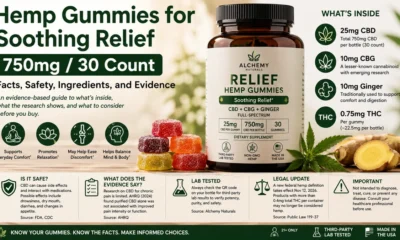
 Health2 weeks ago
Hemp Gummies for Soothing Relief 750mg / 30 Count: Facts, Safety, Ingredients, and Evidence
-

 Education2 weeks ago
Quizlet NC Permit Test: 2026 North Carolina Permit Study Guide
-

 AI5 days ago
vrgamegirl19/comfyui-vrgamedevgirl: Features, Setup, Installation, and Safety Guide
-

 Education2 weeks ago
Kinematic Equations: Complete Guide With Formulas, Examples, and Solutions
-

 Guide2 weeks ago
Best Laptops for Writers in 2026: 7 Top Picks for Writing, Research, and Travel
-

 AI2 weeks ago
Open CoDesign: What It Is, Features, Setup, and How It Works
-

 Technology2 weeks ago
Best Coding YouTube Channels in 2026: 12 Channels I Recommend for Learning to Code
-

 Technology1 week ago
Techmeshnews.com: Guide to Content, Ownership, Safety, & Trust