
Business
Doubtnut Valuation: From $154M Peak to $10M ALLEN Acquisition


When I examine Doubtnut valuation, the most important point is that there is no fresh standalone 2026 valuation comparable with a conventional venture funding round. Doubtnut ceased being an independent venture-backed startup when ALLEN Career Institute acquired it in December 2023. The companies officially confirmed the acquisition but did not disclose the commercial terms. Multiple reputable reports, including The Economic Times, Moneycontrol, Business Standard, and TechCrunch, placed the transaction value at approximately $10 million, or around ₹83 crore at the time.
That $10 million benchmark is striking because The Economic Times, citing Tracxn data, reported that Doubtnut had previously been valued at $154 million in January 2022. Earlier still, its 2020 Series A financing valued the company at about $50 million, while its 2021 Series B was reportedly completed at a valuation of roughly $100 million to $125 million.
Measured purely as a headline comparison, moving from $154 million to $10 million represents approximately a 93.5% decline. I would not interpret that number as a perfect apples-to-apples measure, however. A venture financing valuation and an acquisition price are different financial events. Financing valuations reflect what investors are willing to pay for minority equity under assumptions about future growth, while an acquisition reflects what a buyer is willing to pay for control, assets, technology, team, users, brand, liabilities, and strategic value at a specific moment.
Doubtnut’s story is therefore more useful than a simple rise-and-fall chart. It shows how quickly private-company valuations can change when rapid user growth is not matched by sustainable monetization, when capital becomes more expensive, and when an entire industry shifts from rewarding growth to demanding profitability.
By 2026, there is another important signal. Doubtnut’s web presence has become integrated into ALLEN’s ecosystem. Opening former Doubtnut pages now leads into ALLEN’s current education platform, while Doubtnut’s post-acquisition terms identified ALLEN Career Institute Private Limited as the company operating the service. That makes the idea of assigning Doubtnut a separate public 2026 market capitalization increasingly artificial.
Key Takeaways About Doubtnut Valuation
The most important facts are:
- Doubtnut was founded in 2016 by IIT Delhi alumni Tanushree Nagori and Aditya Shankar.
- Its product used image recognition and machine learning to help students photograph questions and receive video explanations.
- Doubtnut raised roughly $52 million before being acquired.
- A $15 million Series A led by Tencent in 2020 reportedly valued Doubtnut at about $50 million.
- BYJU’S later explored acquiring Doubtnut at a reported value as high as $150 million, but that transaction did not close.
- Its 2021 Series B raised roughly $31 million and reportedly valued the company at around $100 million to $125 million.
- Dealroom records a roughly $121 million valuation for that financing.
- The Economic Times later reported, citing Tracxn, that Doubtnut was valued at $154 million in January 2022.
- Existing investors provided about $2.5 million through convertible notes in 2023 as the company worked to extend its runway.
- ALLEN Career Institute acquired Doubtnut in December 2023.
- The deal terms were officially undisclosed, but several reports placed the transaction at approximately $10 million or ₹83 crore.
- The $154 million to $10 million comparison implies roughly 93.5% headline valuation compression.
- Doubtnut’s large audience did not translate into equally strong financial performance.
- FY22 operating revenue was reported at ₹10.8 crore by Moneycontrol, while net loss was about ₹179 crore. Other reporting using a broader revenue measure cited ₹15.2 crore.
- Doubtnut aggressively reduced costs during 2023 and narrowed its business before the acquisition.
- There is no separately disclosed independent Doubtnut valuation for 2026 because the platform now sits inside ALLEN.
In my view, the most accurate answer to “What is Doubtnut worth today?” is therefore not $154 million. The best public historical transaction benchmark remains the reported $10 million ALLEN acquisition price, while the business itself is now part of a larger privately held education company.
What Was Doubtnut?
Doubtnut was created around a simple but powerful idea: let a student photograph a mathematics or science problem and receive a short explanatory video showing how to solve it.
The company used image recognition, machine learning, and a growing library of educational content to match photographed questions with solutions. It focused heavily on students outside India’s largest metropolitan areas and provided material in multiple regional languages.
That strategy differentiated Doubtnut from several premium edtech businesses that depended heavily on live paid courses.
Doubtnut could attract enormous numbers of learners through a free or low-cost doubt-resolution product and then attempt to convert some of those users into paid courses, live instruction, exam preparation, test series, and other education services.
Its founders described that mission in strongly accessibility-focused terms.
“We specialize in developing content in vernacular languages and use technology to create affordable solutions.”
Tanushree Nagori, Doubtnut co-founder and CEO, quoted by The Economic Times.
I think this explains a major part of the company’s early valuation appeal. Doubtnut was not merely another urban online coaching brand. Investors could imagine it becoming a massive educational distribution network serving the next generation of Indian internet users.
How Doubtnut Built Its Early Valuation
Investors normally value a young technology company less on current profit and more on the future economics they believe the company might achieve.
For Doubtnut, several characteristics created an attractive growth story.
Large Student Audience
By the 2021 Series B, Doubtnut said it had more than 2.5 million daily active users who were spending around 600 million minutes per month on its platforms.
Those were substantial engagement numbers.
At the time of the ALLEN acquisition, the platform was said to have a monthly reach of 32 million students across apps, websites, and YouTube.
Audience scale mattered because a venture investor could reasonably imagine several paths to monetization:
- Paid classes
- Examination preparation
- Premium subscriptions
- Advertising
- Lead generation
- Learning materials
- Tutoring
- Test series
- Partnerships
- Cross-selling education products
The challenge was converting theoretical monetization opportunities into sustainable financial results.
Strong Vernacular Positioning
Doubtnut’s focus on regional languages gave it access to students who might have been underserved by English-first education platforms.
Business Standard reported in 2021 that roughly 85% of users were outside India’s top 15 cities and that a majority of state-board learners used local vernacular languages.
From an investor’s perspective, that represented an enormous addressable market.
Technology-Led Discovery
Students could discover Doubtnut because they had an immediate question rather than because they were already shopping for a costly course.
That lowered the barrier to entry.
A student might search one homework question, watch one explanation, return repeatedly, download the app, and later become a paid customer.
This kind of high-volume top-of-funnel behavior can create substantial strategic value, even when monetization remains difficult.
Doubtnut Valuation Timeline
The following table separates completed financing valuations from proposed transactions and acquisition benchmarks. I think this distinction is essential because these numbers are frequently mixed together online.
| Date | Event | Reported Value | What the Number Represents |
|---|---|---|---|
| 2018 | Pre-seed financing | Valuation not publicly disclosed | Early venture financing |
| 2019 | Seed funding of roughly $3.3M | Valuation not publicly disclosed | Product and market expansion |
| Feb. 2020 | $15M Series A led by Tencent | About $50M | Reported financing valuation |
| Mid-2020 | BYJU’S acquisition discussions | Up to $150M | Reported proposed acquisition value, not completed |
| Feb. 2021 | Roughly $31M Series B | $100M-$125M | Reported financing valuation |
| Feb. 2021 | Dealroom estimate | About $121M | Database valuation for the Series B |
| Jan. 2022 | Later private valuation | About $154M | Tracxn figure reported by ET |
| Apr. 2023 | $2.5M convertible funding | Not disclosed | Bridge capital from existing investors |
| Dec. 2023 | ALLEN acquisition | About $10M / ₹83 crore | Reported acquisition benchmark; official terms undisclosed |
| 2026 | Doubtnut within ALLEN | No standalone valuation disclosed | No independent financing valuation |
The table makes one fact very clear: Doubtnut valuation did not move in a straight line based purely on the number of users.
It rose rapidly during a period when investors were willing to pay high multiples for online education growth, then compressed when the financial and funding environment changed.
The $50 Million Series A Valuation
Doubtnut raised $15 million in Series A funding in early 2020, led by Tencent. Existing investors including Omidyar Network India and Sequoia Capital India participated.
TechCrunch reported that the financing valued Doubtnut at approximately $50 million and brought total funding at that point to roughly $18.5 million.
That valuation reflected an early growth-stage company.
A $50 million startup valuation did not mean Doubtnut had $50 million in cash, revenue, or tangible assets. It represented the implied value assigned to the equity through the financing round.
This distinction is fundamental whenever we discuss private startups.
If an investor buys 10% of a company for $5 million, the implied post-money valuation is $50 million. That does not mean someone has offered $50 million to buy the whole business on identical terms.
Was Doubtnut Really Worth $150 Million in 2020?
One of the most frequently repeated numbers in Doubtnut’s history is $150 million.
TechCrunch reported that BYJU’S attempted to acquire Doubtnut during 2020 and valued the company at as much as $150 million during those discussions. The transaction did not happen.
This number needs to be labelled correctly.
It was not a completed funding-round valuation.
It was not a completed acquisition.
It was a reported level associated with acquisition negotiations.
Business Standard reporting from 2021 referenced BYJU’S discussions at around $100 million, illustrating that reported negotiation figures varied.
For that reason, I would never place “$150 million valuation” into a timeline without explaining that it represented a reported proposed transaction.
Had Doubtnut accepted and completed a $150 million deal in 2020, its history would look very different. It ultimately remained independent and continued raising capital.
The 2021 Series B Pushed Doubtnut Above $100 Million
In February 2021, Doubtnut raised approximately ₹224 crore, or around $31 million, in Series B financing.
SIG and James Murdoch’s Lupa Systems led the round, while existing investors including Sequoia Capital India, Omidyar Network India, and WaterBridge Ventures participated.
The Economic Times reported that the financing valued Doubtnut at approximately $100 million to $125 million.
Dealroom currently records the financing at approximately $121 million, which sits within ET’s reported range.
This was arguably the point when Doubtnut’s investment story looked strongest.
Online education was experiencing enormous demand.
Capital was abundant.
Consumer behavior had shifted toward digital learning.
Doubtnut had millions of daily users.
Its regional-language strategy differentiated it.
The company had high-profile global investors.
Under those conditions, investors could assign significant value to future scale.
The Reported $154 Million Doubtnut Valuation
When ALLEN later acquired Doubtnut, The Economic Times reported that the startup had previously been valued at $154 million in January 2022, citing Tracxn data.
That is the highest completed private-company valuation benchmark I found reported by a major business publication.
It is also where readers need to be careful.
Search results sometimes combine:
- The $150 million BYJU’S proposal
- The $154 million Tracxn valuation
- The $100 million to $125 million Series B valuation
These are three different data points.
The $150 million figure relates to acquisition discussions.
The $100 million to $125 million range relates to the 2021 funding round.
The $154 million figure is the later valuation reported by ET using Tracxn data.
For the purpose of evaluating the eventual decline, I consider $154 million the strongest reported peak valuation benchmark.
How Much Funding Did Doubtnut Raise?
Published figures vary slightly depending on whether every convertible note and small early transaction is included.
CB Insights currently reports total funding of about $52.34 million. TechCrunch said Doubtnut had raised more than $52 million before its acquisition, while some Tracxn-based reports put the figure closer to $50 million.
The difference is relatively small and can result from databases counting rounds differently.
Doubtnut Funding and Major Investors
| Funding Stage | Approximate Amount | Major Investors Mentioned Publicly | Valuation Information |
|---|---|---|---|
| Pre-seed | ~$0.5M | Early investors including WaterBridge ecosystem | Not disclosed |
| Seed | ~$3.3M | Surge, WaterBridge and others | Not disclosed |
| Series A | $15M | Tencent, Sequoia India, Omidyar Network India, AET | About $50M |
| Series B | ~$31M | SIG, Lupa Systems, Sequoia India, Omidyar, WaterBridge | $100M-$125M reported |
| Convertible financing | ~$2.5M | Existing investors | Undisclosed |
| Total before acquisition | Roughly $50M-$52M | Multiple venture investors | Various |
The funding amount should not be confused with valuation.
A company can raise $52 million over several years and later sell for $10 million.
That does not automatically mean “investors lost $42 million” either. Investment outcomes depend on share ownership, liquidation preferences, debt, secondary sales, transaction structure, employee options, and how proceeds are distributed among shareholders.
Because the ALLEN deal’s full commercial structure was never made public, I would not invent a precise investor return calculation.
Why Did Doubtnut Valuation Fall?
There was no single cause.
In my analysis, the decline came from the intersection of company economics and a dramatically different market environment.
Revenue Was Small Relative to the Cost Base
Moneycontrol reported that Doubtnut generated approximately ₹10.8 crore in FY22 operating revenue while recording a net loss of roughly ₹179 crore.
Other reporting based on annual financial statements listed total FY22 revenue at approximately ₹15.2 crore, while maintaining the same approximately ₹179.2 crore loss figure. The difference likely reflects the use of operating revenue versus a broader income measure.
Either way, the direction is unmistakable.
The company’s losses were vastly larger than its revenue.
This matters because valuation eventually has to connect to economics.
A startup can lose money while growing rapidly, and many successful businesses do. Investors tolerate those losses when they believe current spending creates future revenue that will be both large and profitable.
The problem emerges when growth requires continuous heavy spending without enough evidence of future monetization.
Doubtnut Had Reach but Faced Monetization Challenges
Doubtnut’s audience remained impressive.
At acquisition, the platform was reported to reach 32 million students monthly across its apps, websites, and YouTube.
Yet The Economic Times reported that some potential buyers primarily valued Doubtnut for its traffic because the company had struggled to scale beyond a certain point.
That is a useful case study in the difference between user value and enterprise value.
A free educational platform can help millions of people.
That does not guarantee that enough of those people will pay enough money to support the organization required to serve them.
High engagement is valuable.
High engagement plus strong monetization is far more valuable.
The Pandemic Edtech Boom Ended
Doubtnut’s major valuation growth occurred during one of the most aggressive periods of global edtech investment.
Schools were disrupted.
Digital education adoption accelerated.
Investors competed heavily for online learning companies.
Future growth expectations rose rapidly.
Later, students returned to physical classrooms and the supply of venture capital tightened.
Economic Times reporting on the broader Indian edtech sector described a major shift away from emphasizing total addressable market and growth toward unit economics, profitability, and sustainable cash flow.
Doubtnut was not alone.
Numerous Indian education technology startups struggled to raise capital at previous valuations, cut employees, shut business lines, sought buyers, or consolidated with larger companies.
Cost Cutting Came Before the Sale
During 2023, Doubtnut dramatically reduced spending.
YourStory reported that Tanushree Nagori said monthly burn had fallen from roughly ₹10.6 crore to ₹2.2 crore, a reduction of more than 80%. The company also narrowed its focus and closed several exam-preparation categories.
Reports also described substantial workforce reductions.
Nagori said FY23 revenue had reached approximately ₹27.6 crore while the company worked toward profitability.
Those measures show that management recognized the need to change the economic model.
But restructuring does not instantly restore a former valuation.
Potential investors and buyers evaluate not only improving costs but also whether future revenue, growth, and profitability justify the requested price.
Capital Became Harder to Raise
Doubtnut raised about $2.5 million through convertible notes from existing investors in 2023.
Convertible financing can provide runway without immediately fixing a company’s equity valuation.
In this case, the funding came as the broader edtech sector faced a difficult investment environment.
TechCrunch reported that Doubtnut had held discussions with several investors, including Prosus Ventures, but disagreements around valuation prevented a new deal from materializing.
Once a startup needs capital but outside investors will not fund it at the previous valuation, several possibilities emerge:
- Accept a down round
- Reduce costs
- Raise bridge financing
- Merge with another company
- Sell to a strategic buyer
- Shut down
Doubtnut ultimately combined cost reduction with a strategic sale.
Why ALLEN Acquired Doubtnut
ALLEN did not acquire Doubtnut simply because of its old valuation.
The strategic value lay in the platform’s doubt-resolution technology, digital audience, content, and educational engagement.
ALLEN CEO Nitin Kukreja summarized the rationale clearly:
“Timely and effective resolution of doubts is a core consumer need in education.”
Nitin Kukreja, CEO of ALLEN Career Institute.
ALLEN wanted to strengthen its digital learning capabilities, while Doubtnut brought an existing technology platform and a large student reach.
ALLEN also intended to offer its curriculum and academic products to Doubtnut users.
From my perspective, that is why the $10 million number should not be read simply as “Doubtnut had no value.”
It had strategic assets.
The issue was the price at which those assets could be transferred given the company’s economics, funding environment, and negotiating position.
The December 2023 Acquisition
ALLEN Career Institute announced that it had completed the acquisition of Doubtnut on December 4, 2023.
The official announcement did not reveal the price.
Moneycontrol, citing sources, reported approximately $10 million or ₹83 crore. Business Standard reported the same approximate dollar amount. The Economic Times likewise reported a $10 million value.
Doubtnut co-founder Aditya Shankar framed the transaction around the two organizations’ educational missions:
“Doubtnut’s mission is to bring education to every student across India using technology and high-quality content.”
Aditya Shankar, Doubtnut co-founder.
Following the transaction, Doubtnut’s team was expected to continue developing doubt-resolution products for both ALLEN and Doubtnut students.
The acquisition therefore represented strategic integration rather than simply closing the product.
From $154 Million to $10 Million: What the Decline Really Means
The simple calculation is:
So the reported acquisition value was approximately 93.5% below the earlier $154 million valuation benchmark.
That is a dramatic repricing.
Still, I would describe it as headline valuation compression, not as a mathematically exact destruction of 93.5% of economic value.
Why?
The $154 million number represented private-company equity pricing.
The $10 million number was a reported acquisition figure whose full structure was not officially disclosed.
One may include assumptions about debt, preference rights, cash, stock consideration, liabilities, and strategic arrangements that are unavailable publicly.
The calculation remains useful for understanding the magnitude of the reset, but not for reconstructing every investor’s actual financial outcome.
Funding Valuation and Acquisition Price Are Not the Same Thing
This distinction deserves its own section because it is the source of many misleading articles about startup wealth.
Financing Valuation
A venture round usually involves an investor buying a minority stake.
Suppose an investor pays $20 million for a 20% post-money stake.
The implied valuation is:
That does not necessarily mean another company would pay $100 million to buy 100% of the business immediately.
Acquisition Value
A buyer seeking control evaluates:
- Current revenue
- Cash burn
- Technology
- Users
- Intellectual property
- Employees
- Liabilities
- Competition
- Negotiating leverage
- Strategic synergies
- Cost of integration
- Alternative acquisition targets
Those considerations can produce a much lower or higher number than the startup’s previous financing valuation.
Doubtnut illustrates the difference exceptionally well.
Is Doubtnut Worth $10 Million in 2026?
I would phrase the answer differently.
$10 million is the most widely reported public acquisition benchmark for Doubtnut, not a separately established 2026 standalone valuation.
After the acquisition, Doubtnut became part of ALLEN.
Current Doubtnut URLs and educational content have increasingly been integrated into ALLEN’s online environment, and current visits to former Doubtnut pages can redirect into ALLEN’s platform.
That means a fresh Doubtnut valuation would require separating the economic value of:
- The brand
- Traffic
- Content library
- Technology
- User data
- Team
- Revenue
- Cross-selling impact
- Contribution to ALLEN’s digital business
ALLEN does not publicly report those assets as a standalone listed company would.
Therefore, anyone claiming an exact “$X million Doubtnut valuation in 2026” should identify the source and methodology.
Without a new funding round, sale, impairment disclosure, or independently published segment valuation, such a number is mostly an estimate.
Does ALLEN’s Valuation Become Doubtnut’s Valuation?
No.
ALLEN itself received a $600 million investment from Bodhi Tree Systems in 2022 for a 36% stake, indicating a valuation above $1 billion.
That does not mean Doubtnut became a billion-dollar company after being acquired.
A subsidiary, product, brand, or technology asset does not inherit the total valuation of its parent company.
Consider a hypothetical example.
If a $5 billion corporation buys a startup for $20 million, the startup’s brand does not suddenly become worth $5 billion.
What changes is ownership.
Doubtnut is now one part of a much larger education platform.
Why Doubtnut’s Audience Still Had Strategic Value
One of the most interesting aspects of the transaction is that Doubtnut still had substantial user reach.
ALLEN’s acquisition statement said Doubtnut was reaching approximately 32 million students every month through apps, websites, and YouTube.
For ALLEN, that audience could potentially serve several purposes.
A student who arrives looking for a free solution might later discover:
- JEE coaching
- NEET preparation
- School courses
- Mock tests
- Scholarship programs
- Premium study material
- ALLEN classroom centers
- Online courses
This is where strategic buyers can see value that financial investors may price differently.
A venture fund generally wants the acquired company itself to produce an attractive return.
A strategic buyer can benefit from cross-selling and integration with its existing operations.
What Investors Can Learn From Doubtnut Valuation
I think the Doubtnut case offers several useful lessons that extend beyond edtech.
User Numbers Are Not Revenue
Millions of users can produce impressive headlines.
Investors ultimately need a path from usage to cash flow.
Revenue Growth Is Not Enough Without Unit Economics
Doubtnut was increasing revenue before its sale.
But the company was also coming from an extremely high loss and burn base.
A startup’s valuation can decline even while revenue rises if investors become less confident about eventual profitability.
Funding Conditions Affect Valuation
The same business can receive radically different valuations depending on the availability and cost of capital.
In 2020 and 2021, investors competed aggressively for digital education exposure.
By 2023, the market demanded evidence of sustainability.
Acquisition Negotiations Are Not Valuations Until Completed
A reported $150 million BYJU’S proposal sounds impressive.
It never closed.
I would always distinguish between:
- Rumored discussions
- Term sheets
- Completed financing
- Secondary transactions
- Acquisition agreements
- Completed acquisitions
More Funding Does Not Guarantee a Higher Exit
Doubtnut raised roughly $52 million and was reportedly sold for about $10 million.
Capital raised is an input.
Exit valuation is an outcome.
They are not required to move together.
Common Mistakes When Discussing Doubtnut Valuation
Calling the $150 Million BYJU’S Figure Doubtnut’s Peak Valuation
It was a reported proposed acquisition level.
The stronger completed private valuation benchmark is the $154 million figure later reported by ET using Tracxn data.
Saying Doubtnut Is Currently Worth $154 Million
There is no evidence supporting that as a 2026 standalone valuation.
The business was acquired in 2023.
Saying ALLEN Officially Paid $10 Million
ALLEN officially confirmed the acquisition but did not publicly disclose the price.
The $10 million figure comes from well-sourced media reports.
That distinction should remain visible.
Assuming Investors Lost Exactly $42 Million
Doubtnut raised approximately $52 million and reportedly sold for $10 million, but subtracting those numbers does not tell us investor losses.
Investor returns depend on the capital structure and distribution of transaction proceeds.
Treating Traffic as Equivalent to Valuation
A large audience is valuable only to the extent that it can eventually produce economic returns or strategic benefits.
Doubtnut’s experience illustrates that difference clearly.
How I Would Evaluate Any Future Doubtnut Valuation Claim
If a new article claims that Doubtnut is worth a particular amount in 2026 or later, I would ask four questions.
First, what transaction created that number?
Was there a sale, funding round, spin-off, or financial disclosure?
Second, who published it?
A regulatory filing or company announcement deserves more weight than an unsourced blog.
Third, is it Doubtnut’s valuation or ALLEN’s valuation?
They should not be combined.
Fourth, what exactly is being valued?
It could be the Doubtnut brand, platform assets, revenue stream, legal entity, or a business unit.
Without those answers, an exact current number gives readers false precision.
Conclusion
I see the Doubtnut Valuation story as one of the clearest examples of how quickly startup pricing can change when market expectations move from growth toward sustainable economics. Doubtnut had a compelling product, major investors, millions of users, strong regional-language positioning, and an important educational mission. Its financing valuation climbed from around $50 million in 2020 to $100 million to $125 million in 2021, with The Economic Times later reporting a $154 million valuation in January 2022.
Yet revenue remained modest relative to losses and burn, the edtech funding environment deteriorated, and raising new capital became harder. ALLEN eventually acquired the company in December 2023 in a transaction widely reported at about $10 million, although the official commercial terms remained undisclosed.
For me, the practical lesson is not simply that Doubtnut “lost 93.5% of its value.” It is that private-market valuation depends on assumptions about future cash generation. When those assumptions change, valuations can change much faster than products, users, or educational impact.
In 2026, I would therefore use $10 million as the latest reported transaction benchmark, not claim a fresh independent Doubtnut valuation that has never been publicly disclosed.
READ: Best Zoos in the US: 10 Top Zoos Worth Visiting in 2026
Frequently Asked Questions
What Is Doubtnut Valuation in 2026?
There is no separately disclosed Doubtnut Valuation in 2026 because Doubtnut is no longer an independent venture-backed startup. ALLEN Career Institute acquired the business in December 2023, and Doubtnut has since become increasingly integrated into ALLEN’s digital ecosystem. The acquisition price was not officially disclosed, but several major publications reported that the transaction valued Doubtnut at approximately $10 million, or roughly ₹83 crore at the time.
What Was Doubtnut’s Highest Valuation?
The strongest reported peak private valuation I found is approximately $154 million in January 2022, according to The Economic Times citing Tracxn. Earlier, its February 2021 Series B was reported at a $100 million to $125 million valuation. A separate figure of up to $150 million relates to BYJU’S acquisition discussions in 2020 and should not be treated as a completed financing or acquisition valuation.
How Much Did ALLEN Pay for Doubtnut?
ALLEN did not publicly disclose the official commercial terms of the Doubtnut acquisition. However, Moneycontrol, Business Standard, The Economic Times, and TechCrunch reported a transaction value of approximately $10 million, with Indian reports placing it around ₹83 crore. Because the number comes from sources familiar with the transaction rather than an official purchase-price announcement, I describe it as the reported acquisition value rather than a formally disclosed price.
How Much Funding Did Doubtnut Raise?
Doubtnut raised roughly $50 million to $52 million before its acquisition. CB Insights currently reports $52.34 million, while TechCrunch said the company had raised more than $52 million. Major rounds included a $15 million Tencent-led Series A in 2020 and roughly $31 million in Series B funding led by SIG and Lupa Systems in 2021. Existing investors also provided about $2.5 million in convertible financing during 2023.
Why Did Doubtnut Valuation Fall So Much?
Doubtnut’s valuation fell as its high-growth investment story collided with difficult business economics and a weaker edtech funding environment. Moneycontrol reported FY22 operating revenue of roughly ₹10.8 crore against a net loss of approximately ₹179 crore. The company later cut burn substantially and narrowed its operations, but raising outside capital remained difficult. At the same time, investors across Indian edtech increasingly prioritized profitability and unit economics instead of user growth and total addressable market.
Was Doubtnut Really Offered $150 Million by BYJU’S?
TechCrunch reported that BYJU’S explored acquiring Doubtnut in 2020 at a value of as much as $150 million, but the acquisition did not happen. Other reporting referenced discussions at lower levels, including around $100 million. The safest interpretation is therefore that $150 million was a reported upper-end acquisition discussion, not money actually paid and not a completed financing valuation.
Who Founded Doubtnut?
Doubtnut was founded in 2016 by IIT Delhi alumni Tanushree Nagori and Aditya Shankar. The company was established under Class 21A Technologies and built a technology-driven question-solving platform in which students could photograph academic problems and receive video explanations. The product later expanded into courses, test preparation, regional-language education, and other learning services.
Who Invested in Doubtnut?
Major Doubtnut investors included Tencent, Peak XV Partners when it was known as Sequoia Capital India, Omidyar Network India, WaterBridge Ventures, SIG, and James Murdoch’s Lupa Systems. The company also participated in Sequoia India’s Surge accelerator program. These investors supported Doubtnut across its seed, Series A, Series B, and later convertible financing stages.
Was Doubtnut Profitable Before the Acquisition?
No evidence I found indicates that Doubtnut was profitable before the ALLEN acquisition. FY22 financial reporting showed a net loss of approximately ₹179 crore. During 2023, management significantly reduced monthly burn and said it was working toward breakeven, but the company was still restructuring its economics and narrowing business categories during the period leading up to the sale.
Why Did ALLEN Buy Doubtnut?
ALLEN acquired Doubtnut to strengthen its technology-led learning and doubt-resolution capabilities. Doubtnut brought a large digital audience, AI-enabled problem-solving technology, an extensive library of educational solutions, and strong student engagement. At the time of the deal, ALLEN said Doubtnut reached around 32 million students each month through apps, websites, and YouTube, creating an opportunity to introduce ALLEN’s courses and curriculum to that audience.
Is Doubtnut Still Operating?
The Doubtnut educational content and brand have continued after the acquisition, but they increasingly operate as part of ALLEN’s broader digital ecosystem. Former Doubtnut web destinations now redirect into ALLEN’s current website infrastructure, and post-acquisition Doubtnut terms identified ALLEN Career Institute Private Limited as the company providing the service. This is why treating Doubtnut as a separately valued startup in 2026 is no longer appropriate.
Is Doubtnut Worth More Because ALLEN Is a Billion-Dollar Company?
Not automatically. ALLEN received a $600 million Bodhi Tree Systems investment in 2022 for a substantial minority stake, placing ALLEN itself above the billion-dollar level. That valuation applies to ALLEN as a whole. Doubtnut is one acquired platform within the organization. A subsidiary or product does not inherit the parent’s entire valuation simply because ownership changes.
Sources and References
- The Economic Times, Doubtnut acquisition by ALLEN, for the reported $10 million acquisition value, previous $154 million valuation, roughly $52 million in funding, 32 million monthly reach, and statements from Nitin Kukreja and Aditya Shankar.
- The Economic Times, Doubtnut Series B, for the ₹224 crore funding round, investors, and reported $100 million to $125 million valuation.
- TechCrunch, 2020 Series A, for the $15 million funding round and approximately $50 million valuation.
- TechCrunch, ALLEN acquisition, for the reported $10 million deal, more than $52 million raised, and earlier BYJU’S acquisition discussions at up to $150 million.
- Moneycontrol, for the reported ₹83 crore acquisition value, FY22 operating revenue and losses, and broader analysis of edtech valuation pressure.
- Business Standard, for the ALLEN acquisition, Doubtnut’s monthly reach, and official strategic rationale.
- YourStory, for Doubtnut’s FY22 financials, 2023 burn reduction, reported FY23 revenue, workforce restructuring, and acquisition background.
- CB Insights, for current historical funding data showing approximately $52.34 million raised before acquisition.
- Dealroom, for financing history and its approximately $121 million valuation figure for the 2021 Series B.
- Current ALLEN / Doubtnut web infrastructure, for evidence that Doubtnut’s web presence has become integrated into ALLEN following the acquisition.
Disclaimer
This article is an independent informational analysis and is not affiliated with Doubtnut, ALLEN Career Institute, Peak XV Partners, Tencent, Lupa Systems, SIG, Omidyar Network, WaterBridge Ventures, BYJU’S, Tracxn, or any investor mentioned. Private-company valuations are estimates or implied transaction values unless formally disclosed, and the approximately $10 million ALLEN acquisition figure was reported by media sources rather than officially announced by the companies. Historical funding valuations, proposed acquisition prices, investor database estimates, and completed acquisition values are not directly interchangeable. Nothing in this article should be treated as investment, financial, tax, or legal advice.
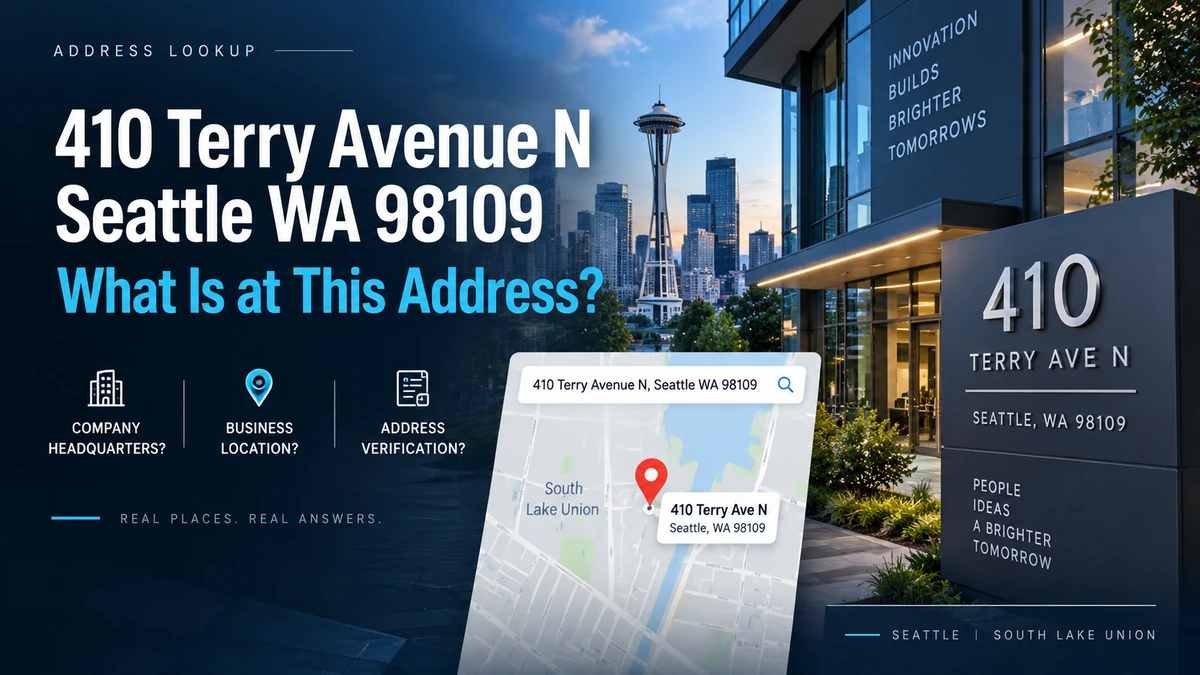
I can understand why 410 Terry Avenue N Seattle WA 98109 attracts so many searches. An unfamiliar street address can appear on a company filing, payment-related document, vendor record, business registration, correspondence, or map result without explaining why it matters. In this case, the answer is relatively clear: 410 Terry Avenue North in Seattle is strongly associated with Amazon.com, Inc. and multiple Amazon-affiliated businesses.
The most authoritative confirmation comes from Amazon’s regulatory filings. Amazon.com’s 2025 Form 10-K, filed with the U.S. Securities and Exchange Commission in February 2026, identifies 410 Terry Avenue North, Seattle, Washington 98109-5210 as the address of the company’s principal executive offices. The filing also lists Amazon’s main business telephone number as (206) 266-1000. More recent SEC filings from August 2026 continue to use 410 Terry Avenue North as Amazon.com’s business and mailing address.
The address sits in Seattle’s South Lake Union neighborhood, an area where Amazon developed a large corporate campus rather than concentrating all headquarters operations inside one traditional skyscraper. Amazon announced its move to South Lake Union in 2007, describing plans for a headquarters spanning multiple buildings along Terry and Boren avenues.
That distinction matters. I would describe 410 Terry Avenue N as Amazon.com’s official principal executive office address and a major Amazon corporate address, but not assume that every Amazon department, employee, customer-support function, return operation, or subsidiary physically operates from one desk or one reception area inside that building.
Key Facts About 410 Terry Avenue N Seattle WA 98109
Here is the quickest way to understand the address.
| Detail | Verified Information |
|---|---|
| Street address | 410 Terry Avenue North |
| City | Seattle |
| State | Washington |
| ZIP code | 98109 |
| Extended ZIP seen in filings | 98109-5210 |
| Primary company association | Amazon.com, Inc. |
| SEC classification | Principal executive offices |
| Main telephone listed by Amazon in SEC filing | (206) 266-1000 |
| Neighborhood | South Lake Union |
| Building commonly identified on maps | Amazon Invictus / SEA22 |
| Public customer return center | No evidence that it should be used as a normal retail return address |
| Amazon Pay association | Amazon Payments, Inc. also lists this address |
| Public transportation nearby | South Lake Union Streetcar, including Terry & Mercer stop |
Amazon’s current SEC filings provide the strongest evidence for the corporate association, while Apple Maps identifies the location as Amazon Invictus and labels it a corporate headquarters location in South Lake Union.
The practical takeaway is that seeing this address connected to Amazon is normal. What the address does not tell you by itself is why a particular payment, letter, registration, order, or business entity is associated with it.
What Is 410 Terry Avenue N Seattle WA 98109?
410 Terry Avenue N Seattle WA 98109 is the address Amazon.com, Inc. currently reports to the SEC for its principal executive offices. Amazon’s 2025 annual filing gives the more complete postal format as 410 Terry Avenue North, Seattle, Washington 98109-5210.
That is more meaningful than simply finding Amazon listed on a directory website. A Form 10-K is a formal filing made by a public company with the SEC, and Amazon’s 2026 filing explicitly labels this location as its principal executive offices.
Amazon continued using the same address in subsequent 2026 SEC filings. For example, filings dated July and August 2026 show 410 Terry Avenue North as both Amazon.com’s business and mailing address.
Several map and business-location services identify the building itself as Amazon Invictus, sometimes also called SEA22. Apple Maps identifies Amazon Invictus at 410 Terry Ave N as a corporate headquarters location, while other mapping sources use the Invictus or SEA22 name for the same address.
I would therefore separate three concepts:
- The legal/corporate address: Amazon officially uses 410 Terry Avenue North for its principal executive offices.
- The physical building: Mapping sources commonly identify the location as Amazon Invictus.
- The wider headquarters campus: Amazon’s Seattle corporate presence extends across numerous buildings in and around South Lake Union.
This prevents the common mistake of assuming that “Amazon headquarters” means one building containing every corporate function.
Why 410 Terry Avenue N Seattle WA 98109 Is Associated With Amazon
Amazon’s connection with South Lake Union goes back many years.
In December 2007, Amazon, the City of Seattle, Vulcan, and Schnitzer West announced plans for Amazon to establish a new corporate headquarters in the South Lake Union neighborhood. The original plan described up to 11 buildings on six blocks along Terry and Boren avenues between Mercer and John streets, totaling up to approximately 1.6 million square feet. Amazon expected employees to begin moving into the development in 2010, with full occupancy planned for 2011.
One comment from the announcement shows why the location mattered to Amazon.
“We’re very excited about our move to South Lake Union”
Tim Halladay, then Amazon.com vice president of real estate and finance operations
Halladay said the move was intended to improve collaboration and productivity. Amazon’s announcement also specifically stated that proximity to public transportation was an important factor in choosing South Lake Union.
Seattle’s mayor at the time also framed the move as a major local development.
“Amazon.com is one of those great Seattle success stories”
Greg Nickels, then Mayor of Seattle
The broader historical point is useful today because it explains why searching one Amazon address produces references to a much larger campus. Amazon did not design its South Lake Union presence around a single isolated headquarters tower. The campus developed as a collection of neighboring office buildings integrated into the surrounding city.
Is 410 Terry Avenue North Amazon’s Headquarters?
Yes, with an important qualification.
Amazon.com’s latest annual filing I verified identifies 410 Terry Avenue North as its principal executive offices. In ordinary language, that makes it reasonable to describe the address as Amazon’s Seattle corporate headquarters address.
However, I would not interpret that to mean Amazon’s headquarters consists only of the physical space at 410 Terry Avenue N.
Amazon’s original South Lake Union headquarters plan involved numerous buildings across multiple blocks, and the company has continued operating a broad Seattle office footprint.
This is why someone searching Amazon headquarters may see multiple Seattle building names and street addresses.
A useful comparison is a university campus. A university can have one official administrative address while actually occupying dozens of buildings. Large corporate campuses can work similarly.
What About Amazon’s Other Headquarters Operations?
Amazon also has major corporate operations outside Seattle, including its second headquarters development in Northern Virginia. That does not change what Amazon reports to the SEC as its principal executive office address.
As of Amazon’s 2025 Form 10-K and subsequent 2026 SEC filings, the formal address remains:
Amazon.com, Inc.
410 Terry Avenue North
Seattle, WA 98109-5210
For address verification, I would give more weight to this current regulatory disclosure than to an undated directory page.
Why So Many Amazon Companies Use the Same Address
Searching 410 Terry Avenue North can reveal numerous Amazon-related corporate entities.
For example, current public business registrations show companies such as Amazon.com Services LLC, Amazon Logistics, Inc., Amazon Data Services, Inc., Amazon Development Center U.S., Inc., and Project Kuiper-related entities using the same Seattle address as a principal or mailing address.
This does not necessarily mean each company has an entirely separate physical office at exactly the same location.
Large corporate groups frequently use a central corporate address for legal, administrative, regulatory, and correspondence purposes. Amazon operates many separate legal entities for different products, services, regions, regulatory requirements, and business functions.
For example, a state corporate filing currently lists Amazon.com Services LLC with 410 Terry Avenue North as both its principal and mailing address. Another lists Amazon Logistics, Inc. at the same location.
The Washington Utilities and Transportation Commission also lists 410 Terry Avenue N as the mailing address for Amazon Logistics, Inc.
For me, the practical lesson is not to assume that two records with the same address refer to the same legal company. The address may be shared, while the entity names and legal responsibilities differ.
Amazon Businesses Connected With the Address
The following examples illustrate why the address appears across different documents.
| Amazon-Related Entity | How 410 Terry Avenue N Appears in Verified Records |
|---|---|
| Amazon.com, Inc. | Principal executive offices in SEC filings |
| Amazon.com Services LLC | Principal and mailing address in state registration |
| Amazon Logistics, Inc. | Principal/mailing or regulatory mailing address |
| Amazon Data Services, Inc. | Principal and mailing address in business registration |
| Amazon Development Center U.S., Inc. | Principal and mailing address |
| Amazon Payments, Inc. | Contact address on Amazon Pay |
| Amazon Capital Services, Inc. | Registered office on Amazon supplier documentation |
| Amazon Kuiper Infrastructure LLC | Principal and mailing address in business registration |
These records demonstrate that 410 Terry Avenue N Seattle WA 98109 functions as a significant corporate and administrative address across the Amazon organization, not only as a map location for one office building.
That explains why the address can appear in contexts that have little obvious connection with someone physically visiting Amazon’s Seattle offices.
Why This Address Might Appear on a Payment or Financial Document
One common reason people search corporate addresses is that they encounter them alongside unfamiliar payment information.
Amazon Payments, Inc. itself lists 410 Terry Ave N., Seattle, Washington 98109-5210 at the bottom of its Amazon Pay help and contact pages.
That means the address’s appearance in payment-related material can have a legitimate connection with Amazon or Amazon Pay.
However, an address by itself is not enough to identify the exact transaction.
Amazon’s official charge-identification guidance explains that card statements can use several different descriptors depending on the type of purchase. Examples include Amazon Marketplace purchases, Prime memberships, digital services, Amazon Pay orders, Amazon Fresh transactions, and temporary bank authorizations.
If I saw an unfamiliar charge associated with Amazon or this Seattle address, I would investigate the transaction rather than focusing only on the address.
What to Do if 410 Terry Avenue N Appears With an Unknown Charge
Amazon provides a fairly straightforward process for identifying charges.
Step 1: Check Amazon’s Transaction History
Amazon recommends reviewing Your Transactions to match the amount and date against your account activity.
Look for:
- recent Amazon purchases
- partially shipped orders
- Amazon Marketplace purchases
- digital content
- Kindle purchases
- Prime membership charges
- Prime Video subscriptions
- recurring services
- Amazon Pay transactions
The transaction date on a bank statement may not always match the day you originally placed an order, particularly when an item ships later.
Step 2: Check Other Authorized Users
Amazon’s payment help notes that unfamiliar transactions can result from another authorized user, family member, colleague, gift purchase, or previously back-ordered item.
This is easy to overlook in households where several people use the same payment card.
Step 3: Check Amazon Pay Separately
A purchase made on another website can potentially use Amazon Pay even though the product was not purchased directly from Amazon.com.
Amazon Pay says customers can review Amazon Pay orders and transaction activity separately.
Step 4: Treat a Truly Unrecognized Charge Seriously
If you cannot match the transaction after checking your accounts and authorized users, Amazon Pay recommends contacting the bank or card issuer and taking appropriate account-security measures when unauthorized use is suspected.
The important point is that the legitimate Amazon association of 410 Terry Avenue N Seattle WA 98109 does not prove that every charge containing Amazon-related information is authorized.
Always verify the transaction itself.
Does 410 Terry Avenue N Mean a Charge Is From Amazon?
It strongly suggests an Amazon corporate connection when the address appears alongside an Amazon company name, because Amazon.com and several affiliates officially use the location.
But I would still avoid using the address as the sole authentication method.
A transaction should be confirmed using:
- merchant descriptor
- amount
- date
- Amazon order history
- Amazon Pay activity
- subscription history
- card issuer records
For example, an unfamiliar $14.99 entry may turn out to be a subscription renewal rather than a physical order. Amazon’s charge-identification page specifically tells users to consider Prime and digital-service subscriptions when investigating unexplained charges.
The address helps answer who the company is associated with. It does not necessarily answer what you purchased.
Should You Send an Amazon Return to 410 Terry Avenue N?
I would not send an ordinary Amazon retail return to this address unless Amazon specifically provides it on an authorized return label or gives you direct instructions to do so.
Amazon’s return instructions direct customers to the Online Return Center, where the system provides the appropriate return method and shipping label for an eligible item. Amazon’s device-return guidance similarly tells customers to print the mailing label through the Online Return Center and send the package using the address provided by the return process.
That is an important distinction.
Corporate address:
410 Terry Avenue North
Seattle, WA 98109-5210
Correct return address:
The location printed on the return label generated for your specific item.
Amazon operates fulfillment centers, return centers, sellers, carriers, and specialized processing locations. There is no reason to assume a corporate headquarters address is equipped to process consumer merchandise returns.
A package mailed to the wrong corporate address could be delayed, rejected, or fail to satisfy the required return procedure.
Is 410 Terry Avenue N a Customer Service Center?
I would not treat the location as a normal walk-in Amazon customer service center.
Amazon’s consumer help processes direct customers toward online account tools, transaction history, return workflows, and customer support rather than telling people to travel to the Seattle corporate address.
The fact that a corporate telephone number and street address appear in SEC filings does not mean that arriving at the building is the correct way to resolve an Amazon order problem.
For order issues, use the support process associated with the Amazon account.
For Amazon Pay issues, use Amazon Pay’s help and transaction-support tools.
For returns, use the Online Return Center.
For corporate or legal correspondence, the appropriate address may depend on the specific Amazon entity and purpose involved.
Can Members of the Public Visit 410 Terry Avenue N?
The address corresponds to corporate office space rather than a conventional public attraction or retail store.
Map services identify the location as Amazon Invictus, an Amazon corporate building.
I would therefore not assume that a member of the public can simply enter office areas without an appointment, employee host, event invitation, or other authorization.
If you have a business meeting, interview, delivery, or scheduled visit, use the instructions from your Amazon contact. Amazon operates numerous buildings in Seattle, so simply knowing the corporate headquarters address may not tell you which building entrance or reception area your appointment uses.
This becomes particularly important for job candidates. A Seattle Amazon interview or meeting could occur at another corporate building, so I would follow the location information supplied with the invitation rather than substituting 410 Terry Avenue N because it appears online as the corporate address.
Where Is 410 Terry Avenue N in Seattle?
The address is in South Lake Union, immediately north of Seattle’s downtown core.
Amazon’s original headquarters announcement described South Lake Union as the location of its new headquarters complex, with offices along Terry and Boren avenues between Mercer and John streets.
The neighborhood has a strong technology and office presence and is integrated with Seattle’s public transportation network.
Seattle’s Department of Transportation operates the South Lake Union Streetcar through the neighborhood. Its official route includes the Terry & Mercer stop and connects South Lake Union with downtown Seattle and connections to other transit systems.
Amazon specifically cited public transportation access as an important factor when planning its move to the neighborhood.
For anyone with a legitimate scheduled visit, I would check current transit schedules immediately before traveling because service hours, construction, and transportation conditions can change.
What Does the ZIP Code 98109 Tell Us?
The ZIP code 98109 covers part of central Seattle, including South Lake Union.
Amazon’s SEC filing uses the more specific ZIP+4 version 98109-5210, while many other business and map records shorten it to 98109.
These address forms refer to the same general destination:
- 410 Terry Ave N, Seattle, WA 98109
- 410 Terry Avenue N, Seattle, WA 98109
- 410 Terry Avenue North, Seattle, Washington 98109
- 410 Terry Avenue North, Seattle, WA 98109-5210
“N,” “North,” and the extended ZIP do not indicate separate Amazon headquarters locations.
For formal correspondence, I prefer the complete version Amazon uses in its SEC filings:
410 Terry Avenue North
Seattle, Washington 98109-5210
Why Does the Building Have More Than One Name?
Corporate buildings often have internal or campus names in addition to their street addresses.
Mapping sources commonly label the building at 410 Terry Avenue N as Amazon Invictus, and some sources also identify it as SEA22.
That can make internet searches confusing.
A document may say “410 Terry Avenue North.”
A map might say “Amazon Invictus.”
An employee communication might use a campus building code.
All can potentially refer to the same location.
When navigating to a business meeting, I would use both the street address and the building name supplied by the host to minimize confusion.
Why Amazon Chose South Lake Union
Amazon’s 2007 headquarters announcement provides useful historical context.
The company said the South Lake Union plan would allow greater consolidation of employees into adjacent buildings and improve collaboration and productivity. Public transportation also factored into the location decision.
The proposed complex initially covered six blocks and up to 11 buildings, showing how significant Amazon’s move was for the neighborhood.
The development was also planned around environmental standards. Amazon’s announcement said the headquarters buildings would target LEED certification, while developers committed to a combination of sustainability, transportation-management, landscaping, and community measures.
From my perspective, the history explains why a simple address lookup quickly expands into a story about Seattle’s urban development. Amazon’s headquarters did not merely occupy an existing isolated office. Its move became part of South Lake Union’s transformation into a major employment district.
Common Misconceptions About 410 Terry Avenue N
Several misunderstandings appear naturally when researching this address.
“This Is Amazon’s Only Seattle Office”
No.
Amazon developed a multi-building corporate campus and operates numerous Seattle offices. 410 Terry Avenue North is the principal executive office address in SEC filings, but it is not Amazon’s only Seattle workplace.
“Anything Mailed to Amazon Should Go Here”
No.
Retail returns should follow Amazon’s return instructions and use the generated return label.
Corporate correspondence and consumer merchandise returns are different functions.
“Every Company Using the Address Is Amazon.com, Inc.”
No.
Multiple Amazon-controlled or affiliated legal entities use the address. Examples include Amazon.com Services LLC, Amazon Logistics, Amazon Data Services, and others.
The entity name matters when reviewing a contract, tax form, legal notice, or business registration.
“An Amazon-Related Address Proves a Bank Charge Is Legitimate”
No.
The address has a legitimate Amazon connection, but an unfamiliar financial transaction should still be matched against account activity and reported if it cannot be explained.
“The Building Is a Public Amazon Store”
No evidence from Amazon’s corporate disclosures suggests that 410 Terry Avenue North should be treated as a normal Amazon retail store or general customer-service counter.
It is primarily documented as a corporate address.
How to Verify a Business Using 410 Terry Avenue N
If you encounter this address on a contract, invoice, email, business filing, or payment document, I recommend verifying both the address and the company name.
Step 1: Read the Full Legal Entity Name
Look for something such as:
- Amazon.com, Inc.
- Amazon.com Services LLC
- Amazon Payments, Inc.
- Amazon Logistics, Inc.
- Amazon Data Services, Inc.
Do not shorten every entity to simply “Amazon.”
Step 2: Match the Entity Against an Authoritative Record
For Amazon.com, Inc., SEC filings provide a strong source.
For regulated or separately registered subsidiaries, state corporation registries or regulatory records can provide confirmation.
Step 3: Verify the Communication Channel Separately
A scammer can copy a legitimate business address.
An address appearing in an email signature does not prove the sender works for Amazon.
Use official Amazon websites, account portals, or previously verified corporate contacts rather than trusting contact information contained only in an unsolicited message.
Step 4: Never Send Sensitive Information Based on the Address Alone
A legitimate corporate address is public information.
Anyone can paste it into a fake invoice, phishing email, recruitment message, or payment request.
The correct verification question is not merely, “Is this Amazon’s address?”
It is, “Can I independently verify that this message, transaction, or request actually came from the Amazon entity named?”
That distinction can prevent a legitimate address from creating false confidence.
410 Terry Avenue N for Job Applicants and Business Visitors
Job seekers sometimes encounter corporate addresses while researching interviews or applications.
Amazon does operate major corporate offices in Seattle, and 410 Terry Avenue N is an authentic Amazon business address. That still does not mean every legitimate Seattle Amazon interview will take place there.
Amazon’s campus includes numerous buildings.
If an interview invitation lists a different Amazon building, use the address from that invitation.
If someone claims to be an Amazon recruiter but asks for money, gift cards, unusual financial information, or payment for equipment, the existence of a legitimate Amazon address in the email does not authenticate the recruiter.
For scheduled visitors, I would verify:
- exact building name
- complete street address
- meeting time
- employee or host name
- visitor check-in procedure
- required identification
- current transportation instructions
That is much more reliable than navigating solely from a generic online search for “Amazon Seattle headquarters.”
How the Address Differs From an Amazon Fulfillment Center
A corporate office and a fulfillment center serve very different purposes.
A fulfillment center handles physical inventory, order processing, packing, or related logistics.
The Terry Avenue address is identified in Amazon’s SEC filing as its principal executive offices.
That is why customers should not assume they can bring a package there simply because Amazon shipped the original item.
Likewise, Amazon Logistics having its administrative address at 410 Terry Avenue North does not make the corporate building a public parcel depot. The Washington Utilities and Transportation Commission records the address as Amazon Logistics’ mailing address.
Administrative records and operational delivery locations are not the same thing.
How I Would Interpret the Address in Different Situations
The safest interpretation depends on context.
| Where You See 410 Terry Avenue N | Most Likely Meaning | What I Would Do |
|---|---|---|
| Amazon annual report | Principal executive office | Treat as verified corporate address |
| Business registration | Principal or mailing address for an Amazon entity | Verify exact entity name |
| Amazon Pay page | Amazon Payments contact information | Use official Amazon Pay support for transaction issues |
| Bank or card information | Possible Amazon-related merchant data | Compare with Amazon transaction history |
| Return instructions | Do not assume it is correct | Follow the generated return label |
| Job invitation | Could be relevant to Amazon’s campus | Confirm exact building and recruiter independently |
| Unsolicited email | Address alone proves nothing | Verify sender through official channels |
| Map search | Amazon corporate building / Invictus | Appropriate for location identification, not automatically public access |
This table captures the point I consider most important: the meaning of an address depends on why you are seeing it.
Is the Address Still Current in 2026?
Yes, based on the latest authoritative information I found.
Amazon.com’s Form 10-K for the year ending December 31, 2025 lists 410 Terry Avenue North as its principal executive offices. That report was filed in February 2026.
The SEC also shows the same address in Amazon filings accepted in July and August 2026, including a filing on August 19.
That gives me strong grounds to treat the address as current as of September 2026.
Business-address information can change in the future, so someone using this article for legal service, regulatory correspondence, or another formal process should always recheck the relevant company’s latest official filing before sending time-sensitive material.
Conclusion
The clearest answer to the search for 410 Terry Avenue N Seattle WA 98109 is that it is a major Amazon corporate address in Seattle’s South Lake Union neighborhood. Amazon.com’s latest Form 10-K identifies the location as the company’s principal executive offices, and current 2026 SEC records continue to use it as Amazon’s business and mailing address. Several Amazon subsidiaries and services also use the same address in regulatory, corporate, and payment-related records.
What I would not do is treat the address as a universal Amazon destination. It is not automatically the correct place for a merchandise return, customer-service visit, job interview, package drop-off, or every type of corporate correspondence. Amazon’s Seattle operation spans multiple buildings, and consumer returns follow their own label-based process.
If the address appears unexpectedly on a payment or document, verify the full legal entity and the underlying transaction instead of relying on the address alone. A legitimate corporate address can confirm an Amazon connection, but context is what explains why it appears.
READ: Diva Scans: 2026 Guide to Manhwa, Novels, Coins & Safety
Frequently Asked Questions
What Company Is at 410 Terry Avenue N Seattle WA 98109?
Amazon.com, Inc. is the primary company associated with 410 Terry Avenue N Seattle WA 98109. Amazon’s 2025 Form 10-K identifies 410 Terry Avenue North, Seattle, Washington 98109-5210 as the address of its principal executive offices. Several Amazon subsidiaries and affiliated legal entities also use the address for principal, mailing, regulatory, or administrative purposes.
Is 410 Terry Avenue N Seattle WA 98109 Amazon Headquarters?
Yes, it is reasonable to describe it as Amazon’s official Seattle headquarters address because Amazon identifies it as its principal executive offices in current SEC filings. Amazon’s actual Seattle corporate campus, however, consists of numerous buildings, so the address should not be interpreted as the only Amazon office in the city.
What Is the Phone Number for 410 Terry Avenue North?
Amazon’s current Form 10-K lists (206) 266-1000 alongside 410 Terry Avenue North as the telephone number for its principal executive offices. This is a corporate telephone number and should not necessarily be treated as the best contact route for retail orders, returns, Prime subscriptions, or other consumer account issues.
Why Is 410 Terry Avenue N on My Bank Statement?
The address may appear in Amazon-related payment or company information because Amazon and Amazon Payments use 410 Terry Avenue North as a corporate address. However, the address alone does not identify a specific charge. Amazon recommends reviewing Your Transactions and checking purchases, Prime memberships, digital services, Amazon Pay activity, and bank authorizations when investigating an unfamiliar transaction.
Can I Return an Amazon Package to 410 Terry Avenue N?
You should not send an ordinary Amazon return to 410 Terry Avenue North unless Amazon specifically instructs you to use that destination. Amazon directs customers to its Online Return Center, which creates the appropriate shipping method and return label for the item. The destination printed on that authorized label should be used instead of assuming the corporate address is a return facility.
Is 410 Terry Avenue N Open to the Public?
The location is an Amazon corporate office rather than a conventional public retail location. Public map information identifies the building as Amazon Invictus. I would not assume unrestricted office access. Anyone attending a meeting, interview, event, or business appointment should use the access and check-in instructions supplied by their Amazon contact.
What Neighborhood Is 410 Terry Avenue N In?
410 Terry Avenue N is in Seattle’s South Lake Union neighborhood. Amazon announced in 2007 that South Lake Union would become the home of its new corporate headquarters, with a multi-building development along Terry and Boren avenues. The South Lake Union Streetcar serves the area, including a Terry & Mercer stop.
Are 98109 and 98109-5210 the Same Amazon Address?
Yes. Amazon’s regulatory filing uses the full ZIP+4 form 98109-5210, while many maps and registrations display the shorter ZIP code 98109. Both refer to 410 Terry Avenue North in Seattle. The extended ZIP provides more specific postal routing but does not indicate a different Amazon location.
Why Do Multiple Amazon Companies Have the Same Address?
Large corporate groups commonly use a central location for administrative, principal-office, or mailing purposes. Public registrations show Amazon.com Services LLC, Amazon Logistics, Amazon Data Services, Amazon Development Center U.S., and other Amazon entities using 410 Terry Avenue North. These are separate legal entities even though they may share the same corporate address.
Sources
- U.S. Securities and Exchange Commission, Amazon.com 2025 Form 10-K: Identifies 410 Terry Avenue North as Amazon.com’s principal executive offices and lists the corporate telephone number.
- SEC Amazon filings, July and August 2026: Confirm continued use of 410 Terry Avenue North as Amazon.com’s business and mailing address.
- Amazon Press Center: Amazon’s 2007 announcement concerning its move to a multi-building corporate headquarters in South Lake Union.
- Amazon Pay: Official payment help and contact pages listing Amazon Payments, Inc. at 410 Terry Ave N.
- Amazon Customer Service: Official guidance for identifying Amazon charges and processing returns.
- Seattle Department of Transportation: Official South Lake Union Streetcar information, including the Terry & Mercer stop.
- State and regulatory business records: Examples of Amazon subsidiaries and affiliated entities using 410 Terry Avenue North.
Disclaimer
This article is provided for general informational and address-verification purposes. Corporate addresses, office assignments, visitor procedures, return locations, transportation schedules, and legal-entity information can change. The information above reflects sources verified through September 2026. For legal service, regulatory notices, returns, financial disputes, employment appointments, or time-sensitive correspondence, verify the correct Amazon entity, current official address, and required procedure directly through the relevant official source before taking action.
-

 Health2 weeks ago
Hemp Gummies for Soothing Relief 750mg / 30 Count: Facts, Safety, Ingredients, and Evidence
-

 Education2 weeks ago
Quizlet NC Permit Test: 2026 North Carolina Permit Study Guide
-

 AI5 days ago
vrgamegirl19/comfyui-vrgamedevgirl: Features, Setup, Installation, and Safety Guide
-

 Education2 weeks ago
Kinematic Equations: Complete Guide With Formulas, Examples, and Solutions
-

 Guide2 weeks ago
Best Laptops for Writers in 2026: 7 Top Picks for Writing, Research, and Travel
-

 AI2 weeks ago
Open CoDesign: What It Is, Features, Setup, and How It Works
-

 Technology2 weeks ago
Best Coding YouTube Channels in 2026: 12 Channels I Recommend for Learning to Code
-

 Technology1 week ago
Techmeshnews.com: Guide to Content, Ownership, Safety, & Trust