
Education
Kinematic Equations: Complete Guide With Formulas, Examples, and Solutions

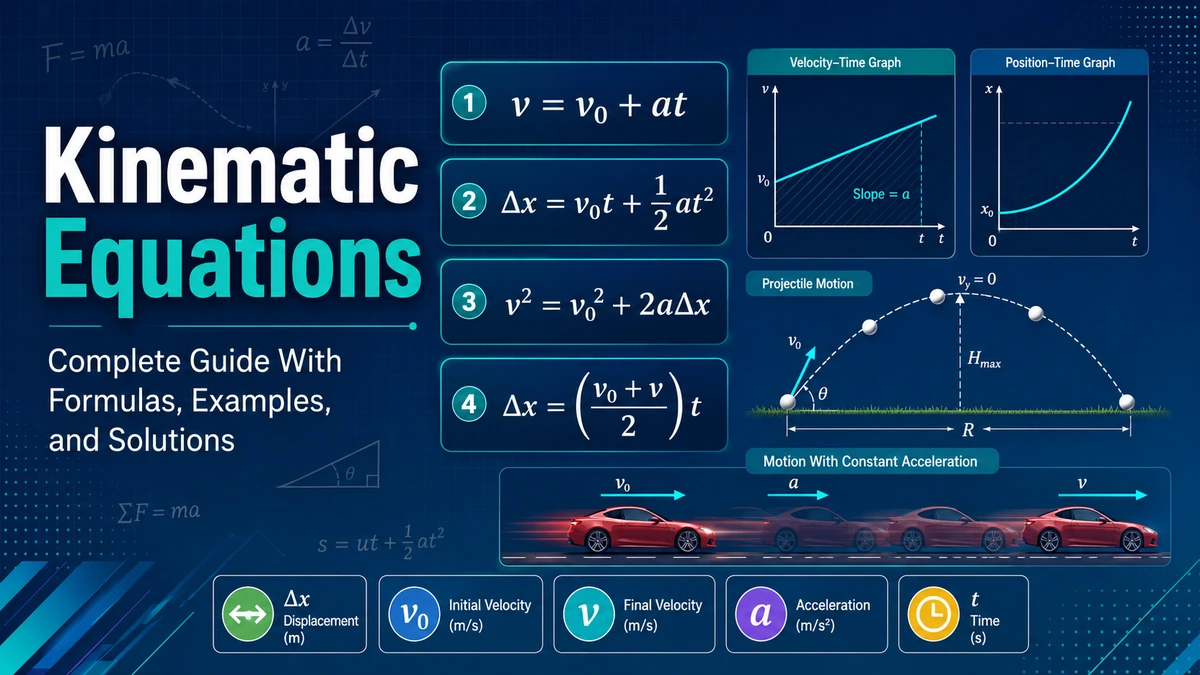
When I first explain kinematic equations, I prefer to start with what they actually accomplish rather than asking anyone to memorize four formulas. These equations connect position, displacement, initial velocity, final velocity, acceleration, and elapsed time for motion in which acceleration remains constant. Once I know which quantities a problem gives me and which quantity I need to find, the equations become a practical toolkit rather than a collection of symbols.
The constant-acceleration condition is essential. Khan Academy notes that the familiar kinematic equations apply when acceleration does not change throughout the interval being analyzed, while OpenStax likewise develops the standard equations specifically for constant-acceleration motion.
I find that most student difficulties come from three areas: choosing the correct equation, assigning positive and negative signs consistently, and knowing whether an equation is valid for the physical situation. Once those three habits become automatic, problems involving cars, falling objects, projectiles, elevators, runners, spacecraft, and many other forms of motion become much easier to organize.
In this guide, I will develop the equations from their underlying ideas, show what every variable means, work through several numerical examples, explain free fall and projectile motion, and show when the equations should not be used.
Key Takeaways About Kinematic Equations
The most important ideas to remember are:
- The standard kinematic equations assume constant acceleration.
- The five major variables are displacement, initial velocity, final velocity, acceleration, and time.
- Each equation leaves out one of those variables, which helps us choose the right formula.
- Velocity and displacement require direction, so positive and negative signs matter.
- Free fall near Earth’s surface can usually be modeled with approximately when air resistance is neglected.
- Projectile motion can be handled by applying the equations separately to horizontal and vertical components.
- A value such as does not necessarily mean .
- Dimensional analysis is one of the quickest ways to catch an incorrect equation or calculation.
- The equations should not be used unchanged when acceleration varies significantly with time.
The point I emphasize most is that equation selection should follow the physics of the problem. Memorizing formulas without identifying the known and unknown variables usually makes kinematics harder than it needs to be.
What Are Kinematic Equations?
Kinematics is the part of mechanics concerned with describing motion. Instead of beginning by asking what force caused an object’s motion, kinematics focuses on quantities such as where the object is, how fast it is moving, the direction it is moving, and how its velocity changes.
The standard kinematic equations give mathematical relationships among those quantities when acceleration is constant.
Khan Academy summarizes the restriction particularly clearly:
“The kinematic equations are only accurate if acceleration is constant during the time interval considered.”
Khan Academy
That condition is more important than the specific notation. Different textbooks may use instead of , instead of , or instead of . The physics remains the same.
The four commonly used equations can be written as:
Here, , so the second equation can also be written:
OpenStax presents the same set of constant-acceleration relationships, including the average-velocity form and the time-independent velocity equation.
Variables Used in the Kinematic Equations
Before solving anything, I recommend identifying every variable explicitly.
| Symbol | Meaning | SI Unit | Typical Question |
|---|---|---|---|
| Initial position | m | Where does the object start? | |
| Final position | m | Where does it finish? | |
| Displacement, | m | How far did position change in a specified direction? | |
| Initial velocity | m/s | How fast and in what direction did it start? | |
| Final velocity | m/s | How fast and in what direction is it moving later? | |
| Constant acceleration | m/s² | How quickly is velocity changing? | |
| Elapsed time | s | How long does the motion last? |
One distinction deserves special attention: displacement is not always the same as distance. Distance describes the total length of the path traveled, whereas displacement describes the change in position from start to finish.
Suppose someone walks 30 m east and then 20 m west. The total distance traveled is 50 m, but the displacement is only 10 m east.
That distinction matters because the kinematic equations use displacement.
The Four Main Kinematic Equations
Each formula becomes easier to remember when we understand what information it connects.
First Kinematic Equation: Final Velocity and Time
The first equation is:
It connects:
- Initial velocity
- Final velocity
- Acceleration
- Time
It does not contain displacement.
I use this equation whenever the question concerns velocity after a known amount of time and displacement is irrelevant or unknown.
Example: Car Accelerating From 5 m/s
Suppose a car begins at:
and accelerates at:
for:
Its final velocity is:
The car therefore reaches 17 m/s after six seconds.
I like this example because it shows the physical meaning of acceleration directly. An acceleration of means the velocity increases by 2 m/s every second.
After six seconds, the velocity has increased by:
Adding that change to the initial 5 m/s gives 17 m/s.
Second Kinematic Equation: Displacement and Time
The next equation is:
or:
This formula connects displacement, initial velocity, acceleration, and time.
Final velocity does not appear.
Example: Finding the Car’s Displacement
Using the same car:
we calculate:
The car moves 66 m during the six-second interval.
This calculation also reveals why acceleration produces a term. As time passes, the object is not merely moving for longer. It is also moving progressively faster, so its displacement increases more rapidly than it would at constant velocity.
Third Kinematic Equation: Velocity Without Time
The third equation is:
This equation contains no time variable.
I find it especially useful for braking-distance problems, maximum-height calculations, and situations where distance is known but time is not.
Example: Braking Distance
Suppose a car is traveling at:
and brakes with constant acceleration:
We want to know how far it travels before stopping.
At the stopping point:
Substitute:
Therefore:
Under this ideal constant-deceleration model, the car requires 62.5 m to stop.
The negative acceleration does not mean anything is wrong with the calculation. I defined the car’s original direction of travel as positive, so acceleration opposite that direction is negative.
Fourth Kinematic Equation: Average Velocity
For constant acceleration:
The expression:
is the average velocity during constant acceleration.
The equation can therefore be understood as:
Example Using the Accelerating Car
Earlier, our car had:
The average velocity is:
Then:
We obtain the same 66 m result as we did using the displacement equation.
That agreement is useful as a check.
How the Kinematic Equations Compare
I use the following table when deciding which formula to select.
| Equation | Missing Variable | Best Used When |
|---|---|---|
| You know time and want velocity or acceleration | ||
| You know time and initial velocity but not final velocity | ||
| Time is unknown or unnecessary | ||
| Acceleration is constant but its value is unknown |
The useful pattern is that every equation omits one major variable. Khan Academy specifically recommends recognizing which variable is absent from the information you have and do not need to find, then selecting the equation that leaves it out.
That method is much more reliable than guessing formulas from memory.
Why Constant Acceleration Matters
OpenStax gives a compact definition:
“Constant acceleration is acceleration that does not change over time.”
OpenStax
Suppose an object’s acceleration is:
for the entire period from to seconds.
The familiar equations apply.
But imagine acceleration changes every second:
There is no single constant that correctly represents the entire interval.
Using:
with one arbitrarily selected acceleration would generally give the wrong answer.
When acceleration varies continuously, the more general relationships are based on calculus:
and:
Khan Academy derives the constant-acceleration equations from these derivative and integral relationships, showing that the familiar formulas are special cases of the more general mathematical description of motion.
How the First Kinematic Equation Is Derived
Acceleration is defined as the rate of change of velocity.
For constant acceleration:
Multiply both sides by :
Add :
This derivation helps explain the equation physically.
The term:
is the change in velocity during the interval.
Therefore:
Once I understand that meaning, I no longer need to treat the equation as an arbitrary formula.
How the Displacement Equation Is Derived
For constant acceleration, average velocity can be written:
Displacement is:
Therefore:
From the first kinematic equation:
Substitute this into the average-velocity equation:
Simplify:
Therefore:
This derivation also shows why the equations are interconnected rather than four unrelated rules.
OpenStax makes this point explicitly by noting that the constant-acceleration equations are not independent from one another.
How the Time-Independent Equation Is Derived
Start with:
Solve for time:
Now use:
Substitute the expression for :
Use the difference-of-squares identity:
Therefore:
Multiply by :
Then:
The lack of time is not accidental. We eliminated it algebraically.
A Step-by-Step Method for Solving Kinematic Problems
I recommend using the same workflow every time instead of jumping immediately into substitution.
Step 1: Draw or Imagine the Motion
Determine what the object is doing.
Is it speeding up?
Slowing down?
Falling?
Moving upward?
Changing direction?
A quick sketch can prevent many sign mistakes.
Step 2: Choose a Positive Direction
You may define right as positive and left as negative.
For vertical motion, you can choose either upward or downward as positive.
Neither convention is universally required.
What matters is consistency.
Step 3: Identify Known Variables
Write down:
Then fill in everything the problem gives you.
Also translate common phrases.
“Starts from rest” means:
“Comes to rest” means:
“Dropped” usually implies:
if the object is simply released.
Step 4: Identify the Unknown
Write exactly what the question wants.
For example:
Step 5: Select the Equation
Choose the formula containing the known values and desired unknown while omitting the variable you do not know.
Step 6: Substitute Units and Signs
Do not strip away signs too early.
If acceleration is negative, substitute the negative value.
Step 7: Solve Algebraically
Whenever possible, rearrange the equation symbolically before substituting numbers.
That usually produces cleaner reasoning.
Step 8: Check the Answer Physically
Ask:
- Does the sign make sense?
- Is the magnitude reasonable?
- Are the units correct?
- Should the object have sped up or slowed down?
- Does the answer agree with the diagram?
This final step catches many errors that algebra alone will not.
Kinematic Equations for Free Fall
Free fall is one of the most important applications of kinematics.
When air resistance is negligible, an object near Earth’s surface accelerates downward approximately uniformly due to gravity.
OpenStax gives an average value around:
and commonly rounds it to:
for introductory calculations. It also notes that the actual local value varies slightly with factors including latitude and altitude.
OpenStax explains why the equations work here:
“The acceleration due to gravity is constant.”
OpenStax
That is an approximation for ordinary near-surface introductory problems, but it is an extremely useful one.
Example: Object Dropped From a 20 m Height
Suppose an object is dropped from rest from a height of 20 m.
Let upward be positive.
Then:
We first find time using:
Substitute:
The object takes approximately 2.02 seconds to fall.
Now calculate its velocity immediately before impact:
The negative sign means downward because we defined upward as positive.
Its speed is therefore approximately:
Why Gravity Can Be Positive or Negative
Students often memorize:
and assume gravity must always be negative.
That is not correct.
Gravity points downward. The sign depends entirely on the coordinate system.
If upward is positive:
If downward is positive:
OpenStax explicitly notes that the sign of gravitational acceleration depends on the chosen positive direction.
I think the better habit is to remember the direction of gravity rather than memorizing its sign.
Example: Ball Thrown Upward
Suppose a ball is launched vertically upward at:
We want its maximum height above the launch point.
Choose upward as positive:
At the highest point:
Time is unnecessary, so use:
Substitute:
Therefore:
The ball rises approximately 20.4 m above its launch point.
An important conceptual point appears here.
At the very top:
but:
The ball’s velocity is momentarily zero, but its acceleration is not zero. Gravity continues acting downward.
OpenStax uses similar vertical-motion examples to emphasize that acceleration remains present even when velocity becomes zero at the top of a trajectory.
Using Kinematic Equations for Projectile Motion
Kinematic equations also apply to ideal projectile motion when horizontal and vertical motion are analyzed separately.
Suppose a ball is launched at an angle.
Its initial velocity can be separated into components:
Ignoring air resistance, horizontal acceleration is:
Vertical acceleration is:
Therefore the horizontal equations become especially simple:
Vertically:
and:
The important idea is that horizontal and vertical motion occur simultaneously and share the same elapsed time.
Khan Academy notes that constant-acceleration equations can be applied to different coordinate dimensions as long as each dimension is handled separately.
Position-Time and Velocity-Time Graphs
Graphs provide another way to understand the equations.
For constant acceleration:
This has the mathematical form:
So a velocity-time graph is a straight line.
Its slope is:
and its vertical intercept is:
The area under a velocity-time graph represents displacement.
For position:
the term means the position-time graph is generally curved when acceleration is nonzero.
Khan Academy connects these relationships to differentiation and integration: velocity is the derivative of position, acceleration is the derivative of velocity, and accumulated area can be used to recover changes in the corresponding quantities.
I find that graph interpretation gives the equations more meaning because the mathematics becomes visible.
Dimensional Analysis for Kinematic Equations
Units provide a powerful error check.
Consider:
The left side has units of meters.
For the first term:
For the second:
Every term therefore has displacement units.
Now imagine accidentally writing:
The second term would have:
That is velocity, not displacement.
The units immediately reveal the mistake.
Common Kinematic Equation Mistakes
Confusing Speed With Velocity
Speed is a scalar magnitude.
Velocity includes direction.
An object moving at 10 m/s east and an object moving at 10 m/s west have equal speeds but opposite velocities under an east-positive convention.
Confusing Distance With Displacement
Kinematic equations normally use displacement.
If a runner completes one full lap and finishes where they started:
even though the runner traveled a substantial distance.
Forgetting the Constant-Acceleration Assumption
This is probably the most important technical error.
If acceleration changes substantially throughout the interval, the standard equations cannot simply be applied with one arbitrary acceleration value.
Using With the Wrong Sign
Gravity is directed downward.
Its algebraic sign depends on your coordinate convention.
Choose the convention first.
Assuming Zero Velocity Means Zero Acceleration
A vertically thrown ball has zero instantaneous velocity at the highest point but still accelerates downward.
Mixing Units
If velocity is given in km/h while acceleration is in m/s² and time is in seconds, convert everything into compatible units before substitution.
Using the Wrong Initial Velocity
The word “initial” refers to the beginning of the interval you choose.
A motion problem can be divided into several stages, each with its own initial conditions.
Rounding Too Early
Keep additional digits through intermediate calculations, then round the final answer appropriately.
Early rounding can cause noticeable errors in multi-step problems.
Trying to Use Every Number
Some word problems include information you do not need.
Equation selection should depend on relevant variables, not on a desire to insert every number provided.
When Kinematic Equations Should Not Be Used Directly
The familiar equations are extremely useful, but they are not universal.
I would not use the standard constant- formulas unchanged when:
- Acceleration varies substantially with time.
- Air resistance produces strongly changing acceleration.
- A vehicle’s acceleration follows a complex engine or braking profile.
- An object moves through a medium with significant drag.
- The gravitational field changes significantly over the distance traveled.
- Relativistic effects become important.
- The coordinate system itself requires a more advanced treatment.
In such situations, the correct model may require differential equations, numerical methods, calculus, or a piecewise approximation.
For example, a real skydiver does not continue accelerating downward at indefinitely. Air resistance increases with speed, reducing the net downward acceleration until terminal behavior can emerge.
The simple free-fall equations therefore work best when air resistance is negligible.
How to Improve at Kinematic Equation Problems
In my analysis, improvement comes less from memorizing dozens of examples and more from developing a repeatable reasoning process.
Start every problem by defining the coordinate system.
Write the known variables before selecting a formula.
Use the equation that omits the irrelevant unknown.
Carry units throughout the calculation.
After solving, ask what the sign means physically.
Then verify whether the calculated magnitude seems plausible.
I also recommend solving the same problem in two different ways when possible.
For example, the accelerating-car problem produced a displacement of 66 m using:
and again using:
Getting the same result from independent equations is a strong check.
Practical Applications of Kinematic Equations
These formulas appear far beyond classroom exercises.
Engineers can use constant-acceleration approximations when studying vehicle motion.
Sports analysis can use kinematics to estimate jumping height, sprint acceleration, or ball trajectories.
Transportation problems can estimate stopping distances and travel times.
Robotics systems use motion relationships when planning controlled movement.
Aerospace calculations use more advanced versions of the same underlying concepts to describe trajectories.
Animation and game physics also depend on position, velocity, acceleration, and time, although real-time simulations often update those quantities numerically rather than applying one closed-form equation over a long interval.
The broader lesson is that kinematic equations are mathematical models of motion. Their usefulness depends on how accurately their assumptions represent the physical situation.
Conclusion
I see kinematic equations as one of the most useful first examples of how physics turns observations about motion into a compact mathematical model. The four familiar formulas connect displacement, initial velocity, final velocity, constant acceleration, and time, but their real value comes from understanding why they work and when they apply.
The constant-acceleration assumption should always come first. From there, I identify the known variables, choose a positive direction, determine what I need to find, and select the equation that excludes the unnecessary unknown. That process works for ordinary linear motion, braking problems, free fall, and each component of ideal projectile motion.
Sign conventions deserve just as much attention as arithmetic. Negative velocity, displacement, or acceleration usually communicates direction rather than an error. Likewise, zero velocity does not imply zero acceleration.
For anyone learning this topic, my recommended next step is simple: practice identifying variables before doing any algebra. Once equation selection becomes systematic, kinematics stops feeling like formula memorization and starts becoming a clear method for describing and predicting motion.
READ: Photography Lighting Basics: A Beginner’s Guide to Better Photos
Frequently Asked Questions
What Are the Four Kinematic Equations?
The four commonly used kinematic equations for constant acceleration are , , , and . They relate initial velocity, final velocity, acceleration, displacement, and elapsed time. Different textbooks may present slightly different notation, but the underlying relationships remain the same. These formulas are valid when acceleration remains constant over the interval being studied.
How Do I Know Which Kinematic Equation to Use?
Identify your known variables and the quantity you need to calculate, then select the equation that leaves out the variable you do not know and do not need. For example, if time is unknown and the problem gives initial velocity, final velocity, acceleration, and displacement, is usually the most direct choice. Khan Academy recommends using this missing-variable structure as a practical equation-selection strategy.
When Can Kinematic Equations Be Used?
Standard kinematic equations can be used when acceleration is constant during the interval under consideration. They work well for idealized vehicle acceleration, constant braking, and near-surface free fall when air resistance is neglected. If acceleration changes significantly with time, the constant-acceleration formulas generally cannot describe the whole motion accurately with a single value of . More general calculus or numerical methods may then be required.
What Does Mean in Kinematics?
represents the object’s initial velocity at the beginning of the time interval being studied. The subscript zero means the value at the chosen starting time. It does not necessarily represent the velocity at the beginning of the object’s entire journey. If a long motion is divided into stages, each stage can have its own . Because velocity includes direction, can also be positive, negative, or zero depending on the coordinate system.
What Is the Difference Between Kinematics and Dynamics?
Kinematics describes motion using variables such as position, velocity, acceleration, and time without necessarily analyzing the forces responsible for that motion. Dynamics examines why motion changes, commonly through forces and Newton’s laws. A kinematics problem might ask how far a car travels while accelerating, whereas a dynamics problem might ask what net force produces that acceleration. The two areas are closely related but answer different questions.
Are Kinematic Equations Used for Free Fall?
Yes. Near Earth’s surface, free fall can usually be treated as motion with approximately constant gravitational acceleration when air resistance is negligible. Introductory physics problems commonly use . If upward is defined as positive, acceleration is ; if downward is positive, it is . OpenStax gives an average gravitational acceleration around 9.81 m/s² and explains that its precise local value varies slightly.
Why Is Acceleration Negative Sometimes?
Negative acceleration simply means acceleration points in the negative direction of the coordinate system you selected. It does not automatically mean an object is slowing down. If velocity is positive and acceleration is negative, the object may slow down. If both velocity and acceleration are negative, its speed can increase while it moves in the negative direction. I therefore recommend interpreting signs through direction rather than associating negative acceleration automatically with braking.
Is Velocity Zero at the Top of a Thrown Object’s Path?
Yes, the vertical velocity is momentarily zero at the highest point of a vertically thrown object’s path, but its gravitational acceleration remains downward. If upward is positive, that acceleration is approximately . The nonzero acceleration changes the velocity from upward to downward immediately after the highest point. OpenStax uses this distinction when discussing vertical free-fall motion.
Can Kinematic Equations Be Used in Two Dimensions?
Yes, provided the motion is resolved into separate coordinate components and acceleration in each component is constant. In ideal projectile motion, for example, horizontal acceleration is zero while vertical acceleration is approximately when upward is positive. The equations can be applied independently in the and directions, with both components sharing the same elapsed time.
Why Does the Displacement Equation Contain ?
The term appears because acceleration continuously changes velocity. The displacement contributed by the object’s initial velocity grows proportionally with time as , while the additional displacement caused by constant acceleration grows as . This relationship can be derived algebraically from constant-acceleration average velocity or from calculus by integrating velocity over time.
Sources and References
- OpenStax, University Physics Volume 1, Motion with Constant Acceleration, for the standard constant-acceleration equations and their relationships.
- OpenStax, Physics, Representing Acceleration with Equations and Graphs, for constant acceleration, average velocity, and motion equations.
- OpenStax, University Physics Volume 1, Free Fall, for gravitational acceleration, free-fall assumptions, sign conventions, and vertical-motion examples.
- Khan Academy, The Kinematic Equations, for the variables, formulas, equation-selection method, and constant-acceleration limitation.
- Khan Academy, Deriving the Kinematic Equations, for the calculus relationships among position, velocity, acceleration, and the resulting constant-acceleration formulas.
- Khan Academy, Motion With Constant Acceleration Review, for problem-solving guidance and interpreting commonly implied variables such as starting from rest.
- NIST Technical Note, for reference information distinguishing the internationally defined standard gravity of 9.80665 m/s² from practical rounded engineering values.
Disclaimer
This article is intended for educational purposes and focuses on introductory classical kinematics under the assumption of constant acceleration. Real-world motion may involve changing acceleration, air resistance, friction, variable gravitational fields, rotational effects, measurement uncertainty, or other factors that require more advanced models. I recommend using the assumptions provided in a specific physics course, laboratory, engineering standard, or examination when they differ from the simplified examples used here.

I see Quizlet NC Permit Test searches as a sign that people want a faster, less intimidating way to prepare for the North Carolina learner permit exam. Flashcards can certainly help with memorizing traffic signs, right-of-way rules, speed limits, school-bus laws, and other facts, but I would not treat a Quizlet set as the official source for the test. The North Carolina Division of Motor Vehicles provides the current Driver Handbook, testing information, and sample questions, while Quizlet contains study sets created by individual users whose information can vary in age and accuracy.
That distinction matters in 2026 because some North Carolina licensing rules have changed over time. For example, the current NCDMV Level 2 requirements say a teen must hold a Level 1 Limited Learner Permit for nine months before qualifying to move forward, while an older Quizlet set still says twelve months. This is exactly why I recommend using Quizlet as a memory tool and the official NCDMV material as the final authority.
In this guide, I will explain how the North Carolina permit process currently works, what the written and traffic-sign tests cover, how to evaluate Quizlet flashcards, which topics deserve the most study time, and how to create a study routine that prepares you for the actual knowledge rather than merely memorizing somebody else’s answers.
Key Facts About the Quizlet NC Permit Test and the Real NCDMV Exam
The first thing I would establish is what comes from NCDMV and what comes from Quizlet. That prevents a study aid from being confused with the actual testing authority.
| Topic | Current Information |
|---|---|
| Official testing authority | North Carolina Division of Motor Vehicles |
| Quizlet’s role | Third-party flashcards and study sets created by users |
| Written test coverage | Traffic laws and safe-driving practices |
| Separate sign test | Yes, regulatory and warning signs |
| Sign-test skill | Identify signs by color and shape and explain their meanings |
| Vision test | Required for permit applicants |
| Teen Level 1 age | 15 to 17 |
| Teen driver education | Required before Level 1 permit |
| Current Level 1 permit fee | $25.50 |
| Current Level 1 holding period before Level 2 | 9 months |
| Logged driving before Level 2 | At least 60 hours |
| Adult learner permit | Available beginning at age 18 |
| Road test for learner permit | Not required for the learner permit itself |
NCDMV’s current testing page is especially useful because it separates the written knowledge test from the traffic-sign test. The written portion covers traffic laws and safe-driving practices, while the signs portion focuses on regulatory and warning signs.
What Is the Quizlet NC Permit Test?
The phrase Quizlet NC Permit Test generally refers to North Carolina permit-study flashcards hosted on Quizlet. There is no single official Quizlet set designated by NCDMV.
Current search results show just how different these sets can be. One North Carolina set contains 39 terms, another contains 46, another contains 50, another has 100 questions, and one very large collection includes more than 700 terms. Their titles also range from general “NC Permit Test” sets to sets organized around specific sections of the North Carolina Driver Handbook.
That variety can be useful. A small set may be better for reviewing road signs before bed, while a larger collection can help someone work through the handbook over several weeks.
The problem is consistency.
Quizlet sets are normally created by users, students, teachers, or other members of the platform rather than by NCDMV. A flashcard may accurately reflect the current handbook, reflect an older version of North Carolina law, simplify an important rule too aggressively, or occasionally contain an outright error.
In my view, the smartest approach is not “Quizlet versus the handbook.” It is Quizlet plus the handbook, with the handbook settling any disagreement.
What the Official North Carolina Permit Test Covers
NCDMV summarizes the purpose of the written portion very simply:
“Covers traffic laws and safe-driving practice”
North Carolina Division of Motor Vehicles.
That short description tells me why memorizing isolated numbers is not enough. You need to understand how North Carolina expects drivers to behave around intersections, pedestrians, traffic signals, school buses, emergency vehicles, road hazards, and other motorists.
The traffic-sign test is separate. NCDMV says applicants must identify regulatory and warning signs based on color and shape and explain the meaning of each sign.
This is why I would divide preparation into two broad tracks: driving knowledge and sign recognition.
Why the North Carolina Driver Handbook Should Be Your Main Study Source
Quizlet can make information easier to review, but the North Carolina Driver Handbook is published by the agency administering the test.
NCDMV makes its current handbook available online and through driver license offices. It also publishes separate regulatory-sign and warning-sign resources.
The handbook is particularly direct about signs:
“All the information on the traffic signs test is in this handbook.”
North Carolina Driver Handbook.
That gives me a straightforward study rule. If I were preparing and a Quizlet answer contradicted the current handbook, I would use the handbook answer.
I would also check the publication date. A flashcard set created several years ago can remain highly visible because it has thousands of users or positive reviews, even after a licensing rule changes.
Why Some Quizlet NC Permit Test Sets Can Become Outdated
The Level 1 to Level 2 licensing timeline provides a useful real-world example.
A Quizlet set indexed in current search results asks how long someone must hold a Limited Learner Permit before applying for a Limited Provisional License and gives twelve months as the answer.
The current NCDMV Level 2 page says otherwise. As of September 2026, a teen must be 16 to 17 years old, hold a Level 1 permit for nine months, meet the violation requirements, and complete at least 60 logged driving hours before progressing to the Level 2 road test.
This does not make Quizlet useless. It demonstrates the limits of crowdsourced study material.
A flashcard may have been correct when someone created it.
The law may have changed later.
The original creator may never update the set.
Search engines can still rank it prominently.
For that reason, I would verify any flashcard involving ages, permit durations, fees, penalties, required documents, licensing restrictions, or other rules that can change.
North Carolina Teen Permit Requirements in 2026
Teens between 15 and 17 follow North Carolina’s graduated licensing system.
NCDMV states:
“Teens 15 to 17 years old must apply for a limited learner permit”
North Carolina Division of Motor Vehicles.
Before applying for the Level 1 Limited Learner Permit, a student must meet current eligibility requirements and complete approved driver education. NCDMV says the driver-education program includes 30 hours of classroom instruction plus at least six hours of behind-the-wheel instruction.
The student must also have a Driving Eligibility Certificate and Driver’s Education Certificate.
At the DMV office, the teen needs documentation establishing identity and date of birth, a Social Security number, North Carolina residency, and the required school and driver-education certificates. A parent or guardian generally needs to be present for the testing process, although NCDMV describes a written-consent option when another person is involved.
The current Level 1 fee is $25.50.
What Happens During the Level 1 Permit Testing Process
A Level 1 applicant must pass written, sign, and vision tests.
The knowledge portion evaluates traffic laws and safe-driving practices.
The sign portion checks whether the applicant can recognize and explain regulatory and warning signs.
The vision screening determines whether the applicant meets the state’s vision requirements for driving.
A road test is not part of obtaining the learner permit itself. The current North Carolina Driver Handbook states that the driving test is required for an initial driver license but not for a learner permit.
This distinction is useful for study planning. Someone preparing specifically for Level 1 should prioritize handbook knowledge, signs, and the practical rules learned during driver education rather than worrying about performing parking maneuvers during the permit appointment.
High-Priority Topics for Quizlet NC Permit Test Study
Based on the official handbook and the types of material repeatedly appearing in public Quizlet sets, I would concentrate on a group of core subjects.
Traffic Sign Shapes and Colors
Sign recognition is one of the clearest priorities because North Carolina tests it separately.
Applicants should know common regulatory and warning signs, including how color and shape communicate meaning even before the wording can be read.
For example, the current handbook explains that the five-sided pentagon shape identifies school zones or school crossings. It also explains that interstate signs use red, white, and blue shields, while hospital and certain service signs use blue and white.
A Quizlet deck can be especially useful here because flashcards naturally suit visual recognition.
I would avoid learning only the wording printed on a sign. NCDMV specifically wants applicants to understand shape, color, and meaning.
Speed Limits
North Carolina’s default speed limits are common study material.
NCDOT says that unless otherwise posted, the speed limit is 35 mph within towns or cities and 55 mph outside municipalities. Drivers still have to adjust their speed for conditions and obey posted changes.
The Driver Handbook also lists 70 mph as the maximum for interstates in the general maximum-speed table, though the actual posted limit controls the road you are driving on.
The important learning principle is not merely memorizing “35, 55, 70.” Drivers must understand that posted signs and current road conditions determine how fast it is safe and lawful to travel.
Following Distance
The current North Carolina Driver Handbook still teaches the “two-second rule” as a general safe-distance concept. It also stresses that higher speeds require greater stopping and visibility distances.
For motorcycles, NCDOT gives more conservative guidance, recommending three to four seconds of following space.
I would learn the principle rather than focusing only on one number: more speed, bad weather, reduced visibility, or a vulnerable road user means more space is appropriate.
School Bus Laws
School-bus rules deserve serious attention because they protect children entering and leaving buses.
NCDOT explains that yellow flashing school-bus lights mean the bus is preparing to stop. Drivers should slow down and prepare to stop.
Red flashing lights and the extended stop arm mean children are boarding or leaving. Drivers who are required to stop must remain stopped until the red lights stop flashing, the arm retracts, and the bus begins moving.
The exact stopping requirement can depend on roadway configuration, so this is an area where studying the handbook diagrams is more useful than memorizing one sentence from a flashcard.
Intersections and Right of Way
Quizlet sets frequently cover situations involving vehicles arriving at intersections simultaneously.
One current North Carolina study set says that when two or more vehicles arrive at an intersection at the same time, the vehicle to the right generally has the right of way.
That is useful to remember, but right of way cannot be reduced to one rule.
Pedestrians, traffic controls, vehicles already in an intersection, emergency vehicles, and special road configurations can alter what the correct response should be.
I would use scenario questions rather than memorizing a sentence without context.
Weather and Reduced Visibility
North Carolina permit materials also emphasize driving appropriately in rain, snow, fog, and other reduced-traction or reduced-visibility conditions.
Public Quizlet sets commonly include low-beam use in heavy fog or snow, safe slowing on slippery roads, and hydroplaning concepts.
These questions are easier when the driver understands the safety principle: slow down, increase space, improve visibility, and avoid sudden movements.
How Quizlet Compares With Official NCDMV Study Resources
I would use different resources for different purposes rather than expecting one platform to do everything.
| Study Resource | Best Use | Main Strength | Main Limitation |
|---|---|---|---|
| Current N.C. Driver Handbook | Learning official rules | Published by NCDMV | Longer and less interactive |
| NCDMV traffic-sign materials | Sign recognition | Directly relevant to sign test | Focused mainly on signs |
| NCDMV sample questions | Understanding question style | Official source | Limited compared with full study sets |
| Quizlet flashcards | Repetition and memorization | Fast, interactive review | User-created information can be outdated |
| Driver education course | Learning concepts and practical driving | Structured instruction | Only part of the preparation process |
| Self-made flashcards | Weak-topic review | Based on material you personally verify | Takes time to create |
| Practice scenarios | Applying rules | Tests understanding rather than memorization | Must be based on correct source material |
My preferred combination would be the handbook first, Quizlet second, and self-testing third.
How I Would Use Quizlet to Prepare for the NC Permit Test
I would begin by reading one topic in the current NCDMV handbook rather than opening a 700-card deck and trying to memorize everything immediately.
For example, I might study traffic signs first.
After reading that section, I would open a Quizlet sign set and test myself without looking at the answers.
Any question I miss would go onto a short personal review list.
Then I would verify the answer in the handbook.
That final verification step is what protects against stale flashcards.
Once signs become comfortable, I would move to speed rules, intersections, right of way, safe following, school buses, impaired driving, emergency situations, and vehicle safety.
The next day, I would mix old topics with new ones.
This approach uses spaced repetition rather than cramming. Each review session forces the brain to retrieve information after some time has passed, which is more useful than repeatedly reading the same page.
A Seven-Day Quizlet NC Permit Test Study Plan
A one-week plan can work well when the learner has already completed driver education and is using the week for focused review.
Day 1: Learn the Test Structure
I would review the NCDMV testing page, permit requirements, required documents, and current Driver Handbook.
The goal on the first day would not be memorization. It would be understanding exactly what the state expects.
Day 2: Master Regulatory and Warning Signs
I would study signs from the official handbook and then use Quizlet for rapid visual review.
Any sign I could recognize only by its wording, rather than shape and color, would remain on my study list.
Day 3: Study Speed, Following, and Road Position
I would review default speed limits, safe following distance, lane use, curves, passing, and general road positioning.
Quizlet works well here for numbers and short rules, but scenario-based review should follow.
Day 4: Focus on Intersections and Right of Way
This is where I would practice situations rather than isolated definitions.
Who goes first at an uncontrolled intersection?
What changes when a pedestrian is present?
What happens at a traffic circle?
What should a driver do when an emergency vehicle approaches?
Day 5: Review School Buses, Weather, and Safety
School buses, fog, rain, snow, vehicle breakdowns, seat belts, distracted driving, alcohol, and medication effects all deserve attention.
These topics are particularly suitable for “What would you do?” questions.
Day 6: Take Mixed Practice Tests
At this point I would stop studying by chapter.
I would mix signs, safety, traffic law, right of way, and numerical rules in random order.
Any repeated mistake would send me back to the handbook.
Day 7: Light Review Instead of Cramming
On the final day, I would review weak topics and road signs rather than trying to learn hundreds of new flashcards.
Sleep and calm recall are more useful than an exhausted last-minute study session.
Original Practice Questions Based on Current North Carolina Material
The following questions are not actual NCDMV exam questions. I created them from topics found in current official North Carolina resources so they can be used for legitimate study.
| Practice Question | Answer |
|---|---|
| What does the written knowledge test cover? | Traffic laws and safe-driving practices |
| What must you do during the traffic-sign test? | Identify regulatory and warning signs by color and shape and explain their meaning |
| What is the default speed limit inside North Carolina cities and towns unless posted otherwise? | 35 mph |
| What is the default speed limit outside cities and towns unless posted otherwise? | 55 mph |
| What do yellow flashing lights on a school bus mean? | The bus is preparing to stop, so slow down and prepare to stop |
| What do red school-bus lights and an extended stop arm indicate? | Children are boarding or leaving and drivers required to stop must remain stopped |
| What age range uses the Level 1 Limited Learner Permit system? | Ages 15 to 17 |
| How long must a current Level 1 permit generally be held before Level 2 eligibility? | 9 months |
| How many logged driving hours are required before the current Level 2 process? | At least 60 hours |
| Is a road driving test required to receive the learner permit? | No |
These answers are supported by current NCDMV and NCDOT materials reviewed in September 2026.
Quizlet Features That Can Help With Permit Preparation
Quizlet’s biggest advantage is repetition.
Public North Carolina permit sets currently offer combinations of flashcards, Learn, Test, Match, Blocks, Blast, and other study interfaces depending on the set and account experience.
Flashcards work well for sign meanings and short factual rules.
Test-style modes are useful after basic knowledge has been learned.
Matching activities can speed up recognition of terms and definitions.
What I would avoid is treating a high Quizlet score as proof that I am ready for the DMV.
A learner can memorize the exact order and wording of one deck without understanding the rule behind the answer.
The real goal should be transfer. If a question changes the road layout, weather condition, sign, or sequence of events, you should still understand what a safe driver is expected to do.
Common Mistakes With Quizlet NC Permit Test Flashcards
The most common mistake is assuming the highest-rated or most popular set must be current.
Popularity measures how much a set has been used, not whether every answer matches 2026 North Carolina rules.
Another mistake is memorizing actual-looking questions without learning the handbook.
A question bank may use wording similar to common permit-preparation websites, but the real test can phrase the concept differently.
A third mistake is ignoring road signs until the end.
North Carolina specifically tests sign recognition separately, which makes signs too important to treat as a minor chapter.
A fourth mistake is trusting exact legal requirements from old flashcards. Fees, licensing timelines, and graduated-license rules can change.
For example, the current Level 1 fee is $25.50, and current Level 2 eligibility uses a nine-month Level 1 holding period.
Finally, I would not try to find leaked or supposedly exact live exam questions. Even aside from test-integrity concerns, those materials can be inaccurate or outdated. Learning the official rules prepares someone not only to pass a test but also to make safer decisions after receiving the permit.
Current Level 1 Restrictions After You Pass
Passing the knowledge, sign, and vision tests is only the beginning for a teen driver.
A Level 1 permit requires supervision.
North Carolina’s graduated-license handout says that the supervising driver must sit beside the permit holder in the front seat while the vehicle is moving. During the first six months, the Level 1 driver may drive from 5 a.m. to 9 p.m. with that supervising driver. After six months, supervised driving can occur at any time.
The permit stage exists to create real driving experience before independent driving privileges increase.
That is why studying should not stop the moment the written test is passed.
The learner should apply handbook concepts while driving with an experienced supervising driver.
Moving From Level 1 to Level 2
The current Level 2 process is particularly important because older internet study guides may describe different timelines.
NCDMV’s 2026 page says applicants must be 16 to 17 years old, hold Level 1 for nine months, satisfy the recent-violation requirement, and document at least 60 hours of driving.
At that point, the road test becomes relevant.
NCDMV currently allows the Level 2 road test to be completed at a certified driver-education school or an NCDMV driver-license office. Applicants need the Level 1 permit, driving log, required insurance documentation, and an appropriate vehicle when testing through DMV.
This is another reason I would keep the official NCDMV website bookmarked even after passing the permit test.
What Adults Should Know About the North Carolina Learner Permit
Adults follow a different process.
NCDMV says a standard learner permit is available to individuals who are at least 18 years old. Adults may also apply directly for a driver license rather than first obtaining a permit.
The adult learner permit still requires the applicable knowledge, road-sign recognition, and vision testing.
The permit allows driving only when the permit holder is accompanied by an appropriately licensed person seated beside them.
So while “Quizlet NC Permit Test” is often searched by teenagers, adults can also use North Carolina permit flashcards to prepare for the same core driving knowledge and sign concepts.
What to Bring to the DMV for a Teen Level 1 Permit
I would check the current NCDMV Level 1 page shortly before the appointment because document requirements can create unnecessary delays if something is missing.
As of September 2026, NCDMV lists proof of identity and date of birth, Social Security documentation, proof of North Carolina residency, the Driving Eligibility Certificate, and the Driver’s Education Certificate among the required materials for the teen Level 1 process. A parent or guardian also plays a role in the application and testing process.
The current permit fee is $25.50.
I would not rely on a Quizlet deck for document requirements. This is exactly the kind of administrative information that should come directly from the DMV website.
How to Know When You Are Ready for the Permit Test
I would not judge readiness by how many flashcards have been viewed.
Instead, I would ask whether I can explain the rules without seeing the answer.
Can I identify a sign from shape and color alone?
Can I explain why one driver yields at an intersection?
Can I describe what to do when a school bus activates red lights?
Can I explain why a speed lower than the posted maximum may still be appropriate in rain?
Can I distinguish Level 1 permit rules from Level 2 rules?
Can I answer mixed questions without relying on the wording of one familiar Quizlet set?
If those answers are yes, the studying is doing what it should.
Conclusion
I believe the best way to use Quizlet NC Permit Test resources is as a supplement to the current North Carolina Driver Handbook, not as a replacement for it. Quizlet gives learners a convenient way to repeat signs, terminology, traffic rules, and scenarios, but its public sets are created by users and can preserve outdated information long after North Carolina changes a licensing requirement.
The current 2026 NCDMV material should settle every disagreement. The written test covers traffic laws and safe-driving practices, the traffic-sign portion requires applicants to recognize and explain signs, and teen Level 1 applicants must meet current driver-education and documentation requirements. Teens progressing toward Level 2 currently need nine months with Level 1 and at least 60 logged driving hours.
My practical approach would be to read the official handbook by topic, use Quizlet immediately afterward for recall practice, verify every missed or questionable answer against NCDMV, and finish with mixed scenario questions. That method prepares a learner for more than a test. It builds the knowledge needed to start driving safely under supervision.
READ: Best Laptops for Writers in 2026: 7 Top Picks for Writing, Research, and Travel
Frequently Asked Questions
Is Quizlet Good for the NC Permit Test?
Yes, Quizlet can be useful for North Carolina permit-test preparation when it is used alongside official NCDMV resources. Flashcards are particularly effective for reviewing signs, traffic-law terminology, speed limits, and common driving situations. The limitation is that Quizlet sets are created by users and are not automatically updated when North Carolina rules change. I would verify important answers with the current North Carolina Driver Handbook before memorizing them.
Is the Quizlet NC Permit Test Official?
No. The Quizlet NC Permit Test is not the official North Carolina DMV examination. Quizlet hosts user-created study materials, while the actual learner permit tests are administered by the North Carolina Division of Motor Vehicles. NCDMV publishes the current Driver Handbook, testing requirements, sign information, and sample questions. I would use Quizlet for practice and repetition while treating current NCDMV information as authoritative.
What Is on the North Carolina Permit Test?
The knowledge test covers traffic laws and safe-driving practices. North Carolina also administers a traffic-sign test covering regulatory and warning signs. Applicants must identify signs by color and shape and explain what they mean. A vision screening is also required for learner permit applicants. The Driver Handbook is the primary official source for the material.
How Old Do You Have to Be for an NC Learner Permit?
Teens can apply for a Level 1 Limited Learner Permit from ages 15 through 17 after meeting North Carolina’s driver-education and eligibility requirements. Adults age 18 or older may apply for a standard learner permit or may apply for a driver license. NCDMV treats these as separate licensing paths, so applicants should follow the instructions for their age group.
How Much Does an NC Limited Learner Permit Cost in 2026?
The current Level 1 Limited Learner Permit fee is $25.50 according to NCDMV. Standard learner permits are also listed at $25.50 in the current fee materials. Fees can change over time, so I recommend checking the NCDMV fee page shortly before applying rather than relying on an older Quizlet card or study guide.
How Long Must You Keep a Level 1 Permit Before Level 2?
The current 2026 requirement is nine months. NCDMV says a teen moving to Level 2 must be 16 to 17 years old, have held Level 1 for nine months, satisfy the applicable violation requirement, and complete at least 60 logged driving hours. Some older Quizlet sets still show a twelve-month period, which is why current official information should always be checked.
Do You Need a Road Test for the NC Learner Permit?
No. The North Carolina Driver Handbook states that the driving-skills test is not required for a learner permit. Permit applicants complete the required knowledge, traffic-sign, and vision testing instead. A teen moving from Level 1 to the Level 2 Limited Provisional License does eventually need a road test after satisfying the current experience and eligibility requirements.
What Should I Study Most for the Quizlet NC Permit Test?
I would prioritize official traffic signs, right-of-way situations, speed rules, school-bus requirements, safe following distance, intersections, impaired and distracted driving, weather conditions, and graduated-license rules. Signs deserve particular attention because North Carolina tests sign recognition separately. Quizlet can help repeat these subjects quickly, but any rule involving a number, age, fee, deadline, or legal requirement should be verified against current NCDMV material.
Can I Pass the NC Permit Test Just by Memorizing Quizlet?
Memorizing one Quizlet set may help with recall, but I would not rely on it as the entire preparation strategy. The real value is understanding why an answer is correct so you can handle differently worded scenarios. Because Quizlet sets vary widely and can contain outdated information, I recommend reading the official handbook first and then using flashcards to reinforce the material.
Sources and References
- North Carolina Division of Motor Vehicles, Driver License Tests, current information on written knowledge, traffic-sign, vision, and driving tests.
- NCDMV, North Carolina Driver Handbook and handbook resources.
- NCDMV, Level 1 Limited Learner Permit requirements, driver education, documents, and fee.
- NCDMV, Level 2 Limited Provisional License requirements, including the nine-month Level 1 period and 60 logged driving hours.
- NCDMV, learner permit and driver-license eligibility for adult applicants.
- NCDOT, current North Carolina speed-limit guidance.
- NCDOT, North Carolina school-bus safety and flashing-light rules.
- Quizlet, publicly indexed North Carolina permit-test study sets used to evaluate how flashcard content and set sizes vary.
Disclaimer
This article is an independent educational study guide and is not affiliated with, endorsed by, or produced by Quizlet, the North Carolina Division of Motor Vehicles, or the North Carolina Department of Transportation. I have used current official North Carolina sources to verify licensing and testing information available as of September 2, 2026, but driver-license rules, fees, testing procedures, and administrative requirements can change. Quizlet sets are user-created and may contain outdated or inaccurate information. Applicants should review the current North Carolina Driver Handbook and official NCDMV website before taking a permit test or visiting a driver license office.
-

 Health2 weeks ago
Hemp Gummies for Soothing Relief 750mg / 30 Count: Facts, Safety, Ingredients, and Evidence
-

 Education2 weeks ago
Quizlet NC Permit Test: 2026 North Carolina Permit Study Guide
-

 AI5 days ago
vrgamegirl19/comfyui-vrgamedevgirl: Features, Setup, Installation, and Safety Guide
-

 Guide2 weeks ago
Best Laptops for Writers in 2026: 7 Top Picks for Writing, Research, and Travel
-

 Technology1 week ago
Techmeshnews.com: Guide to Content, Ownership, Safety, & Trust
-

 AI2 weeks ago
Open CoDesign: What It Is, Features, Setup, and How It Works
-

 Technology2 weeks ago
Best Coding YouTube Channels in 2026: 12 Channels I Recommend for Learning to Code
-
 Technology1 week ago
allintext:login filetype:log Explained: Meaning, Risks, and Defensive Security Guide