News
Minneapolis Shooting: Annunciation Attack, Investigation, Victims, and 2026 Updates

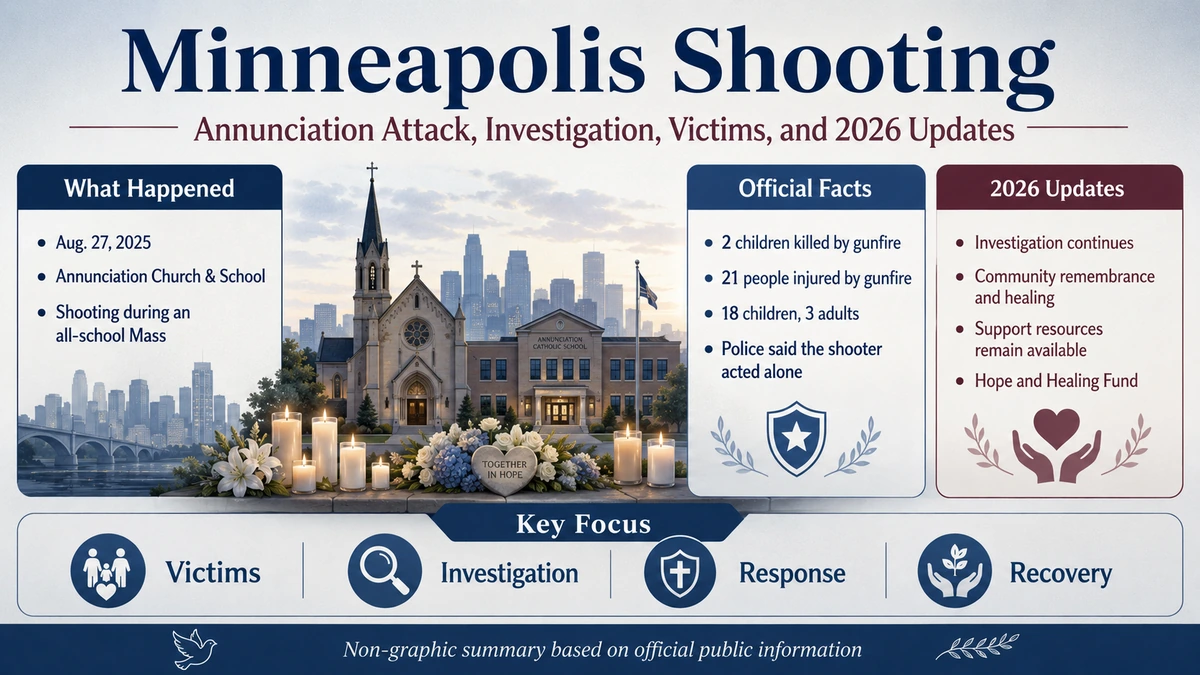
I use the phrase Minneapolis Shooting in this article primarily to refer to the August 27, 2025 mass shooting at Annunciation Catholic Church and School in south Minneapolis. That attack has returned to national attention because Minneapolis authorities released roughly 2,600 pages of investigative records around its first anniversary in August 2026. Those records provide the clearest account yet of the emergency response while still leaving a central question unresolved: investigators have not established a simple, definitive explanation for why the attack happened.
The attack occurred during an all-school Mass in the first week of classes. Eight-year-old Fletcher Merkel and 10-year-old Harper Moyski were killed. More than 20 other children and adults were injured, with official totals changing as additional injuries were identified after the initial emergency response. The attacker, 23-year-old Robin Westman, died by suicide at the scene. Authorities said the firearms used in the attack had been legally purchased.
From my perspective, a responsible account of this tragedy should do more than repeat the first breaking-news headlines. A year of investigation has clarified how quickly officers responded, how many agencies became involved, what investigators found about the shooter’s background, and how the community has tried to recover. At the same time, there are still important limits to what the evidence shows, particularly around motive.
There is another reason clarity matters. Minneapolis has experienced other shootings before and after Annunciation, including a separate September 1, 2026 incident in which a 13-year-old boy suffered a non-life-threatening gunshot wound. Police had announced no arrest in that case when it was reported. That incident is separate from the Annunciation shooting discussed throughout most of this article.
Key Takeaways About the Minneapolis Shooting
- The Annunciation shooting occurred on August 27, 2025 during an all-school Mass at Annunciation Catholic Church in Minneapolis.
- Eight-year-old Fletcher Merkel and 10-year-old Harper Moyski were killed.
- More than 20 other people were wounded, and later City of Minneapolis materials used higher victim totals than the earliest reports.
- The first responding Minneapolis officer arrived roughly three and a half minutes after the first report of a possible shooting, according to records released in 2026.
- Police said the shooter acted alone and used firearms that had been legally purchased.
- Investigative records describe the shooter as having shown depression, isolation, previous suicidal thoughts, and an interest in previous mass shooters, but people interviewed by investigators generally did not report expecting violence against others.
- The 2026 document release still did not establish a clear motive for the attack.
- The FBI initially investigated the attack as domestic terrorism and a hate crime targeting Catholics, while Minneapolis police emphasized that the exact motive remained under investigation.
- Annunciation families and survivors became active in Minnesota’s debate over firearm restrictions, school safety, threat prevention, and mental-health resources.
- A gun-policy measure passed the Minnesota Senate in 2026 but did not receive a House floor vote before the legislative session ended.
What Happened in the Minneapolis Shooting at Annunciation
The shooting took place on the morning of Wednesday, August 27, 2025 at Annunciation Catholic Church, which is connected with Annunciation Catholic School. Students were attending Mass marking the beginning of the school year when the shooter opened fire from outside the church through its windows. Initial police information described three firearms, a rifle, shotgun, and pistol, and said investigators believed the shooter acted alone.
I think one of the most important details is the setting. This was simultaneously a school community and a house of worship. Students from the affiliated school were gathered inside a church rather than sitting in conventional classrooms. That distinction later became relevant to discussions about emergency drills because survivors had practiced school safety procedures but had not necessarily rehearsed the same scenario inside the sanctuary.
The two children killed were Fletcher Merkel, 8, and Harper Moyski, 10. Their names have remained central to memorials, legislative hearings, community service projects, and the work of families pushing for policy changes after the shooting. Minneapolis marked the first anniversary in August 2026 with a community day of service and remembrance.
The attacker died from a self-inflicted gunshot wound. By the time the first responding officer reached the scene, approximately three and a half minutes after the initial report, investigators say the attacker was already down. The emergency operation then shifted quickly toward locating victims, clearing the building, providing medical aid, and determining whether additional attackers or threats existed.
Minneapolis Shooting Timeline From the Attack to the 2026 Records Release
A timeline helps separate facts known immediately after the shooting from information established later. Early casualty reports and investigative assessments changed as authorities gathered additional information.
| Date | Development | What It Established |
|---|---|---|
| August 27, 2025 | Shooting during Mass at Annunciation Church | Two children were killed; numerous children and adults were wounded |
| August 27, 2025 | Police identify the suspected shooter | Police said the 23-year-old acted alone and the firearms used were legally purchased |
| August 27 to 28, 2025 | Federal and state agencies join investigation | FBI said it was investigating possible domestic terrorism and an anti-Catholic hate crime |
| August 31, 2025 | Minneapolis updates injury information | City reported 18 wounded children and three wounded adults at that stage |
| 2025 to 2026 | Investigation and recovery continue | Witnesses, relatives, responders, evidence, digital materials, and crime-lab findings were reviewed |
| May 2026 | Minnesota Senate advances major gun legislation | Senate approved restrictions on certain semiautomatic firearms and high-capacity magazines |
| May 2026 | Legislative session concludes | House did not hold a floor vote on the Senate gun measure |
| August 2026 | Roughly 2,600 pages of investigative records released | Records reveal extensive response details but little new certainty about motive |
| August 27, 2026 | First-anniversary remembrance | Minneapolis held a public day of service while Annunciation requested privacy for church events |
Sources: City of Minneapolis, CBS Minnesota, AP, Minnesota legislative reporting and official state materials.
What stands out to me is how much information grew after the first day. Breaking-news casualty totals were necessarily preliminary. The evidence base a year later includes thousands of pages of reports, nearly 1,500 photographs referenced in news accounts, witness interviews, crime-lab reports, dispatch records, and reports from numerous responding agencies.
What the 2,600-Page Minneapolis Shooting Report Revealed
The newly released records are significant because they reconstruct the response in far greater detail than initial press conferences could.
CBS Minnesota reported that the material totals roughly 2,600 pages and is divided broadly between the Minneapolis Police Department investigation and reports from the Minnesota Bureau of Criminal Apprehension and other responding agencies. The Minneapolis portion alone reportedly runs 816 pages and includes 10 crime-lab reports.
Police Reached the Scene Within Minutes
Dispatch records show that the first Minneapolis officer arrived approximately three and a half minutes after the initial report of a possible shooting. Dozens of officers ultimately arrived from Minneapolis and roughly half a dozen federal, state, county, and neighboring agencies.
The documents describe more than 150 first responders and their movements through the scene. Their priorities included locating the attacker, clearing areas that could still pose a threat, treating injured people, managing families gathering around the area, and coordinating transportation to hospitals.
I think this is one of the clearest lessons from the 2026 release. The records are more informative about the response than about the motive. They show an emergency system moving rapidly under extraordinarily difficult circumstances, but they do not turn the investigation into a simple story with one clear explanation for the attack.
Medical Aid Became an Immediate Priority
Once officers determined that the immediate threat had ended, responding personnel began triage and lifesaving care. AP’s reporting on the documents describes officers applying pressure to wounds, using a tourniquet for an injured adult, assisting students, and helping coordinate hospital transport.
The response involved law enforcement, emergency medical workers, hospital staff, school personnel, teachers, and others who had to make decisions very quickly. Later Minneapolis City Council resolutions formally recognized several city departments for their work after the shooting, including police, fire, emergency management, public health, communications, and other municipal teams.
The Documents Describe an Extensive Investigation
Police interviewed victims, witnesses, parents, neighbors, friends, former coworkers, relatives, and people who previously knew the shooter. Investigators also reviewed physical evidence, digital information, personal writings, video, and other materials.
Some of the newly public records remain redacted to protect victims’ privacy. City officials also withheld images from inside the church from the public release, and officials indicated that additional records or video could potentially be released later.
I consider those privacy limitations appropriate to keep in mind when interpreting the release. The public now knows much more about the investigation, but a public-records package is not necessarily identical to every piece of evidence held by investigators.
What Investigators Know About the Shooter
Police identified the shooter as 23-year-old Robin Westman, a former Annunciation student. Authorities said Westman acted alone, and police reported that the firearms used in the attack had been legally purchased. Westman’s mother had previously worked at the parish or school, giving the family a past connection to Annunciation.
Investigators examined writings and other materials showing an intense interest in previous mass shooters and hateful references toward multiple religious, racial, and other groups. Minneapolis Police Chief Brian O’Hara said shortly after the attack that investigators had found hatred directed toward many different groups rather than one clean ideological message.
The 2026 records also contain interviews with Westman’s father, former partner, close friend, former coworkers, and others. Several described depression, social isolation, or suicidal thoughts at points in the past, but they generally told investigators they had not expected Westman to attack other people.
I think that distinction matters. Evidence that someone experienced depression or suicidal thoughts does not by itself explain mass violence, and it would be misleading to use mental illness as a shortcut for motive. The records document several personal difficulties, but investigators have still not identified a single factor that adequately explains the decision to attack children and worshippers.
Is the Motive for the Minneapolis Shooting Known?
No definitive motive has been established publicly.
That remains true even after the large 2026 records release. AP reported that the nearly 1,500 photographs, witness interviews, evidence inventories, police accounts, and other documents added relatively little certainty about why Westman chose to carry out the attack.
Investigators found evidence of fascination with previous mass shooters and writings containing hostility toward religion, race, ethnicity, and other groups. The FBI announced on the day of the attack that it was investigating the shooting as an act of domestic terrorism and a hate crime targeting Catholics. Minneapolis police, however, said at the time that the precise motive was still unknown.
Those statements are not necessarily contradictory. An investigative classification tells us what federal authorities were examining. It does not automatically mean that every element of motive had already been conclusively established.
The 2026 documents reportedly show Westman drove past the church before the attack and displayed emotional distress in personal video. Interviews also provide additional evidence of isolation and depression. Yet none of those facts, individually or together, produces a definitive explanation for the attack.
In my view, the careful answer is therefore less satisfying but more accurate: investigators know a great deal about the shooter’s actions, interests, emotional state, and connection to Annunciation, but the public evidence does not support reducing the motive to one simple cause.
What Is Known and What Remains Unresolved
I find it useful to separate established facts from questions that remain uncertain.
| Question | Current Evidence |
|---|---|
| Did the shooting occur during a school Mass? | Yes |
| Were two children killed? | Yes, Fletcher Merkel and Harper Moyski |
| Were numerous others injured? | Yes |
| Did the shooter act alone? | Police said they believe so |
| Were the firearms legally purchased? | Police said yes |
| Did police respond within minutes? | Yes, first officer arrived in about 3.5 minutes |
| Did the shooter previously attend Annunciation? | Yes |
| Did investigators identify fascination with previous mass shooters? | Yes |
| Did federal authorities examine an anti-Catholic hate-crime theory? | Yes |
| Is one definitive motive publicly established? | No |
| Did people close to the shooter report expecting an attack? | Investigative interviews generally indicate they did not |
| Could additional evidence still become public? | Yes, officials have indicated further records may be released |
Sources: Minneapolis Police, City of Minneapolis, AP and CBS Minnesota.
The biggest difference between the two sides of this table is certainty. We can be confident about the setting, the deaths, the emergency response, the shooter’s identity, and many pieces of physical evidence. We should be much more cautious when interpreting psychological motives or trying to assign the attack to one social or political explanation.
Why Minneapolis Shooting Victim Counts Have Varied
Anyone comparing articles from August 27, 2025 with reports published a year later may notice different casualty figures.
Initial Minneapolis information reported two children killed, 14 other children injured, and three adult parishioners injured. By August 31, the City’s emergency page listed 18 wounded children and three wounded adults, meaning 21 people injured by gunfire in addition to the two children killed.
Later City of Minneapolis remembrance materials published in August 2026 use a still higher total, referring to 31 victims and describing additional injuries identified after the initial response. The City’s current anniversary material also distinguishes people injured by gunfire from an individual injured in another way during the incident.
I would therefore avoid treating the lower first-day total as the final victim count. Breaking-news numbers frequently change after hospitals, investigators, and authorities reconcile records. The consistent facts across the reporting are that Fletcher and Harper were killed and that many other children and adults were injured.
Remembering Fletcher Merkel and Harper Moyski
I believe coverage of a mass shooting should resist allowing the perpetrator to become the only memorable name in the story. The people whose lives were taken deserve at least as much attention.
Fletcher Merkel was 8. Harper Moyski was 10. Their families, classmates, teachers, and parish community have spent the year since the attack grieving while also participating in public remembrance and, in some cases, policy advocacy.
The Parish of the Annunciation’s statement ahead of the first anniversary centered Fletcher, Harper, their families, and those still recovering.
“Our faith remains at the center of our healing.”
Parish of the Annunciation.
I think that short statement captures an important part of the story that police reports cannot. Investigations can reconstruct timelines and evidence, but community recovery does not fit neatly into a case file.
Minneapolis marked August 27, 2026 with a day of service and remembrance at Pearl Park. Activities included planting flowers and trees, assembling care kits for young people experiencing homelessness, and collecting school supplies. Annunciation asked that its church events remain private and encouraged those wanting to help to support its Hope and Healing Fund rather than sending physical donations.
How Survivors and First Responders Have Described the Aftermath
A year after the Minneapolis shooting, survivors and first responders continued to speak publicly about the lasting consequences.
MPR News interviewed Minneapolis officers who had been among the first people responding to the church. Inspector Ryan Kelly was reported to have arrived approximately three and a half minutes after the initial call. The interviews focused not only on the immediate emergency but also on the memories officers continued to carry a year later.
Survivors and families have described a similarly long recovery. Reporting from the anniversary showed students, parents, and educators continuing to cope with physical injuries, grief, anxiety, and memories of the attack. Some families became involved with the Annunciation Light Alliance, a parent-led organization advocating measures involving gun violence prevention, threat assessment, online safety, secure firearm storage, and restrictions on certain firearms and magazine capacities.
That recovery is why I would avoid describing the shooting as an event that simply “ended” when the gunfire stopped. The immediate emergency lasted minutes. The physical, psychological, legal, political, and community consequences have lasted far longer.
How Minnesota’s Gun Policy Debate Changed After Annunciation
The Minneapolis shooting intensified a long-running political debate in Minnesota over firearm laws, school security, mental-health resources, threat prevention, and constitutional rights.
Families connected to Annunciation appeared at legislative hearings in 2026 to support restrictions on semiautomatic military-style weapons and high-capacity magazines. A Minnesota Senate measure advanced after extensive debate, but the legislative session ended without a corresponding House floor vote.
Supporters argued that limiting access to particular weapons and magazine capacities could reduce the lethality of mass shootings. They also advocated broader measures involving threat-assessment teams, anonymous reporting, safe storage, mental-health services, school safety funding, and safeguards involving online threats.
Opponents took a different position. Republican lawmakers and gun-rights groups argued that proposed firearm bans were too broad, imposed burdens on lawful owners, and raised Second Amendment and privacy concerns. Some Republican proposals instead emphasized school-security funding, mental-health treatment, enforcement against repeat offenders, and other approaches.
From my perspective, those competing arguments should be represented accurately rather than reduced to slogans. Supporters view restrictions on certain firearms and magazines as one component of reducing the potential harm of mass attacks. Opponents question their constitutionality and effectiveness and favor approaches more focused on offenders, mental health, school security, or enforcement. The political disagreement remained unresolved when the 2026 regular legislative session ended.
What Changed in School and Community Safety Discussions
Annunciation also pushed Minnesota officials to discuss prevention strategies that begin before an attacker arrives at a school.
The Annunciation Light Alliance’s 2026 policy agenda calls for behavioral threat-assessment teams, statewide anonymous reporting, stronger reporting of credible online threats, safe storage around prohibited persons, and an Office of Gun Violence Prevention, in addition to restrictions on particular firearms and magazine capacities.
Minnesota’s Statewide Safety Council has similarly considered the Annunciation shooting alongside other incidents of targeted violence in the state. A council report described growing concern around threats to schools, public officials, houses of worship, and the influence that previous attacks and online material can have on people contemplating violence.
I think this broader framing is useful because no single intervention can reasonably be presented as capable of preventing every mass attack. Threat recognition, safe storage, security planning, emergency response, mental-health resources, online reporting, policing, firearm policy, and community awareness address different points in a complicated chain of risk.
What the Minneapolis Shooting Does Not Prove
Tragedies often become vehicles for sweeping claims before investigations are complete.
One example is the temptation to explain the attack solely through mental illness. The investigative records describe depression and past suicidal thoughts, but they do not establish that depression itself caused the shooting. The people closest to Westman who spoke with investigators generally said they had not expected violent behavior toward others.
Another is the attempt to turn the shooter’s personal identity into a causal explanation. Evidence of who a perpetrator is does not establish why that person committed violence. Investigators focused on writings, weapons, digital materials, relationships, history, and behavior, and still did not reach a simple public explanation for motive.
A third mistake is claiming that the FBI’s hate-crime and domestic-terrorism investigation automatically settled the motive. Those classifications identified possible federal investigative frameworks. Minneapolis police continued to say motive remained uncertain, and the later records have not resolved that uncertainty.
In my analysis, acknowledging uncertainty is not avoiding the question. It is the only responsible approach when the evidence itself remains incomplete.
How to Follow Verified Minneapolis Shooting Updates
For readers continuing to follow developments, I would prioritize primary sources and established local reporting over viral social-media posts.
The City of Minneapolis maintains an Annunciation incident and remembrance page with official victim information, public resources, news conferences, support services, and updates. The Minneapolis Police Department and city records are useful for investigative material, while MPR News, AP, CBS Minnesota, and other established local and national outlets continue reporting on records releases, survivors, legislation, and community events.
I would also pay attention to publication dates. A first-day article may still contain casualty totals that were accurate at the time but later revised. The same applies to statements about motive, victim conditions, legislative proposals, and which investigative records have been released.
As of September 2, 2026, the City of Minneapolis continues to maintain resources connected with Annunciation and its anniversary. The City’s current page also lists continuing public discussion around state firearm legislation and local authority over gun regulations.
Why the Minneapolis Shooting Remains Relevant a Year Later
The release of approximately 2,600 pages of records might sound like the end of an investigation story, but I think it actually demonstrates why the Minneapolis shooting remains difficult to reduce to a finished narrative.
We now know far more about the emergency response. We know officers reached Annunciation within minutes. We know many agencies converged on the church. We know how responders moved quickly from threat assessment to triage. We know investigators interviewed people across the shooter’s personal history and examined an extensive collection of physical and digital evidence.
Yet the largest unanswered question has not gone away. The records show hatred, fascination with other mass shooters, depression, isolation, and a personal connection to Annunciation, but they have not yielded one definitive motive.
At the same time, the community’s response continues. Families have advocated at the Capitol. The parish has emphasized prayer, service, and healing. Minneapolis held an anniversary service day. First responders have reflected publicly on what they experienced. Students and educators are still living with the consequences.
Governor Tim Walz’s statement on the day of the shooting captured the state’s immediate reaction.
“Minnesota is heartbroken by the senseless shooting that took place this morning.”
Governor Tim Walz.
A year later, that grief has moved into a different phase. The urgent questions now concern recovery, prevention, public policy, accountability to victims, and what lessons institutions can responsibly draw from the evidence.
Conclusion
I believe the most accurate way to understand the Minneapolis Shooting at Annunciation is to separate what investigators have firmly established from what remains uncertain. On August 27, 2025, an attacker opened fire on an all-school Mass at Annunciation Catholic Church, killing 8-year-old Fletcher Merkel and 10-year-old Harper Moyski and injuring many other children and adults. Police reached the scene within minutes, and the attack triggered a massive local, state, and federal response.
The roughly 2,600 pages of records released around the first anniversary significantly expand our understanding of the response, witnesses, evidence, and shooter’s history. They do not, however, establish one definitive motive. That uncertainty should remain part of any responsible account.
For me, the most important next step is to keep the victims and survivors at the center of the story while following evidence rather than speculation. The investigation, community recovery, school-safety debate, and Minnesota policy discussion continue to evolve, so readers should rely on current official information and credible reporting when new details emerge.
READ: Jowls: Causes, Prevention, Treatments, and What Actually Works
Frequently Asked Questions
What Happened in the Minneapolis Shooting?
The Minneapolis shooting most commonly referenced in current anniversary coverage occurred on August 27, 2025 at Annunciation Catholic Church and School. A shooter fired into the church during an all-school Mass, killing 8-year-old Fletcher Merkel and 10-year-old Harper Moyski and injuring numerous children and adults. The shooter died by suicide. Police said the attacker acted alone and used legally purchased firearms.
How Many People Were Killed in the Minneapolis Shooting?
Two victims were killed in the Annunciation shooting: 8-year-old Fletcher Merkel and 10-year-old Harper Moyski. Both were students at Annunciation School. The shooter also died from a self-inflicted gunshot wound. Official injury numbers increased after the first day as authorities identified additional victims, which is why older reports may show lower totals than later Minneapolis remembrance materials.
How Many People Were Injured in the Annunciation Shooting?
More than 20 children and adults were injured. Minneapolis initially reported 14 injured children and three adults, then updated the figure to 18 wounded children and three wounded adults by August 31, 2025. Later City materials published for the 2026 anniversary use higher overall victim totals. I would therefore treat early breaking-news numbers as preliminary rather than final.
Who Was the Minneapolis Shooting Suspect?
Police identified the Annunciation attacker as 23-year-old Robin Westman, a former student at the school. Authorities said Westman acted alone and died by suicide at the scene. Investigators later interviewed family members, friends, a former partner, and former coworkers while examining writings and digital materials. The large 2026 records release still did not establish one simple, definitive motive.
What Was the Motive for the Minneapolis Shooting?
A definitive motive has not been publicly established. Investigators documented fascination with previous mass shooters, hateful writings involving numerous groups, depression, isolation, and previous suicidal thoughts. The FBI initially investigated possible domestic terrorism and an anti-Catholic hate crime, but Minneapolis police said the exact motive remained uncertain. The 2026 investigative records added context without resolving that central question.
How Quickly Did Police Respond to the Minneapolis Shooting?
The first officer reached Annunciation approximately three and a half minutes after the initial report of a possible shooting, according to dispatch records released in 2026. By that time, the shooter was already down from a self-inflicted gunshot wound. More than 150 first responders were described in Minneapolis records, with numerous local, state, federal, and neighboring agencies ultimately participating in the response.
What Did the New Minneapolis Shooting Report Reveal?
The roughly 2,600-page release provides extensive information about dispatch, police movements, victim care, witness interviews, physical evidence, crime-lab work, and interviews with people who knew the shooter. It confirms a rapid multi-agency response but provides relatively little new certainty about motive. Some material remains redacted for victim privacy, and officials have indicated that further records could become public.
Did the Minneapolis Shooting Lead to New Gun Laws?
The Annunciation shooting intensified Minnesota’s gun-policy debate, but the most prominent 2026 firearm restriction proposal did not become law during the regular session. A package involving restrictions on semiautomatic military-style weapons and high-capacity magazines passed the Minnesota Senate, but the House did not hold a floor vote before the session ended. Supporters and opponents remain divided over effectiveness, public safety, constitutional rights, and effects on lawful firearm owners.
Was There Another Minneapolis Shooting in September 2026?
Yes. Minneapolis police were investigating a separate incident reported late August 31 in which a 13-year-old boy suffered a non-life-threatening gunshot wound. Local reporting published September 1 said no arrest had been announced and investigators were still determining what happened. That shooting is separate from the August 2025 Annunciation mass shooting covered in this article.
Sources and References
- City of Minneapolis, official Annunciation shooting and remembrance resources, including updated victim and community-support information.
- Associated Press, reporting on investigative documents released one year after the Annunciation shooting.
- CBS Minnesota, reporting on the approximately 2,600-page investigative records release.
- Minneapolis Police and City of Minneapolis, August 27, 2025 investigation updates.
- Minnesota Governor’s Office, official statements and public-safety response following the shooting.
- MPR News, anniversary reporting on first responders, survivors, and the Annunciation community.
- Minnesota Legislature and legislative reporting, 2026 firearm-policy proposals and hearings.
- Annunciation Light Alliance, 2026 policy agenda.
- CBS Minnesota and FOX 9, September 1, 2026 reporting on a separate shooting involving a 13-year-old in Minneapolis.
Disclaimer
This article is provided for general informational and news purposes. Details involving ongoing investigations, casualty totals, public-record releases, legislation, and related Minneapolis shooting incidents can change as authorities publish additional information. I have relied on official government materials and established news reporting available as of September 2, 2026 and have avoided presenting an unconfirmed motive as fact. Readers seeking emergency information should use official local public-safety channels, while anyone directly affected by mass violence should consider appropriate medical, mental-health, victim-support, or emergency services.

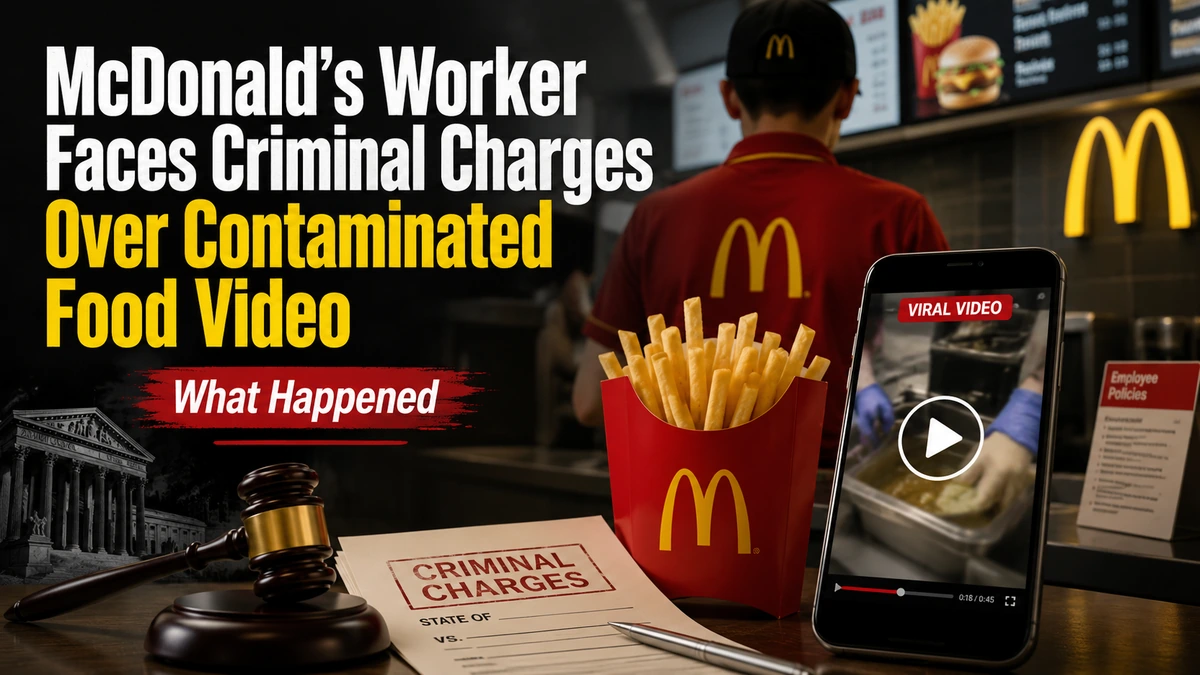
I find this case disturbing for a simple reason: restaurant customers place enormous trust in employees they may never see preparing their meals. That trust became the center of a criminal case in Southbridge, Massachusetts, after a viral video appeared to show a McDonald’s employee putting French fries in her mouth before placing them into a serving carton. Police later alleged that surveillance footage showed even more contamination, and the former manager accused in the case eventually appeared in court and pleaded not guilty.
The headline “McDonald’s Worker Faces Criminal Charges Over Contaminated Food Video” describes only the beginning of what became a more detailed legal story. The employee was identified in court reporting as Kaylie Santos, 22, a former night manager at the Southbridge restaurant. By June 5, 2026, Boston 25 News reported that Santos faced two counts of distributing food with a harmful substance after a second person came forward and said he had shared the allegedly contaminated fries. Santos pleaded not guilty.
As of September 3, 2026, I have not found a reliable publicly indexed report establishing the outcome of the pretrial hearing that news organizations said was scheduled for July 31. That distinction matters. A responsible account should report the charges and allegations accurately without presenting an accusation as a conviction.
Key Takeaways From the McDonald’s Contaminated Food Case
Several verified facts help separate the actual court case from the more sensational versions circulating online.
- Kaylie Santos, 22, was identified as a former night manager at a McDonald’s restaurant in Southbridge, Massachusetts.
- Police said the incident occurred on April 9, 2026, at the East Main Street restaurant.
- Investigators alleged that Santos put French fries in her mouth and that surveillance footage showed her spitting into a fry carton before the food was served.
- The intended recipient was reported to have had a previous relationship with Santos.
- The customer reportedly ate the fries before learning about the alleged contamination.
- Restaurant ownership suspended and later terminated the employees involved.
- Santos initially faced a charge of distributing food with a harmful substance.
- By her June 5 arraignment, Boston 25 reported that a second alleged victim had resulted in a second count.
- Santos pleaded not guilty and was released subject to court conditions.
- Massachusetts law allows imprisonment of up to five years for distributing food containing a foreign substance intended or reasonably expected to cause injury.
- No conviction should be inferred from the viral video, police allegations, or filing of charges.
- The latest reliable public reports I found do not confirm the result of the July 31 pretrial hearing.
In my view, the most important point is that this is no longer simply a viral workplace misconduct story. Once investigators alleged that contaminated food was knowingly handed to people who then consumed it, the matter entered a substantially different legal category.
What Happened in the Viral McDonald’s Food Contamination Video?
The case first drew widespread attention after a short video circulated on social media. Reporting from Boston.com and other Massachusetts outlets described footage that appeared to show an employee taking French fries, putting them into her mouth, and placing them into a McDonald’s fry container.
Southbridge police said they received numerous calls, tips, and media inquiries after the video became widely shared. Authorities began working with the town’s Board of Health and restaurant management to determine whether the food shown in the recording had actually been served to somebody.
That question was crucial. An offensive or unsanitary video created for social media can result in disciplinary consequences, but allegations that intentionally contaminated food was actually delivered to a customer can create much more serious legal exposure.
Investigators subsequently obtained restaurant surveillance footage and records. According to court-document reporting, police said the footage showed Santos spitting into an empty fry carton, putting fries into her mouth, placing them in the carton, and eventually handing a takeout bag through the drive-thru.
The customer was later identified through the investigation. Police reports cited by news organizations said she had previously been in a relationship with Santos. Reporting also said the customer had not ordered French fries but accepted the food when it was handed to her and ate some before discovering the viral recording.
That sequence transformed the meaning of the video. In my analysis, investigators were no longer dealing only with questionable employee behavior recorded inside a restaurant. They were examining whether food had been deliberately altered and then distributed to a specific person.
How Police Connected the Video to an Alleged Victim
The investigation demonstrates how digital evidence can become only one part of a larger criminal inquiry.
Court-record reporting indicates that investigators did not simply rely on the social media clip. The restaurant’s ownership cooperated with law enforcement, supplied surveillance recordings, and helped identify the employee depicted in the viral footage. Reports said management reviewed a large amount of surveillance material while determining when the incident occurred and whether the food left the restaurant.
Police then used information connected with the drive-thru transaction to identify the customer. The investigation reportedly established that the food was handed to a woman who had previously dated Santos.
This is an important distinction for readers evaluating viral evidence. A social media video can attract attention, but investigators normally need additional evidence to establish identity, timing, location, recipients, and what happened before and after the portion captured in a short clip.
Why Restaurant Surveillance Became Important
A viral clip may last only seconds and may lack context. Restaurant surveillance can potentially show a much longer sequence, including employee movements, drive-thru interactions, transactions, and whether a particular food container was actually handed to somebody.
According to Boston.com, the restaurant surveillance allegedly showed Santos spitting into an empty fry carton before the actions shown in the viral recording and later transferring the carton into an order that went through the drive-thru.
From my perspective, that additional footage appears to have been central to the criminal complaint because it allegedly connected the contamination itself to the later distribution of the food.
Timeline of the McDonald’s Worker Criminal Charges
The following timeline shows how the story developed from an alleged April incident to a June court appearance.
| Date | Reported Development | Why It Matters |
|---|---|---|
| April 9, 2026 | The alleged contamination occurred at the Southbridge McDonald’s | This is the incident underlying the criminal case |
| Early May 2026 | The video circulated widely online | Public attention brought the recording to police and health officials |
| May 7, 2026 | Police were reported to have become aware of the viral video | The formal investigation began |
| May 2026 | Restaurant ownership and police reviewed surveillance footage | Investigators sought to establish whether the food was served |
| May 18, 2026 | Court-document reporting identified Santos and a criminal charge | The matter formally moved into the court system |
| June 5, 2026 | Santos appeared in Dudley District Court | She pleaded not guilty |
| June 5, 2026 | Boston 25 reported two counts after a second alleged victim came forward | The reported scope of the prosecution expanded |
| July 31, 2026 | A pretrial hearing had been scheduled | I found no reliable indexed report confirming its outcome |
| September 3, 2026 | Latest status checked for this article | The publicly verifiable record remains incomplete regarding the July hearing |
The most significant change in this timeline occurred between the initial complaint and the June arraignment. Earlier reports described one charge, while Boston 25 reported on June 5 that Santos faced two counts after another person said he had been in the car and shared the fries.
What Criminal Charges Does the Former McDonald’s Manager Face?
The charge reported in this case is commonly described as distributing food with a harmful substance.
Massachusetts General Laws Chapter 270, Section 8A addresses the distribution or sale of food containing a foreign substance that is intended or may reasonably be expected to cause injury. The Massachusetts Legislature’s published text states that a violation can be punished by imprisonment in state prison for up to five years.
The statutory language is worth reading because it explains why an allegation involving something as ordinary as French fries can potentially become a felony-level criminal matter.
“shall be punished by imprisonment in the state prison for not more than five years.”
Massachusetts General Laws, Chapter 270, Section 8A
I would not interpret that provision to mean Santos will receive a five-year sentence. A statutory maximum describes the punishment permitted by law, not the sentence a particular defendant will necessarily receive. Santos has pleaded not guilty, and sentencing becomes relevant only if there is a conviction or another court disposition carrying criminal consequences.
Why Two Counts Were Reported
When Santos was arraigned on June 5, Boston 25 reported that a second person had contacted police and said he was in the vehicle with the initial alleged victim and shared the contaminated fries. The station reported that Santos consequently faced two counts and pleaded not guilty to both.
Some other June reporting still referred to one count. That difference appears to reflect the timing and scope of individual reports rather than necessarily a contradiction about the original allegation. For the latest court status I could verify, I would use the June 5 Boston 25 account specifying two counts, while making the date of that information clear.
Santos Pleaded Not Guilty at Her June 5 Arraignment
A criminal charge is an allegation, and this case requires the same presumption of innocence that applies to other criminal defendants.
Santos appeared in Dudley District Court on June 5 and entered not-guilty pleas. Boston 25 reported that her conditions included no contact with the alleged victims and a prohibition on working in the food industry. Other local coverage reported that she was released on personal recognizance.
That court appearance is important because online discussion often continues to describe viral-video subjects as though guilt has already been legally established. It has not.
Investigators may believe a video, surveillance recordings, witness statements, and other evidence support criminal charges. Prosecutors still have to prove the elements required by law if the case proceeds to trial, unless the case ends through some other lawful resolution.
Why the Alleged Victim’s Relationship With Santos Matters
News reports described the first alleged victim as a former romantic partner of Santos. Court-document reporting said the two had dated for approximately two years and that investigators believed personal conflict may have provided a motive for the alleged conduct.
Motive can help explain why investigators believe an alleged act occurred, but it should not be confused with proof of every element of a criminal charge.
The distinction matters because the viral video became widely discussed as a general food-safety scare. Police and restaurant representatives, however, reportedly viewed the episode as targeted rather than evidence of widespread contamination affecting ordinary customers.
The franchise owners said local health officials did not identify a broader public health concern associated with the restaurant after the investigation.
From what the available evidence shows, readers should therefore avoid two opposite errors. The first would be minimizing an allegation of intentional contamination because only a small number of people may have been targeted. The second would be suggesting without evidence that the restaurant’s wider customer base was exposed to contaminated food.
McDonald’s Franchise Owners Responded to the Video
The local franchise ownership publicly rejected the behavior shown in the footage and said the employees involved were no longer employed.
Their response directly addressed the concern that customers might interpret the incident as representative of normal restaurant practices.
“The actions of these individuals are unacceptable and do not reflect our organization’s food safety standards or values.”
Spadea and Balducci families, Southbridge McDonald’s owners/operators
The owners said the employees involved were suspended after management learned of the incident and were later terminated following an internal review. They also said the organization cooperated with local authorities and the health department.
I think that distinction between individual conduct and institutional procedure is important. A restaurant can have food-safety policies, training, supervision, and sanitation systems, yet intentional employee misconduct can still occur. The organizational question then becomes how rapidly management detects the problem, protects customers, preserves evidence, informs regulators, and takes corrective action.
Why Putting Food in Someone’s Mouth Creates a Serious Safety Concern
French fries are generally served as ready-to-eat food. Once prepared, they are normally handed to customers without another cooking step capable of reducing contamination introduced immediately before service.
FDA retail food-safety materials emphasize preventing employees from touching exposed ready-to-eat foods with bare hands. The FDA recommends appropriate utensils, gloves, deli tissue, tongs, or dispensing equipment because employee contact can transfer microorganisms to food.
Intentional mouth contact is substantially different from an accidental handling mistake. Saliva and direct mouth contact introduce obvious hygiene concerns, and deliberately returning food from a person’s mouth to a customer’s container bypasses ordinary barriers intended to protect ready-to-eat food.
The FDA’s broader guidance explains that employee hygiene practices such as handwashing, illness reporting, and avoiding bare-hand contact with ready-to-eat foods are designed to reduce transmission of viruses and bacteria.
This does not mean the reporting has established that anybody became ill in the Southbridge case. I found no reliable report stating that the alleged victims suffered a confirmed foodborne illness. The criminal allegation concerns the intentional distribution of allegedly contaminated food, not a publicly documented disease outbreak.
Normal Food Safety Failure Versus Alleged Intentional Contamination
The distinction between an ordinary hygiene mistake and deliberate contamination helps explain why this case received both regulatory and criminal attention.
| Situation | Typical Concern | Possible Response |
|---|---|---|
| Employee accidentally touches ready-to-eat food | Cross-contamination risk | Discard food, retraining, sanitation procedures |
| Employee fails to change gloves appropriately | Hygiene and pathogen-transfer risk | Corrective training and management action |
| Sick employee handles food | Potential transmission of foodborne pathogens | Employee restriction or exclusion under applicable rules |
| Employee deliberately places food in mouth and returns it | Intentional contamination and serious hygiene risk | Management action, investigation, possible law enforcement involvement |
| Contaminated food is allegedly given to a targeted customer | Public-health and potential criminal issue | Evidence preservation, police investigation, court proceedings |
In my view, the central difference is intent combined with distribution. Restaurant safety systems generally assume employees are trying to follow procedures even when errors occur. Deliberate contamination represents a breakdown not only of sanitation rules but also of the basic trust on which food service depends.
What Restaurant Managers Should Do When a Contamination Video Appears
Although every incident is different, this case illustrates a practical sequence that food businesses can consider when credible evidence of deliberate contamination emerges.
1. Remove Potentially Involved Employees From Food Handling
The immediate priority is preventing additional potentially contaminated food from being served. Depending on the facts, management may need to remove workers from food preparation while an internal investigation occurs.
The Southbridge franchise ownership said the employees involved were suspended after the incident came to management’s attention.
2. Preserve Video and Transaction Records
Security footage, shift records, drive-thru timestamps, receipts, staffing schedules, and digital communications may help establish exactly what happened.
Deleting or overwriting surveillance before investigators review it could make an already serious incident far harder to reconstruct.
3. Identify Potentially Affected Orders
Managers should determine whether questionable food remained inside the restaurant or was actually served. Transaction and surveillance information can help narrow the time period and identify affected customers when possible.
In the Southbridge case, investigators reportedly used surveillance to connect the allegedly contaminated carton with a vehicle at the drive-thru.
4. Notify Appropriate Health Authorities
Food establishments operate under state and local regulatory systems. Managers should follow applicable reporting requirements and cooperate with health officials when intentional contamination or a possible public-health risk is identified.
Southbridge police said early in the investigation that the matter was being addressed with the Board of Health and restaurant management.
5. Consider Law Enforcement When Conduct May Be Criminal
Not every sanitation mistake belongs in criminal court. Intentional contamination intended for another person, however, can potentially implicate criminal statutes.
Restaurant operators should preserve evidence and let appropriate authorities determine whether criminal investigation is warranted rather than attempting to conduct their own quasi-criminal inquiry.
6. Communicate Carefully With Customers
A business should explain verified facts without minimizing legitimate concerns or making accusations beyond what evidence supports.
This is particularly important when a social media video has already reached a large audience. Silence may allow rumors to grow, while speculative statements can create additional problems.
Common Misconceptions About the Viral McDonald’s Case
One misconception is that the viral video itself proves the criminal charge. It does not. The video may be important evidence, but prosecutors must rely on admissible evidence and satisfy the applicable burden of proof.
Another misconception is that Santos has been convicted. She has not, based on the latest reliable public court reporting I found. She pleaded not guilty on June 5.
A third misconception is that a five-year statutory maximum means she automatically faces a five-year sentence. Massachusetts law provides up to five years for the offense described in Section 8A, but sentencing depends on the eventual legal disposition and other factors.
A fourth misconception is that the video established a restaurant-wide health emergency. The local franchise owners said health officials found no broader public-health concerns or violations connected with their review of the incident.
Finally, it would be inaccurate to claim that the entire case involved only one alleged victim without acknowledging the June 5 update. Boston 25 reported that another person said he shared the fries and that Santos consequently faced two counts at her arraignment.
What the Case Shows About Viral Videos and Criminal Evidence
Social media dramatically accelerated this story. A video originally associated with a private social account was copied, circulated publicly, and eventually drew enough attention to prompt community complaints and police scrutiny.
But virality and evidentiary reliability are different things.
A clip can reveal conduct worth investigating while still leaving unanswered questions. When was it recorded? Who appears in it? Was the food discarded afterward? Was it handed to a customer? Who received it? Was the clip edited? Is there independent surveillance?
The Southbridge investigation reportedly answered several of those questions using restaurant records and surveillance. That progression provides a useful example of the difference between online evidence and a complete investigation.
Based on the available reporting, the restaurant surveillance appears especially important because investigators said it showed activity before and after the short viral recording.
For readers, there is a broader lesson. Sharing a disturbing video is easy. Determining precisely what it proves requires much more care.
How Businesses Can Reduce the Risk of Intentional Food Tampering
No training system can completely eliminate deliberate misconduct, but restaurants can reduce risk through layered controls.
Clear food-safety expectations are the starting point. Employees need to understand that hygiene requirements are not optional operational preferences. FDA guidance emphasizes handwashing, employee health policies, and controls against direct contact with ready-to-eat food.
Supervision also matters. Managers themselves often have elevated access and authority, which means organizations need accountability systems that apply at every level rather than relying entirely on supervisors to police frontline employees.
Video surveillance can provide another layer of deterrence and evidence, although cameras do not replace training or responsible management.
Businesses should also maintain credible reporting channels. If a coworker observes deliberate contamination, reporting should be easier and safer than remaining silent.
Finally, incident response procedures should be established before a crisis occurs. Managers should know whom to contact, how to isolate food, where surveillance is stored, which health authority has jurisdiction, and who is authorized to communicate publicly.
Why Due Process Still Matters in a Disturbing Case
Cases involving food contamination produce strong emotional reactions because eating requires vulnerability and trust.
That emotional response makes careful language particularly important.
News reports can accurately state that police allege Santos spit into a carton and placed fries from her mouth into it. They can report that surveillance allegedly shows the contaminated fries being served. They can state that two charges were reported at arraignment.
What responsible reporting should not do is substitute “did” for “allegedly did” when discussing disputed criminal conduct before conviction.
Santos pleaded not guilty. That plea means the charges remained contested at the June 5 proceeding.
The alleged victim’s attorney described the seriousness of the experience during court coverage:
“I can’t imagine going to a fast food restaurant and having an ex-partner serve my client french fries that were spit upon.”
Christopher Monroy, attorney for the initial alleged victim
The statement captures why the allegations attracted such intense attention, but emotional impact does not remove the prosecution’s burden to establish criminal liability through the legal process.
What Was Known About the Court Case as of September 3, 2026?
The latest reliable publicly indexed reporting I found establishes several points with confidence.
Santos appeared in Dudley District Court on June 5, pleaded not guilty, and faced court-imposed restrictions. Boston 25 reported that she faced two counts after a second alleged victim came forward. The next hearing was scheduled for July 31.
I did not find a reliable indexed news report confirming what occurred at that July 31 proceeding.
That does not establish that the hearing was canceled, completed, continued, or resolved in any particular way. It simply means I cannot responsibly claim an outcome from the reliable public sources located for this article.
This limitation is particularly important for websites updating older breaking-news stories. An article published in May saying an employee “will face charges” is now outdated because an arraignment occurred. But replacing it with an unsupported claim about conviction, dismissal, sentencing, or a later hearing would create a new accuracy problem.
Conclusion
The McDonald’s Worker Faces Criminal Charges Over Contaminated Food Video story is a strong example of how quickly a viral clip can move from social-media outrage to a formal criminal investigation. What initially appeared to show an employee placing fries in her mouth became more serious when investigators alleged that surveillance footage showed intentional contamination and that the food was then handed through a drive-thru and consumed.
What stands out to me is the importance of separating three different issues: restaurant food safety, the evidence gathered by investigators, and the defendant’s legal status. The alleged conduct is serious, and Massachusetts law provides substantial penalties for distributing food containing an injury-causing foreign substance. At the same time, Santos pleaded not guilty, so charges should not be described as a conviction.
For readers following the case, the best next step is to rely on dated court reporting rather than viral reposts. As of September 3, 2026, the June 5 arraignment remains the latest court development I could verify through reliable publicly indexed sources.
READ: United Airlines Flight UA82 Emergency: What Really Happened?
Frequently Asked Questions
Why Is the McDonald’s Worker Facing Criminal Charges Over the Contaminated Food Video?
The former McDonald’s manager faces charges because investigators allege the incident went beyond recording unsanitary behavior. Police reportedly reviewed restaurant surveillance and concluded that contaminated French fries were placed in an order and handed to a drive-thru customer who later ate them. Massachusetts has a specific law covering the distribution of food containing a foreign substance that is intended or reasonably expected to cause injury. Santos pleaded not guilty to the charges reported at her June 5 arraignment.
What Did the McDonald’s Contaminated Food Video Show?
The viral recording appeared to show Santos taking French fries, putting them into her mouth, and placing them into a serving carton. Police later alleged that separate restaurant surveillance footage showed her spitting into the carton as well. Investigators said the food was subsequently placed into a takeout order and handed through the drive-thru. Because the case is pending based on the latest court reporting available to me, those actions should continue to be described as allegations rather than judicially proven facts.
What Charges Does Kaylie Santos Face?
Boston 25 reported on June 5, 2026, that Santos faced two counts of distributing food with a harmful substance after a second person said he shared the allegedly contaminated fries. Earlier May reports described one count, so the date of the reporting matters when describing the number of charges. Santos entered not-guilty pleas at her arraignment. Massachusetts General Laws Chapter 270, Section 8A provides for imprisonment of up to five years for violating the food-contamination provision.
Was the McDonald’s Employee Convicted?
No conviction was established in the latest reliable court reporting I located. Santos pleaded not guilty at her June 5 arraignment and was released subject to court conditions. A pretrial hearing was reported as scheduled for July 31, but I did not locate reliable publicly indexed reporting confirming the outcome of that hearing as of September 3, 2026. It would therefore be inaccurate to describe Santos as convicted based only on the viral recording or the criminal complaints.
Could the McDonald’s Worker Receive Five Years in Prison?
Massachusetts General Laws Chapter 270, Section 8A states that a person convicted under the provision may be imprisoned in state prison for no more than five years. That is a statutory maximum, not a prediction of what Santos will receive. She pleaded not guilty, and no sentence should be assumed unless the case results in a conviction or another disposition involving sentencing. The consequences can depend on the final charges, court findings, and other legal factors.
Did Other McDonald’s Customers Receive Contaminated Food?
The reporting I reviewed does not establish a broader pattern of contaminated food being served to the general public at this restaurant. Police initially described the episode as apparently targeted, and franchise ownership said the local health department found no broader public-health concerns or violations arising from its review. A second person later told police that he shared the same allegedly contaminated fries, leading Boston 25 to report an additional count. Readers should distinguish that second alleged victim from evidence of unrelated customers receiving other contaminated orders.
What Happened to the Employees Seen in the Video?
The Southbridge McDonald’s franchise owners said the employees connected with the incident were suspended after management learned about it and later were no longer employed following an internal review. The owners condemned the conduct and said they cooperated with police and local health officials. The employment response is separate from the criminal case, which concerns Santos specifically and remains subject to normal criminal-court procedures.
Why Are Food Safety Rules So Strict About Ready-to-Eat Food?
Ready-to-eat food may reach the customer without another cooking step that could reduce microorganisms introduced during final handling. FDA materials therefore discourage bare-hand contact with exposed ready-to-eat foods and recommend gloves, utensils, deli tissue, tongs, or other appropriate equipment. These controls are designed to reduce contamination and the transmission of foodborne pathogens. Intentional mouth contact with food intended for a customer falls far outside normal safe-handling practices.
Sources
- Massachusetts Legislature, General Laws Chapter 270, Section 8A: Official statutory language governing food containing foreign injury-causing substances.
- Boston 25 News, June 5, 2026: Court reporting on Santos’ not-guilty pleas, the reported second count, bail conditions, and scheduled July 31 hearing.
- Boston.com, June 5, 2026: Reporting on the arraignment, allegations contained in police records, release on personal recognizance, and possible statutory penalty.
- NBC10 Boston, May 18, 2026: Reporting on police allegations concerning the fry carton and criminal charge.
- People, May 2026: Reporting on the police investigation, franchise response, employee terminations, and local health review.
- U.S. Food and Drug Administration: Retail food protection and employee hygiene guidance concerning ready-to-eat food and contamination prevention.
Disclaimer
This article is provided for news, educational, and informational purposes and is not legal advice. Criminal charges are allegations, and a defendant is presumed innocent unless and until guilt is established through the legal process. Court status can change after publication. The case information above reflects reliable publicly available reporting I was able to verify through September 3, 2026, and I did not find reliable publicly indexed reporting establishing the result of the pretrial hearing that had been scheduled for July 31.

When I examine the United Airlines Flight UA82 emergency, the most important detail is also the simplest: the Boeing 787-9 returned safely to Newark Liberty International Airport after the crew encountered a reported technical problem during a flight to New Delhi. The aircraft had already departed, climbed to cruise altitude, and traveled northeast before the pilots declared an emergency and turned back toward Newark. Contemporary reporting places the event on the night of July 6, 2025, in Newark local time, which was already July 7 in UTC.
I think that date distinction matters because a surprising amount of online coverage creates confusion about whether the emergency happened on July 6 or July 7. Both dates can appear without either necessarily being wrong. Flight information recorded in UTC shows July 7, while the aircraft’s departure from Newark occurred late on July 6 Eastern Daylight Time. The emergency should therefore be understood as one incident spanning those two calendar dates depending on the time zone used.
Another point deserves equal attention. The publicly reported maintenance message included the wording “EE COOLING OPS (1)”, which aviation coverage connected to equipment or electronics cooling. I would not describe that message as proof of a catastrophic avionics failure, engine failure, or imminent crash. It is evidence of a technical indication serious enough that the crew chose to discontinue a very long international flight and return to a major maintenance base. That distinction gives us a much more accurate picture of what happened.
Key Takeaways From the UA82 Emergency
From the available evidence, these are the facts I consider most useful for understanding the incident:
- United Airlines Flight UA82 was operating from Newark Liberty International Airport to Indira Gandhi International Airport in Delhi.
- The aircraft involved was reported as a Boeing 787-9 Dreamliner with registration N23983.
- The aircraft climbed to approximately 33,000 feet before the crew turned back.
- Contemporary flight tracking coverage reported that the aircraft transmitted the emergency transponder code 7700.
- Aviation reporting reproduced an ACARS maintenance message containing the phrase “EE COOLING OPS (1).”
- The aircraft returned to Newark and landed safely.
- No injuries were reported in the sources reviewed.
- The available evidence does not establish an engine failure, decompression, uncontrolled descent, or near-crash.
- The July 2025 emergency should not be confused with the status of a later flight using the same UA82 flight number.
In my analysis, the strongest interpretation is that UA82 experienced a technical condition that the pilots considered unsuitable for continuing a long overwater journey. The emergency declaration gave the crew priority and support while they returned to Newark. The safe outcome is not evidence that the initial problem was insignificant. It shows why aviation crews have procedures that allow them to act before an abnormal indication develops into something more serious.
What the United Airlines Flight UA82 Emergency Was
United Airlines Flight UA82 is associated with a long-haul route between Newark Liberty International Airport in New Jersey and Indira Gandhi International Airport in Delhi, India. Flight tracking services continue to list UA82 on the Newark-to-Delhi route, which is why people searching the flight number today may encounter both ordinary current flight information and stories about the 2025 emergency.
During the incident, AIRLIVE reported that the aircraft left Newark at approximately 9:21 p.m. EDT and was cruising at 33,000 feet roughly an hour into the flight when its pilots declared an emergency. The Boeing 787-9, identified as N23983, then reversed course over the Gulf of Maine. The publication subsequently confirmed that the aircraft was returning to Newark because of a technical issue.
Aviation A2Z reported similar fundamental details. Its coverage identified the aircraft as N23983, described the return as related to a mechanical issue, and reported that the aircraft landed back at Newark at approximately 11:15 p.m. local time. Its report also reproduced the ACARS message that has become central to discussions of the incident.
I would describe the event as an emergency return after departure, rather than an aborted takeoff. The aircraft was already airborne and had reached approximately FL330, or 33,000 feet. That distinction may sound minor, but it changes the meaning of the event considerably. An aborted takeoff happens before an aircraft becomes established in flight. UA82 had already entered the en-route phase before reversing course.
United Airlines Flight UA82 Emergency Timeline
The timeline below combines the most consistently reported facts from contemporaneous aviation coverage. Exact minute-by-minute times can differ slightly between tracking sources, so I regard the overall sequence as more important than small timestamp differences.
| Stage | Reported Detail | Why It Matters |
|---|---|---|
| Departure | UA82 departed Newark late on July 6, 2025 local time | Establishes that the event began July 6 EDT but continued into July 7 UTC |
| Initial climb | Boeing 787-9 climbed to around 33,000 feet | Confirms the aircraft was well beyond takeoff when the problem developed |
| Technical indication | Reporting reproduced an ACARS message containing “EE COOLING OPS (1)” | Points toward an equipment/electronics cooling-related indication |
| Emergency declaration | Flight tracking reports showed squawk 7700 | Signaled an emergency condition to air traffic services |
| Turnaround | Aircraft reversed course over the Gulf of Maine | Crew chose Newark rather than continuing the transatlantic journey |
| Approach | UA82 returned toward Newark under emergency handling | Allowed access to airport, airline, maintenance, and emergency resources |
| Landing | Aircraft landed safely back at Newark | The flight ended without a reported accident |
| Passenger outcome | No injuries were reported in the reviewed coverage | Separates the technical emergency from claims of a crash or passenger casualties |
What stands out to me is how orderly the sequence appears. There was no publicly reported uncontrolled descent or loss of the aircraft. Instead, the data describes a climb, identification of a problem, an emergency declaration, a course reversal, and a controlled return. That is exactly why interpreting the word “emergency” without context can produce unnecessarily dramatic conclusions.
Why UA82 Squawked 7700
One detail that attracted significant attention was the reported use of transponder code 7700. Some readers see that number on a flight-tracking website and assume it means the aircraft is moments from crashing. That is not what the code tells us.
The Federal Aviation Administration’s Aeronautical Information Manual explains that when a distress or urgency condition exists, a pilot seeking to alert radar facilities should use Mode 3/A Code 7700 and establish communication with air traffic control. The FAA also notes that 7700 normally triggers an alarm or special indication at controller positions.
The FAA’s language is useful here:
“Code 7700/Emergency”
Federal Aviation Administration, Aeronautical Information Manual
I interpret that designation as a request for appropriate emergency handling, not as a diagnosis of the aircraft’s mechanical condition. Code 7700 tells controllers that the flight needs emergency priority or attention. It does not tell the public whether the problem involves an engine, a medical situation, smoke, electrical equipment, flight controls, or another condition.
FAA guidance also recognizes that aviation emergencies vary considerably. Its air traffic procedures state that because possible situations are so varied, a single specific response cannot be prescribed for every emergency. Controllers and crews instead respond according to the circumstances.
That principle is particularly important when interpreting UA82. A technical system indication before an extended ocean crossing may justify an emergency return even when the aircraft remains controllable. Declaring early can create more options for the crew rather than fewer.
What the Reported “EE COOLING OPS (1)” Message Means
The most discussed technical clue from UA82 is an ACARS message reproduced by Aviation A2Z. The message identifies UAL82, registration N23983, the Newark-to-Delhi routing, and the phrase “EE COOLING OPS (1).”
ACARS, or the Aircraft Communications Addressing and Reporting System, allows operational and maintenance-related information to move between an aircraft and ground systems. In this case, aviation publications interpreted the message as pointing toward an equipment or electronics cooling condition.
I think the safest wording is reported electronics-equipment cooling indication. That phrasing reflects what is actually visible in the reproduced maintenance data without pretending that a short maintenance message is equivalent to a complete engineering investigation.
Why Equipment Cooling Matters on a Modern Airliner
Modern passenger aircraft contain extensive electronic equipment that supports navigation, communication, flight management, monitoring, displays, and other functions. Electronic equipment produces heat, so aircraft systems must keep relevant components within acceptable operating conditions.
A cooling-related warning can therefore matter even if passengers inside the cabin notice nothing unusual. The problem does not have to produce smoke, noise, vibration, or an engine shutdown to deserve serious attention.
For a simple hypothetical example, imagine a computer server room in which one cooling circuit reports an abnormal condition. The computers may still be operating normally at that moment, but an operator would not necessarily choose to ignore the warning and run the system at maximum load for another 14 hours. Aviation is far more regulated and redundant than that analogy, but the basic risk-management idea helps explain why crews respond conservatively to unresolved technical indications.
Why the ACARS Message Does Not Prove Total Avionics Failure
This is where I believe some online explanations become too confident. A maintenance indication referring to cooling does not, by itself, demonstrate that cockpit screens went blank, navigation was lost, communications failed, or the aircraft became uncontrollable.
The publicly available reports I reviewed do not establish those claims. Aviation A2Z connects the message with equipment cooling, while more recent summaries correctly caution that the exact engineering failure should not be inferred beyond the information available in public reporting.
There is also no credible evidence in the reviewed sources that UA82 suffered an engine failure during this event. The reproduced maintenance information points elsewhere.
For readers, the practical lesson is straightforward. A maintenance message can tell us what system family generated attention, but it should not be treated as a complete root-cause report unless the airline, manufacturer, regulator, or investigating authority publishes findings supporting that conclusion.
How UA82 Returned Safely to Newark
After the emergency was declared, flight tracking coverage showed UA82 reversing course over the Gulf of Maine and flying back toward Newark. AIRLIVE provided successive updates as the aircraft returned and approached the airport.
A short contemporaneous update captures the outcome clearly:
“Touch down on runway 22L, almost 2 hours after takeoff.”
AIRLIVE
That sentence matters because it separates what actually occurred from the dramatic possibilities people sometimes attach to an emergency declaration. The aircraft did not disappear from tracking or make an uncontrolled landing. It reached Newark after nearly two hours in the air and completed the return.
Aviation A2Z reported a safe landing at approximately 11:15 p.m. local time and said passengers and crew disembarked at Terminal C.
From my perspective, Newark was also a logical destination once the crew decided not to continue. It was the departure airport, a major United hub, and a place where the airline could access ground staff and maintenance support. We do not need to invent a more dramatic explanation for the decision when the operational logic is already strong.
What We Know Versus What Online Claims Sometimes Suggest
The following comparison helps separate supported information from claims that go beyond the available evidence.
| Claim | What the Evidence Supports | My Assessment |
|---|---|---|
| UA82 declared an emergency | Yes, contemporary tracking coverage reported squawk 7700 | Well supported |
| UA82 returned to Newark | Yes | Well supported |
| The aircraft was a Boeing 787-9 | Yes | Well supported |
| Registration was N23983 | Yes | Well supported |
| A cooling-related maintenance message appeared | Yes, reproduced reporting shows “EE COOLING OPS (1)” | Supported as a reported indication |
| The aircraft suffered an engine failure | Not established by reviewed sources | Do not state as fact |
| The aircraft lost all avionics | Not established | Unsupported |
| UA82 almost crashed | Not established | Sensational characterization |
| The aircraft aborted takeoff | No, it had climbed to about 33,000 feet | Incorrect description |
| Passengers were injured | No injuries were reported | Unsupported |
| Every later UA82 flight is affected | No, flight numbers are reused | Incorrect inference |
I find this table especially important because aviation stories often spread through rewritten articles, social posts, and search snippets. Each retelling can make a technical warning sound more severe. By the time a reader encounters the story, “equipment cooling indication” may have turned into “total electronics failure” even though no source actually demonstrates that progression.
Why Returning Was a Sensible Long-Haul Decision
A Newark-to-Delhi flight is not a short domestic sector where the aircraft remains close to multiple airline bases throughout the journey. It is a long international operation that would take the aircraft across the Atlantic and onward for many hours.
When a technical warning emerges near the beginning of such a flight, the decision is not simply whether the aircraft can continue flying at that moment. Crews must consider whether continuing remains appropriate for the entire planned journey.
That difference is easy to overlook.
Consider a hypothetical scenario. An aircraft is one hour into a 14-hour flight and displays an unresolved system warning. The crew still has reliable flight controls, stable engines, and normal cabin conditions. A passenger might ask, “If everything still works, why turn around?” From an operational standpoint, however, the more useful question is whether it is prudent to spend another 13 hours moving farther from the airline’s maintenance resources with the condition unresolved.
I believe the UA82 return makes sense when viewed through that lens. A safe return can be a preventive decision rather than evidence that the aircraft was already in immediate physical danger.
FAA guidance reinforces the broader principle that emergency handling depends on the situation rather than one rigid set of circumstances. Air traffic personnel are instructed to respond appropriately when an emergency exists or appears imminent.
What Passengers Can Expect During an Emergency Return
Passengers experiencing an emergency return may receive relatively little technical information while the aircraft is airborne. That is not necessarily evidence that the crew does not understand the situation.
The flight deck’s immediate priorities are to manage the aircraft, complete applicable procedures, communicate with air traffic control and company operations, assess available airports, and prepare for the landing. Cabin crew members also have safety duties that may take priority over providing a detailed technical explanation.
From a passenger’s perspective, several things may occur:
- The seatbelt sign may remain illuminated for an extended period.
- Cabin crew may suspend or stop normal service.
- The captain may announce that the aircraft is returning because of a technical issue.
- Emergency vehicles may be visible near the runway after landing.
- Passengers may be asked to remain seated while the aircraft is assessed.
- The aircraft may return to a gate normally rather than requiring an evacuation.
- The original flight may be delayed, cancelled, or operated later with a different aircraft.
An important point is that the presence of airport fire or rescue vehicles does not prove there was a fire. Airports routinely position emergency resources when an aircraft declares an emergency because having equipment ready is safer than waiting until after landing to decide whether it is needed.
What UA82 Passengers Should Do After a Technical Return or Cancellation
Although the historical passengers on UA82 would have dealt with the airline at the time, the incident raises a practical question for any traveler facing a similar disruption. I recommend focusing on documentation, rebooking options, and the reason for the disruption rather than relying only on verbal announcements.
Step 1: Save the Original Itinerary
Keep your boarding pass, booking confirmation, original departure time, seat information, and any paid extras. Screenshots can be useful because airline apps sometimes update an itinerary after rebooking, making the original schedule harder to reconstruct.
Step 2: Record the Airline’s Stated Reason
If the app, text notification, gate screen, or representative identifies the cause as maintenance or another airline-controlled issue, keep a record.
The reason matters because some customer-service commitments apply specifically to controllable delays and cancellations.
Step 3: Review the Rebooking Offered
A replacement flight may be the fastest way to complete your journey. However, compare its departure time, connections, destination airport, and cabin before accepting automatically.
On an international journey such as Newark to Delhi, a replacement routing through another city can substantially change the travel experience.
Step 4: Know When Refund Rights May Apply
Under current U.S. Department of Transportation rules, passengers can be entitled to a refund when a flight is cancelled or significantly changed and they do not accept the alternative transportation or compensation offered. For international flights, DOT defines certain schedule changes of six hours or more as significant, alongside other specified changes.
The DOT summarized the principle memorably when announcing its refund rule:
“Passengers deserve to get their money back when an airline owes them.”
U.S. Department of Transportation, quoting then-Transportation Secretary Pete Buttigieg
I would not interpret that as meaning every emergency diversion automatically produces a cash refund. The passenger’s eventual itinerary, whether the flight is cancelled or significantly changed, whether alternative travel is accepted, and the applicable regulations all matter.
Step 5: Ask About Meals or Hotels When Appropriate
The DOT Airline Cancellation and Delay Dashboard currently lists United as committing to several forms of assistance for controllable cancellations and significant controllable delays. These include rebooking on United at no additional cost, rebooking on a partner or another airline with which United has an agreement, meals for qualifying waits, and hotel accommodation for qualifying overnight disruptions.
Because commitments and regulations can change, I recommend checking the live DOT dashboard and the airline’s current policy at the time of travel rather than relying on an old article.
Step 6: Keep Receipts
If circumstances force you to purchase food, transportation, or accommodation yourself, save itemized receipts.
Whether reimbursement applies will depend on the disruption, airline policy, commitments, and individual circumstances, but missing documentation makes any later claim harder.
Step 7: Separate Safety Decisions From Customer-Service Questions
A flight crew’s decision to return is fundamentally a safety and operational decision. Rebooking, hotels, refunds, and compensation are separate passenger-service matters.
Keeping those two issues distinct helps avoid a common misconception: the airline does not need to prove that an aircraft was about to crash before a return can be justified, and an emergency declaration does not automatically determine what compensation a passenger receives.
United Airlines’ Current Commitments for Controllable Disruptions
For readers who encounter a similar United disruption today, the Department of Transportation’s dashboard is more useful than relying on what another passenger received during an older incident.
The DOT currently lists United as committing to rebooking passengers on its own flights at no additional cost for controllable cancellations and significant delays. It also lists a commitment to rebook on partner airlines or other airlines with which United has an agreement in applicable circumstances. Meal assistance and overnight hotel commitments are also shown for qualifying controllable disruptions.
I emphasize the word controllable because airline commitments can differ when the cause is weather, air traffic restrictions, security events, or another factor outside the carrier’s control.
A mechanical or maintenance-related disruption may be treated differently from severe weather, but travelers should verify how the airline has categorized the actual event rather than assuming.
Does the UA82 Emergency Mean the Boeing 787-9 Is Unsafe?
I do not believe one technical return provides a sound basis for declaring an entire aircraft type unsafe.
The incident tells us that one United Airlines Boeing 787-9 generated a reported technical indication, the pilots declared an emergency, and the flight returned safely to Newark. It does not establish a fleet-wide defect by itself.
The same principle applies to almost any aircraft model. Commercial airplanes contain many systems, sensors, computers, valves, pumps, fans, actuators, and other components. Individual technical events occur, and airlines have maintenance programs and operating procedures designed to address them.
What would change the analysis would be evidence of a repeated systemic failure, an airworthiness directive, a manufacturer instruction affecting a broad fleet, a regulator finding, or a documented accident investigation identifying a design problem.
The sources reviewed for this article do not establish such a conclusion specifically from the UA82 event.
There is another reason for caution. N23983 appears in later flight-tracking records as an active United Boeing 787-9. That alone does not tell us what repair was performed after UA82, but it does show why claims that the aircraft was permanently disabled or written off would be inaccurate.
How to Check Whether UA82 Is Operating Today
The phrase United Airlines Flight UA82 Emergency continues to appear in searches long after the original event, which can create an important misunderstanding. UA82 is a flight number, not the permanent identity of one particular aircraft or one particular journey.
United can operate UA82 repeatedly using different aircraft registrations. A technical incident on one date does not mean the UA82 operating tonight has the same problem.
Flight-tracking services currently associate UA82 with the Newark-to-Delhi route. FlightStats identifies the service between Newark Liberty International Airport and Delhi Indira Gandhi International Airport, while Flightradar24 also maintains history and schedule information for the flight number.
If I were traveling on UA82, I would check four things close to departure:
- United’s official flight-status information.
- The departure airport’s live board.
- A reputable flight-tracking service.
- Notifications tied to the exact travel date and booking.
This prevents an older emergency story from being mistaken for a current operational alert.
Common Misconceptions About the United Airlines Flight UA82 Emergency
“UA82 Crashed”
It did not. The aircraft returned to Newark and landed safely. Contemporary sources reported a normal safe outcome rather than an accident.
“The Flight Aborted Takeoff”
That description does not fit the timeline. UA82 had climbed to approximately 33,000 feet before turning back.
“An Engine Failed”
The reviewed reporting does not identify an engine failure. The technical information reproduced publicly concerns equipment or electronics cooling.
“Squawk 7700 Means a Crash Is Imminent”
No. Code 7700 identifies an emergency condition to air traffic services. The FAA explicitly describes it as an emergency transponder code.
“The Cooling Message Means Every Electronic System Failed”
The available evidence does not support that conclusion. A maintenance message can identify an abnormal system condition without proving that all related equipment has already stopped operating.
“UA82 Is Still Under an Emergency”
Flight numbers are reused. The July 2025 event cannot be used to determine the condition of a later UA82 departure.
What I Believe Is the Most Accurate Explanation
After comparing contemporary reports, flight-tracking information, the reproduced ACARS message, and FAA guidance, I believe the most defensible explanation is relatively straightforward.
United Airlines Flight UA82 departed Newark for Delhi late on July 6, 2025 local time. The Boeing 787-9, registration N23983, climbed to approximately 33,000 feet. During the early portion of the planned long-haul flight, a technical condition was reported. Aviation coverage reproduced an ACARS maintenance message containing “EE COOLING OPS (1),” which points toward an equipment or electronics cooling issue.
The pilots then declared an emergency, with flight tracking coverage reporting transponder code 7700, and reversed course toward Newark. The aircraft subsequently landed safely.
I would stop there rather than adding claims that the evidence cannot support.
We can reasonably say the technical indication was important enough to prompt a return. We cannot responsibly say, based only on the public material reviewed here, that a specific cooling component completely failed, that all redundancy was lost, that the aircraft was close to crashing, or that the event exposed a fleet-wide Boeing 787 defect.
That narrower description may sound less dramatic, but it is stronger journalism because it follows the evidence.
Practical Lessons From the UA82 Incident
The first lesson I take from UA82 is that an emergency declaration can be a sign of conservative decision-making rather than a sign that a disaster is unavoidable.
Commercial aviation safety depends heavily on recognizing abnormal conditions early and preserving options. Turning back while close to the departure airport can sometimes be preferable to continuing toward a long oceanic segment with an unresolved warning.
The second lesson concerns online information. Flight tracking provides extraordinary visibility into aircraft movements, but a map, altitude trace, or transponder code does not explain an entire cockpit situation. Technical messages add context, but even those should not be overinterpreted without engineering documentation.
Third, passengers should distinguish historical reporting from live flight status. The continued use of UA82 as a flight number means people can encounter a 2025 emergency article while researching a completely normal future trip.
Finally, I think the incident demonstrates why wording matters. “Emergency return following a technical indication” accurately communicates seriousness. “Near-crash after total avionics failure” would communicate something far more extreme that the reviewed evidence does not establish.
Conclusion
The United Airlines Flight UA82 Emergency is best understood as a controlled emergency return following a reported technical indication on a Boeing 787-9 operating from Newark to Delhi. Based on the evidence I reviewed, the aircraft had climbed to approximately 33,000 feet when the crew discontinued the journey, declared an emergency, turned back toward Newark, and landed safely. Public aviation reporting reproduced an ACARS maintenance message containing “EE COOLING OPS (1),” making an equipment or electronics cooling issue the strongest publicly reported technical clue.
I would avoid going further than that evidence allows. There is no solid basis in the reviewed reporting for describing the incident as an engine failure, total avionics loss, aborted takeoff, or near-crash. The emergency code itself also does not establish how close an aircraft is to an accident.
For travelers, the practical response is to check the exact date of their UA82 service, use current airline and flight-tracking information, and understand their rebooking or refund options if a technical disruption affects their own journey. That approach is more useful than treating an old emergency headline as a warning about every later flight carrying the same number.
READ: Weiser’s Market: History, 2026 Closure, and What Happened Next
Frequently Asked Questions
What Happened During the United Airlines Flight UA82 Emergency?
The United Airlines Flight UA82 Emergency occurred when a Boeing 787-9 operating from Newark to Delhi encountered a reported technical issue after departure. Contemporary tracking coverage showed the aircraft at approximately 33,000 feet before the pilots declared an emergency, turned around over the Gulf of Maine, and returned to Newark. Aviation reporting reproduced an ACARS maintenance message containing “EE COOLING OPS (1),” linking the event to an equipment or electronics cooling indication. The aircraft landed safely back at Newark, and no injuries were reported in the reviewed sources.
What Caused United Airlines Flight UA82 to Return to Newark?
The strongest publicly reported technical clue is an ACARS maintenance message containing the wording “EE COOLING OPS (1).” Aviation publications interpreted this as relating to electronics or equipment cooling. However, I would not describe that message as a definitive root-cause investigation. The precise component failure, system state, and maintenance findings have not been established in the public sources reviewed here. What can be said confidently is that the crew encountered a technical condition and decided returning to Newark was preferable to continuing the long flight to Delhi.
Did UA82 Suffer an Engine Failure?
The sources I reviewed do not report an engine failure during the UA82 emergency. The technical information published from the flight concerns an equipment or electronics cooling indication instead. While the Boeing 787-9 involved used twin jet engines like other aircraft of the type, nothing in the reproduced ACARS message establishes an engine malfunction as the reason for the return. Because technical aviation stories are frequently rewritten online, I would be cautious with headlines or social posts that use “engine failure” unless they provide a credible source specifically confirming it.
What Does Squawk 7700 Mean on UA82?
Squawk 7700 is an emergency transponder code. FAA guidance says a pilot encountering a distress or urgency condition who wants to alert a radar facility should use Mode 3/A Code 7700 and establish communication with air traffic control. Radar facilities normally receive a special alarm or indication when the code appears. It does not identify the cause of the problem or prove that a crash is imminent. In the United Airlines Flight UA82 Emergency, it indicated that the aircraft required emergency handling while returning toward Newark.
Was Anyone Injured During the UA82 Emergency Landing?
No injuries were reported in the aviation coverage reviewed for this article. UA82 returned to Newark and landed safely after the crew discontinued the Delhi journey. Aviation A2Z reported that passengers and crew disembarked at Terminal C after landing. This is important because an “emergency landing” headline can sound as though an accident occurred. In this case, the term describes the operational circumstances surrounding the return rather than an aircraft crash or evacuation involving reported casualties.
Did United Airlines Flight UA82 Abort Its Takeoff?
No. Calling the event an aborted takeoff would be inaccurate based on the reported timeline. UA82 was already airborne and had climbed to approximately 33,000 feet before the emergency was declared and the aircraft turned back toward Newark. An aborted or rejected takeoff happens during the takeoff roll before the aircraft continues into normal flight. The better descriptions for UA82 are “emergency return,” “air return,” or “return to Newark after departure.”
Is United Airlines Flight UA82 Safe to Fly Today?
The July 2025 emergency does not determine whether a later UA82 flight is safe or even whether it is using the same aircraft. Airlines reuse flight numbers, and different aircraft can operate the same scheduled service on different dates. Current flight trackers continue to associate UA82 with the Newark-to-Delhi route. Anyone booked on the flight should therefore check United’s current flight status and information for the exact travel date rather than assuming an older technical emergency applies to the present service.
Are Passengers Entitled to a Refund After an Emergency Return?
Possibly, depending on what ultimately happens to the itinerary. Under U.S. DOT rules, passengers may be entitled to refunds when a flight is cancelled or significantly changed and they do not accept the alternative transportation or other compensation offered. The precise rights depend on the circumstances. United also lists customer-service commitments for certain controllable cancellations and significant delays, including qualifying rebooking, meals, and hotel accommodation. Travelers should check the current DOT rules and airline commitments because policies and regulations may change.
Sources and References
- AIRLIVE, contemporaneous reporting on UA82’s emergency declaration, turnaround, and safe return to Newark.
- Aviation A2Z, reporting on the Boeing 787-9, registration N23983, landing, and reproduced ACARS maintenance message.
- Federal Aviation Administration Aeronautical Information Manual, guidance on Code 7700 emergency transponder operation.
- Federal Aviation Administration Air Traffic publications, emergency determination guidance and MAYDAY terminology.
- U.S. Department of Transportation, airline refund requirements and passenger protections.
- U.S. Department of Transportation Airline Cancellation and Delay Dashboard, United Airlines commitments for controllable disruptions.
- Flightradar24 and FlightStats, current route and flight-number references for UA82.
Disclaimer
This article is an informational analysis based on publicly available aviation reporting, flight-tracking information, FAA guidance, and U.S. Department of Transportation resources. I have distinguished reported maintenance information from confirmed engineering findings wherever possible. The article should not be treated as an official accident investigation, aircraft maintenance record, legal opinion, or real-time flight-status notice. Travelers should verify current flight information directly with United Airlines and consult the latest applicable transportation regulations for individual refund, rebooking, or compensation questions.
-

 Health2 weeks ago
Hemp Gummies for Soothing Relief 750mg / 30 Count: Facts, Safety, Ingredients, and Evidence
-

 Education2 weeks ago
Quizlet NC Permit Test: 2026 North Carolina Permit Study Guide
-

 AI5 days ago
vrgamegirl19/comfyui-vrgamedevgirl: Features, Setup, Installation, and Safety Guide
-

 Education2 weeks ago
Kinematic Equations: Complete Guide With Formulas, Examples, and Solutions
-

 Guide2 weeks ago
Best Laptops for Writers in 2026: 7 Top Picks for Writing, Research, and Travel
-

 Technology2 weeks ago
Best Coding YouTube Channels in 2026: 12 Channels I Recommend for Learning to Code
-

 Technology1 week ago
Techmeshnews.com: Guide to Content, Ownership, Safety, & Trust
-

 AI2 weeks ago
Open CoDesign: What It Is, Features, Setup, and How It Works