
Entertianment
Diva Scans: 2026 Guide to Manhwa, Novels, Coins & Safety

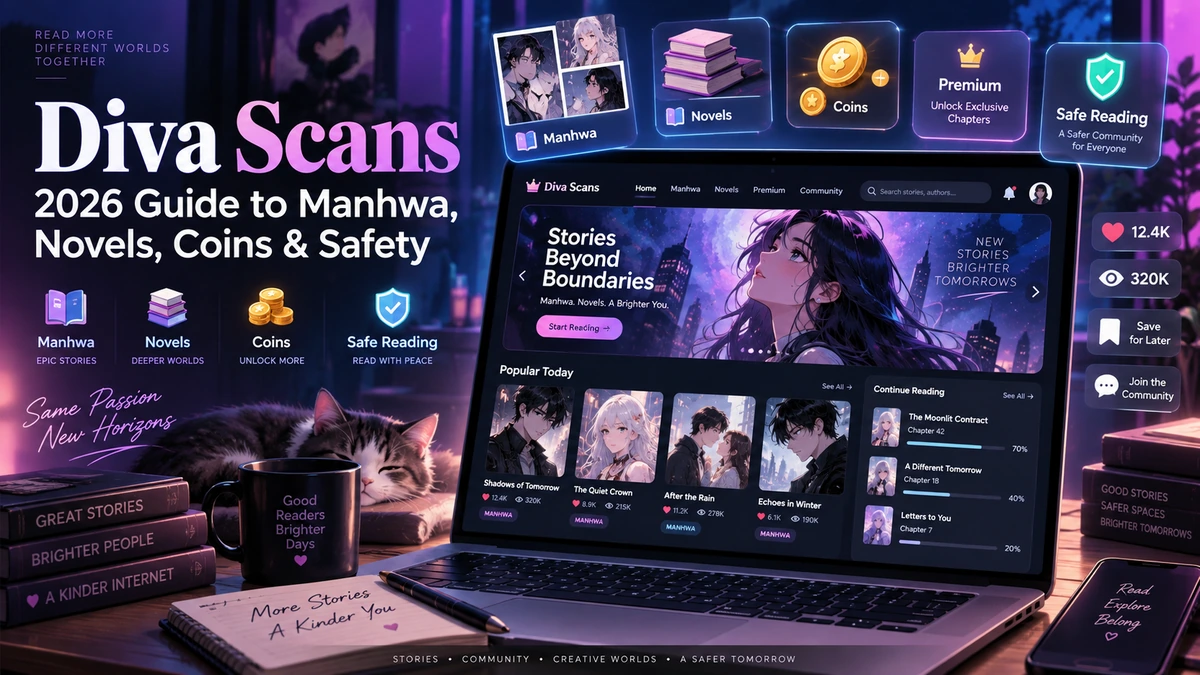
When I look at Diva Scans in 2026, I see something broader than the traditional idea of a small scanlation website. The current DivaScans.org platform combines a large catalog of comics and novels with user accounts, bookmarks, reading history, personalized recommendations, comments, community features, virtual currency, premium chapter unlocking, memberships, reading customization, and support tools. Its current series browser shows more than 1,400 listed works, with Korean-origin titles making up a particularly large portion of the catalog.
The name can also be confusing because the service has moved between domains and changed its website substantially. Older search results still point to divascans.com, and community-maintained records have also associated the project with divatoon.com. A May 31, 2026 GitHub issue for a third-party manga extension specifically documented a move to divascans.org together with a complete website redesign. Current domain-analysis data also reports that the older Diva Scans domains redirect toward the .org address.
For that reason, I think the most useful way to evaluate Diva Scans is not simply to ask whether it “works.” We need to separate several questions. What content does the platform carry? Which features are free? What happens when Coins are purchased? What information does the site collect? Is adult material present? What does the service say about copyright complaints? How much can we verify about the operator? And what precautions make sense before creating an account or paying for digital content?
Based on the current website and public records I reviewed, Diva Scans is an active digital reading platform rather than an abandoned domain. At the same time, several issues deserve careful attention, including hidden domain ownership information, a relatively young current domain, an unusually restrictive refund policy, extensive adult-content labeling, and a copyright takedown policy that makes strong jurisdictional claims that I cannot independently verify from the website alone.
Key Takeaways About Diva Scans
The main points I would understand before using the service are:
- The current primary domain is divascans.org.
- Older Diva Scans addresses have included
divascans.comanddivatoon.com. - A May 2026 website redesign and domain change were substantial enough to break at least one third-party reading extension.
- The current catalog lists more than 1,400 series.
- The platform supports both comics and novels.
- Most content can be browsed or read without payment, according to the site’s Help Center, while some chapters require Coins.
- Coin purchases and premium chapter unlocks are treated as digital goods.
- The refund policy states that purchases are generally final and non-refundable.
- The site supports payments through Stripe, PayPal, and cryptocurrency according to its own Help Center.
- Accounts can store reading progress, preferences, bookmarks, purchase history, and other information.
- The current catalog contains substantial Adult and Mature material.
- Older descriptions claiming adult material was modified for 15+ readers should not automatically be assumed to describe the present
.orgplatform. - The current domain was registered on May 1, 2025 according to third-party WHOIS reporting, and ownership details are hidden through a privacy service.
- Diva Scans has a content takedown policy, but the site’s assertions about its jurisdiction and legal obligations are its own statements and should not be treated as independently established legal conclusions.
- I would check the rights status of a title independently if licensing matters to me.
- I would also read the payment and refund terms before buying Coins rather than assuming normal subscription-store refund rules apply.
In my view, those points make Diva Scans an entertainment and digital comics platform with both free and paid elements, not merely a static manga archive.
What Is Diva Scans?
Diva Scans is a web-based reading platform centered on translated comics, manhwa, manga-style works, and web novels.
Its current Help Center describes itself as:
“The most advanced novels & comics platform”
DivaScans Help Center
That self-description is marketing language rather than an independent ranking, but it does accurately indicate the platform’s direction. Diva Scans is trying to provide more than simple image pages.
The current platform includes dedicated comic and novel readers. Novel readers can offer customizable fonts, sizing, line-height options, infinite scrolling, and text-to-speech. Comic readers support vertical and page-based reading, image preloading, custom backgrounds, and right-to-left manga viewing.
Users can also create accounts, bookmark series, track reading status, view reading history, receive personalized suggestions, participate in comments, connect Google or Discord accounts, and unlock premium chapters. The Help Center describes reading states including Reading, Plan to Read, Completed, On Hold, and Dropped.
I think this distinction matters because the word “Scans” can suggest a much simpler service than what currently exists. The modern site resembles a feature-rich web reading application.
Which Diva Scans Domain Is Current?
The current website is divascans.org.
This is worth emphasizing because search engines can still return older pages hosted under different addresses.
A public GitHub issue filed on May 31, 2026 documented the new Diva Scans URL as https://divascans.org/ and said that the site had been completely redesigned. The issue was tagged as both a domain change and a source change because the redesign broke assumptions used by the associated third-party extension.
Third-party domain information currently says divascans.com and divatoon.com redirect toward DivaScans.org.
There is also historical evidence connecting Diva Scans to Divatoon. A community-maintained GitHub mapping of scanlation sources lists DivaScans with divatoon.com, while older pages from divascans.com remain indexed.
For readers, my practical advice is straightforward: pay attention to the address bar instead of assuming every old Google result reflects the current platform.
How Large Is the Diva Scans Library?
The current Browse Series page reported 1,435 results when reviewed in September 2026.
Filtering by Korean origin showed 994 results, indicating that Korean manhwa makes up a major portion of the indexed catalog.
The platform also includes novels and web novels. Current homepage listings include separate sections for novel updates and comic updates, and the Help Center explicitly describes Diva Scans as a dual-format platform.
Catalog size can change daily, so I would not treat 1,435 as a permanent total. New works and chapters are continuously added while other titles can be completed, hidden, or removed.
What I find more meaningful than the absolute number is the breadth of the catalog. Current listings cover romance, fantasy, drama, comedy, school life, psychological stories, mature material, adult works, and numerous other genres.
What Types of Content Does Diva Scans Offer?
The catalog is dominated by serialized entertainment.
Manhwa
Korean manhwa is especially prominent.
Series pages identify origin, status, chapter count, views, bookmarks, ratings, and update time. Current Korean-filtered listings show a large volume of actively updated series.
Manga and Other Comics
The comic reader supports right-to-left presentation for manga, while the catalog includes works from origins beyond Korea.
Web Novels
Diva Scans also hosts text-based serialized novels. The homepage maintains a separate latest-novel-updates area, and individual novel pages use a reader distinct from the comics interface.
Adult and Mature Material
This is an important part of the present catalog.
The platform has series marked Adult, Mature, and Smut, and its current “Forbidden Pleasures” collection describes itself as containing 50 Adult and Mature stories.
That current reality differs from older Diva Scans descriptions.
An older divascans.com page described the service as modifying adult material for “15+ audiences” and reducing explicit scenes. A 2025 GitHub source request repeated that description.
I would not assume that old 15+ description governs the current website. The present .org catalog openly categorizes a substantial set of works as Adult and Mature. Parents and younger readers should therefore inspect genre and content labels before opening a series.
Diva Scans Features at a Glance
The platform’s current Help Center documents a surprisingly broad feature set.
| Feature | What Diva Scans Says It Provides | Practical Value |
|---|---|---|
| Comics reader | Vertical, paged, RTL and image controls | Supports different comic formats |
| Novel reader | Custom fonts, size, line height and scrolling | Improves long-form reading |
| Text-to-speech | Built-in novel playback | Alternative reading method |
| Bookmarks | Personal library and reading states | Tracks ongoing series |
| Reading history | Progress and reading statistics | Helps resume content |
| Recommendations | Based on genres and reading preferences | Content discovery |
| Paragraph comments | Comments attached to novel sections | Community discussion |
| Accounts | Email, Google and Discord options | Syncs user activity |
| Coins | Unlock premium chapters | Paid-content system |
| Community | Profiles, discussions and activity | Social features |
| Reports | User-submitted support reports | Problem reporting |
| Reading preferences | Interface customization | Personalization |
These features are described in the official Help Center.
The important takeaway is that creating an account does more than provide a username. It allows Diva Scans to maintain a persistent reading profile, which has privacy implications as well as convenience benefits.
Is Diva Scans Free?
Diva Scans uses a freemium model.
The Help Center says most content is free to browse and read, while some chapters are premium and require Coins.
Current series pages visibly distinguish ordinary chapters, coin-priced chapters, and chapters that become unlocked. Many listings show premium chapters priced at values such as 100 Coins, while older chapters can appear as unlocked.
That means “free manga site” is not a complete description of the current platform.
A better description is:
Free browsing and substantial free reading, combined with paid early or premium access to selected chapters.
The exact chapter cost and availability can vary by series and over time.
How Diva Scans Coins Work
Coins are the virtual currency used within the platform for premium chapter access.
The Terms of Service states:
“Coins have no real-world value and cannot be exchanged for cash”
DivaScans Terms of Service
The same terms say Coin purchases are final and non-refundable, that Coin pricing can be modified with notice, and that Coins may expire if an account remains inactive for 12 months.
According to the Help Center, users can buy Coin packages through the store using Stripe, PayPal, or cryptocurrency, after which Coins are added to the account and can be spent on locked chapters.
Once a chapter has been unlocked, the Help Center says it is permanently available to the account.
I would still keep transaction records for any paid digital service. “Permanently” describes the site’s current policy, but no online service can guarantee perpetual operation in the literal sense.
Diva Scans Refund Policy
The refund policy is one of the areas I would read carefully before spending money.
Its headline statement says:
“All purchases on DivaScans are final and non-refundable.”
DivaScans Refund Policy
The policy applies this position to Coin packages, premium chapters, memberships, cosmetic items, and other digital goods. It says unused Coins are generally not refundable and treats access as delivered immediately after purchase.
The document does mention narrow circumstances in which the platform may review a transaction, including certain unauthorized transactions or verified technical errors, but it says any resolution remains at Diva Scans’ discretion and may be provided as Coins rather than money.
I would not assume that this policy overrides mandatory consumer rights in every country. Consumer law varies by jurisdiction, and the site’s own statements are not a substitute for local legal advice.
The practical point is simpler: anyone buying Coins should behave as though the purchase may be irreversible.
What Data Does Diva Scans Collect?
Diva Scans publishes a privacy policy dated January 2026.
According to that document, the platform may collect:
- Email, username, and account credentials
- Profile information
- Reading history and preferences
- Purchase and transaction history
- Device and usage information
The policy says this information can be used to operate the service, process transactions, personalize reading, respond to support requests, deliver notifications, and analyze usage. It also states that the site does not sell personal information and may share information with service providers, when legally required, with consent, or for fraud prevention and rights protection.
Users are also told they can request account deletion, access or update their information, opt out of marketing, and export their data.
The Help Center says account deletion is available through Settings under the Privacy area and describes deletion as permanent.
From my perspective, this is another reason to think carefully before connecting third-party identities or using the same password that is used elsewhere.
Can You Sign In With Google or Discord?
Yes, the Help Center says Diva Scans supports connected Google and Discord accounts as well as ordinary account creation.
Convenient sign-in is useful, but I always recommend checking the permissions requested by any third-party login flow.
A reader who does not need social integration may prefer a dedicated email address and a unique password rather than linking multiple accounts.
Is Diva Scans Safe?
There are at least three meanings of “safe,” and I think they should be separated.
Technical Website Safety
Third-party domain analysis reports that DivaScans.org has a valid SSL certificate and is reachable normally. It also reports that the domain uses Cloudflare infrastructure.
HTTPS protects data in transit between the browser and server.
It does not prove that every file, advertisement, payment, hosted work, or business practice is trustworthy.
Business Transparency
This is less clear.
ScamAdviser reports that the registrant uses WHOIS privacy and that the current .org domain was registered on May 1, 2025. The public ownership information shown there is redacted.
Using domain privacy is common and is not evidence of wrongdoing by itself.
However, it means I cannot use public WHOIS data to independently identify the operator.
Content Safety
The catalog contains Adult and Mature material, so content appropriateness depends heavily on the reader.
Current pages explicitly apply adult-content labels.
For that reason, I would not describe the site as universally suitable for children or younger teenagers.
Safety and Trust Checks I Would Apply
The following table summarizes how I would evaluate the main risk areas.
| Area | What I Found | My Practical Response |
|---|---|---|
| HTTPS | Valid certificate reported | Good basic connection protection |
| Domain age | Current .org registered in 2025 | Treat as a relatively young domain |
| Ownership | WHOIS information hidden | Do not assume operator identity |
| Payments | Stripe, PayPal and crypto listed | Keep receipts and understand refund rules |
| Refunds | Generally final | Purchase cautiously |
| Privacy | Reading, account and purchase data collected | Use strong unique credentials |
| Adult content | Clearly present in current catalog | Check labels before reading |
| Copyright status | Cannot verify licensing for every work | Prefer licensed sources when rights status matters |
| Domain changes | Multiple historical addresses | Verify current URL |
| Third-party apps | Website redesign has broken integrations | Use web access or updated trusted clients |
| Account links | Google and Discord supported | Review requested permissions |
| Community | Comments and profiles available | Avoid sharing unnecessary personal information |
The main lesson is that “safe” cannot be reduced to one green padlock or one automated trust score.
Is Diva Scans Legit?
If “legit” means does the website exist and actively provide a functioning reading service, the evidence points to yes.
The platform has an active catalog, current chapter updates, user profiles, legal-policy pages, support tools, a community section, payments, account management, and a help center.
If “legit” means can I independently verify the corporate operator and licensing status of every title, the answer is much less certain.
The domain registrant is hidden in public WHOIS data, and I have not found first-party documentation in the reviewed pages proving licensing arrangements for the entire catalog.
Those are different questions.
I therefore think a careful description is:
Diva Scans appears to be a real, actively operated reading platform, but readers should independently consider copyright, payment, privacy, and ownership transparency before treating it like a conventional licensed digital publisher.
Diva Scans and Copyright Questions
This is probably the most sensitive part of the site’s operation.
Its Terms of Service states that content on Diva Scans, including novels, chapters, images, and other materials, is protected by copyright and that users may not copy, redistribute, modify, or scrape material without permission.
The site’s separate Content Takedown Policy takes a notably strong position.
Diva Scans states that it is not based in the United States, does not consider itself subject to U.S. DMCA requirements, and will not automatically remove material in response to ordinary DMCA notices. It says content can be considered for voluntary removal and provides a process for rights holders to submit evidence, but it frames legally compelled removal around court orders recognized in its operating jurisdiction.
I want to be precise here: those jurisdictional statements are claims made by Diva Scans itself.
The policy does not identify enough independently verifiable corporate information in the material reviewed for me to confirm the operator’s jurisdiction or determine how a particular court would analyze a copyright dispute.
Copyright rules also differ internationally.
I would therefore avoid simplistic claims such as “Diva Scans is definitely legal everywhere” or “Diva Scans is definitely illegal everywhere.”
If someone wants certainty about whether a particular translated title is officially licensed in their country, the better approach is to check the original publisher, creator, licensed English-language publisher, or authorized digital distributor.
Why the Content Takedown Policy Deserves Attention
The policy is unusually explicit compared with many reading platforms.
It says that ordinary U.S. DMCA notices will not automatically result in removal and that the “vast majority” of requests do not reach the site’s threshold for action. It also says existing purchasers may retain access to titles after certain removals.
For readers, I think this matters for two reasons.
First, it makes the platform’s stance toward disputed content unusually clear.
Second, that stance may differ significantly from the practices readers are familiar with on U.S.-based services.
If copyright provenance is important to you, I would treat official publisher channels as the safest reference point rather than attempting to infer licensing merely from the fact that a title appears on Diva Scans.
Why Diva Scans Sometimes Appears “Not Working”
There was a real technical disruption in 2026 related to the platform’s redesign.
On May 31, a GitHub issue for the Diva Scans source in the Keiyoushi extension ecosystem reported that Diva Scans had changed to divascans.org and redesigned its website, breaking old paths expected by the extension.
That type of failure does not necessarily mean Diva Scans itself is offline.
A browser can access the current site while a third-party app still depends on older URLs, page structures, JSON formats, cookies, or image-host behavior.
I would therefore distinguish between:
Website down: DivaScans.org itself cannot be loaded.
Third-party source broken: The website works, but an unofficial reader or extension cannot parse it.
Those are different problems.
I would also be cautious about installing random APKs, modified extensions, or mirror builds offered by unknown sites simply because a source stops working. A broken third-party integration is inconvenient, but replacing it with unverified software can create a larger security problem.
How to Use Diva Scans More Safely
I would follow a simple process.
Step 1: Verify the Domain
Make sure you know which site you are visiting.
The current address is DivaScans.org, while older search results may reference different Diva Scans domains.
Step 2: Browse Before Creating an Account
The Help Center says most content can be read free.
There is no reason to provide account information before deciding whether you actually need library tracking, comments, premium chapters, or synchronization.
Step 3: Check Content Labels
Review the genre and maturity tags on a series page.
The current catalog includes Adult and Mature material.
Step 4: Use a Unique Password
Do not reuse a banking, email, workplace, or primary social-media password.
The Terms of Service places responsibility for maintaining account-credential confidentiality on the user.
Step 5: Review Third-Party Account Permissions
If using Google or Discord sign-in, read the permissions screen.
Step 6: Understand the Coin Policy Before Paying
Check the chapter price and total Coin balance before confirming a purchase.
Step 7: Assume Refunds Will Be Difficult
The refund policy is deliberately strict.
Step 8: Keep Transaction Records
Save payment confirmations and transaction identifiers.
Step 9: Verify Licensing Separately When It Matters
If supporting creators or buying authorized access is your priority, look for an official publisher or licensed distributor.
Step 10: Avoid Unknown Download Prompts
Ordinary reading should not require installing random programs from unrelated websites.
Common Misconceptions About Diva Scans
“Diva Scans Is Completely Free”
Not anymore, at least not in the simplest sense.
The site says most content is free, but premium chapters can require Coins.
“Diva Scans Is Only a Manhwa Site”
Manhwa is a major part of the catalog, but the platform also supports novels and other comics.
“Divascans.com Is Still the Main Site”
Current evidence points to DivaScans.org as the main domain after the 2026 redesign.
“The Site Is for 15+ Readers”
That description appeared on older DivaScans.com material.
The present DivaScans.org platform has extensive Adult and Mature categories, so I would not rely on the old description.
“HTTPS Means the Content Is Licensed”
No.
HTTPS indicates encrypted communication with the domain. It does not establish copyright authorization.
“A DMCA Page Means the Site Automatically Removes Complaints”
The current policy says the opposite. Diva Scans explicitly says ordinary U.S. DMCA requests are not considered automatically binding on the platform.
“If Diva Scans Fails in Mihon, the Website Must Be Down”
Not necessarily.
The 2026 redesign demonstrated how a working website can still break a third-party parser.
Who Might Like Diva Scans?
From a pure user-experience perspective, Diva Scans may appeal to readers who want:
- A large manhwa-focused catalog
- Novels and comics in one account
- Built-in reading history
- Bookmarks and reading states
- Community features
- Personalized recommendations
- Text-to-speech for novels
- Multiple comic viewing modes
- Frequent chapter updates
- A mixture of free and premium content
These features are all documented on the current platform.
The site is clearly built for readers who consume serialized content frequently rather than people looking for one isolated chapter.
Who Should Be More Cautious?
I would be more cautious if:
- You are underage and want to avoid mature material.
- You are uncomfortable with reading-history tracking.
- You do not want to create another online account.
- You expect easy refunds on digital purchases.
- You need transparent corporate ownership.
- You want independently verified licensing for every title.
- You prefer not to use virtual currency.
- You intend to connect a primary Google or Discord identity.
- You are considering cryptocurrency payments without understanding transaction finality.
None of those concerns automatically means the site is unusable. They simply change the risk-benefit calculation.
Diva Scans Compared With an Official Licensed Publisher
The distinction between a scanlation-style platform and an official licensed publisher is important.
An authorized distributor can usually provide clearer evidence that it has contractual permission to distribute a particular work in a territory or language.
An unofficial or difficult-to-verify platform may still provide a polished reading experience, but user-interface quality does not prove rights ownership.
If my priority were directly supporting the original creator and publisher, I would first look for a licensed release.
If my priority were simply researching whether Diva Scans exists, how its platform works, or why a particular old domain changed, then the current .org site provides plenty of direct evidence.
What I Would Verify Before Buying Coins
Before paying, I would check five things.
First, confirm I am logged into the intended account.
Second, verify the exact chapter and Coin price.
Third, determine whether that chapter is expected to become free later. Current listings sometimes show newer paid chapters alongside older unlocked chapters.
Fourth, read the refund policy.
Fifth, decide whether I am comfortable with the platform’s ownership transparency and rights situation.
That is a more deliberate approach than treating virtual currency as if it were meaningless because the individual transaction is small.
How Diva Scans Handles Support
The Help Center provides two main support routes: a Discord community and a report system.
Users can submit reports through the site’s reporting page and are encouraged to include details and screenshots.
The same Help Center provides troubleshooting guidance for image-loading problems, including clearing the browser cache, refreshing, checking the connection, trying another browser, and then submitting a report if problems continue.
I would use the site’s own support system before relying on random troubleshooting advice from unverified download websites.
Conclusion
I see Diva Scans in 2026 as a substantial digital comics and novels platform rather than the simple scanlation page its name might imply. DivaScans.org offers a large catalog, customizable readers, bookmarks, history, recommendations, community functions, connected accounts, Coins, premium chapters, and support tools. Its move to the .org domain and major 2026 redesign also explain why older domains and third-party reading integrations can create confusion.
At the same time, I would not ignore the areas where caution is justified. The present site carries clearly labeled Adult and Mature content, its current domain is relatively young, public WHOIS ownership is hidden, purchases are generally non-refundable, and its copyright takedown policy makes strong jurisdictional claims that should be understood as the operator’s position rather than an independently verified legal determination.
My practical recommendation is to browse first, check maturity labels, use unique credentials, understand the Coin and refund system before paying, and verify licensing through publishers when creator support or rights status matters to you. That approach lets readers evaluate Diva Scans based on observable facts rather than treating the site as either automatically trustworthy or automatically unsafe.
READ: Menu Mate: What It Is, Features, Pricing, Safety, and How It Works
Frequently Asked Questions
What Is Diva Scans?
Diva Scans is a web platform for reading comics, manhwa, manga-style works, and serialized novels. Its current DivaScans.org site includes dedicated readers, bookmarks, reading history, recommendations, comments, community functions, user accounts, virtual Coins, and premium chapter unlocking. The catalog currently contains more than 1,400 listed series, with Korean-origin manhwa representing a large share of the library.
What Is the Official Diva Scans Website?
The current Diva Scans website is DivaScans.org. A May 31, 2026 GitHub issue documented the move to this domain and described a complete redesign that broke older integration paths. Older search results can still reference DivaScans.com or Divatoon.com, and third-party domain records currently report redirects from those addresses toward the .org site.
Is Diva Scans Free?
Diva Scans is partly free. Its Help Center says browsing and reading most content is free, while some chapters are premium and require Coins. Current series listings show a mixture of free, unlocked, and Coin-priced chapters. Readers can therefore use significant parts of the service without paying, but the newest or selected premium material may require virtual currency.
How Do Diva Scans Coins Work?
Coins are Diva Scans’ internal virtual currency for unlocking premium chapters. They have no cash value and cannot be exchanged back into money according to the Terms of Service. The Help Center says users can purchase Coins using supported payment methods and spend them on locked chapters. The terms also say Coin purchases are non-refundable and may expire after 12 months of account inactivity.
Does Diva Scans Offer Refunds?
Generally, no. The site’s March 2026 Refund Policy says purchases are final and non-refundable, including Coins, premium content, memberships, and other digital goods. It describes only narrow discretionary reviews involving issues such as verified technical failures or certain unauthorized transactions. Because consumer rights vary internationally, readers should also check any mandatory protections that apply where they live.
Is Diva Scans Safe to Visit?
DivaScans.org is an active HTTPS website, and third-party analysis reports a valid SSL certificate. That provides basic encrypted communication but does not independently verify ownership, licensing, or every commercial practice. The domain registrant is hidden through a WHOIS privacy service, and the current .org registration dates to May 2025. I would use normal online precautions, especially when creating an account or paying.
Does Diva Scans Have Adult Content?
Yes. The current DivaScans.org catalog contains content explicitly categorized as Adult and Mature, including dedicated collections built around those labels. That is important because older DivaScans.com descriptions referred to adapting adult material for 15+ readers. I would not assume that older statement represents the current platform, and I recommend checking each series’ genre and maturity labels before reading.
Is Diva Scans Legal?
I cannot make a universal legal determination about Diva Scans because copyright rules, distribution rights, and jurisdiction differ by country and by individual title. The platform publishes its own copyright and takedown position, including a claim that ordinary U.S. DMCA notices are not binding on it, but that is the site’s statement rather than independently verified proof of its legal jurisdiction. Readers who want confirmed authorized access should check official publishers or licensed distributors.
Why Did Diva Scans Change Domains?
Public technical records show that Diva Scans moved to DivaScans.org during a major 2026 redesign. A May GitHub issue documented the new URL and reported that the redesigned site broke old paths used by a third-party reading extension. The public material reviewed does not provide a definitive first-party explanation for every previous domain change, so I would avoid inventing one.
Why Is Diva Scans Not Working in Mihon or Another Reader?
A third-party reader can stop working even while the Diva Scans website remains online. The May 2026 redesign changed the domain and website structure, which broke assumptions in at least one third-party extension. Updating the trusted reader and its source integration is more sensible than immediately downloading an unknown replacement APK or extension from an unofficial mirror.
Can Diva Scans Track My Reading History?
Yes. The privacy policy says Diva Scans collects reading history and preferences along with account, profile, transaction, device, and usage information. The site’s product features also include reading-history tracking and personalized recommendations. Users who prefer not to build a persistent reading profile may want to browse without an account when possible.
Can I Delete My Diva Scans Account?
The current Help Center says users can permanently delete their account through Settings under the Privacy section. The privacy policy also states that users have the right to request deletion of their account and data. Because deletion is described as permanent, I would first save any information needed about purchases or account activity.
Sources and References
- DivaScans official Help Center, for the platform’s comic and novel readers, account setup, bookmarks, reading history, recommendations, Coin purchases, payment methods, connected accounts, support, and account deletion.
- DivaScans Terms of Service, for virtual currency rules, account obligations, content restrictions, termination terms, and service disclaimers.
- DivaScans Privacy Policy, for data collection, reading history, transaction data, usage information, data rights, and information-sharing statements.
- DivaScans Refund Policy, for its current rules concerning Coins, digital goods, premium chapters, memberships, charge disputes, and limited discretionary exceptions.
- DivaScans Content Takedown Policy, for the site’s stated copyright-removal procedures and jurisdictional position.
- Current DivaScans series browser and homepage, for catalog size, Korean-origin titles, recent chapter activity, premium chapter indicators, comics, and novels.
- Keiyoushi GitHub issue #16352, for the May 2026 domain move to DivaScans.org and the associated website redesign that broke older third-party integration paths.
- ScamAdviser domain report, for the reported May 1, 2025 registration date, WHOIS privacy, SSL status, Cloudflare infrastructure, and reported redirection of older Diva Scans domains.
Disclaimer
This article is an independent informational review and is not affiliated with Diva Scans, DivaScans.org, any comic or novel publisher, creator, translator, payment processor, or third-party reading application. I have based factual statements on publicly available website pages, current platform documentation, public technical records, and third-party domain information available at the time of research. I have not independently verified the licensing status of every title, the site’s corporate ownership, its claimed operating jurisdiction, or the legal effect of its copyright policies in every country. Copyright, digital-goods, privacy, and consumer-protection rules vary by jurisdiction, so readers should consult official publishers, local law, or qualified professionals when a specific legal or financial question matters.

I see TozyMagazine.com as a website that needs a little more explanation than its name initially suggests. Someone arriving through a search engine might reasonably expect a conventional online magazine with a narrow editorial focus, named editors, clearly defined sections, and perhaps digital issues. What I found instead is a broad web publication whose stated roots are in birthday wishes, marriage messages, anniversaries, gratitude, quotes, and other sentiment-focused content, but whose current publishing activity stretches across health, business, travel, technology, education, home improvement, product news, finance-related topics, and general news.
That evolution is one of the most important facts to understand about the site. Tozy Magazine’s own About page still describes a mission built around helping people express emotions during special moments. Its current homepage, however, features articles about counselling, beach rentals, feed mills, entrepreneurship, private aviation, electronics measurements, cleaning products, cardio, and funerals. In my view, that makes the modern site better described as a general-interest digital content publication than as a site devoted only to wishes and quotations.
I also think readers should separate two different questions: “Is this a functioning website?” and “Should I trust every article it publishes?” The first is comparatively easy to answer. TozyMagazine.com is active, uses HTTPS, has a contact form, publishes dated content, has an About page, and maintains a substantial archive. The second question requires article-by-article judgment because a lifestyle article, a medical article, an investment article, and a legal or fraud-related article carry very different consequences if the information is inaccurate.
This guide examines what TozyMagazine.com actually is in 2026, how the website has developed, what readers can find there, what public information is available about its ownership and authorship, how its content should be evaluated, and what I would check before relying on an article for an important decision.
Key Takeaways About TozyMagazine.com
The most useful facts I found are:
- The main website is tozymagazine.com, singular.
- Tozy Magazine describes itself as a platform originally centered on meaningful quotes, wishes, messages, birthdays, marriage, anniversaries, and gratitude.
- Its current editorial output is considerably broader and includes health, business, travel, technology, education, home improvement, product news, finance-related subjects, and general news.
- The homepage was actively publishing new articles in early September 2026.
- A recurring visible author name is Devwiz, whose author archive covers many unrelated subject areas.
- The About page mentions “our founder” but does not publicly identify that person by name in the material I reviewed.
- The site provides a contact form and an email address through its official pages.
- ScamAdviser reports a WHOIS registration date of December 26, 2024. I would treat this as the domain-registration date, not automatically as the exact website launch date.
- The domain uses a valid HTTPS certificate according to the available third-party technical check. HTTPS protects transmission, but it does not independently prove editorial accuracy.
- The public pages I reviewed do not provide extensive information about the legal entity or named editorial leadership behind the publication.
- Readers should evaluate medical, financial, legal, safety, and investment-related articles more rigorously than low-risk lifestyle or greeting content.
- A similarly named plural domain,
tozymagazines.com, appears in search results, so readers should check the URL carefully when they specifically want TozyMagazine.com.
The central conclusion I draw is that TozyMagazine.com appears to be a real, actively maintained content website, but “real website” and “authoritative source on every topic” are very different standards.
What Is TozyMagazine.com?
TozyMagazine.com is the website for Tozy Magazine, an online publication built around article-based content.
Its About page presents the publication’s original identity in emotional and occasion-based terms. It says the platform was created around the idea that words can help people recognize birthdays, anniversaries, weddings, acts of kindness, gratitude, love, and other important moments. Its listed core areas include Birthday, Marriage, Anniversary, and Thank You content.
One short statement captures the site’s stated philosophy particularly well:
“Words have the power to uplift, inspire, and connect us.”
Tozy Magazine, About Us
That philosophy makes sense when I look at the site’s original category structure. Someone could visit for a birthday message, wedding wording, anniversary quote, or thank-you note without needing specialized professional expertise.
The live publication in 2026 is much broader.
Recent homepage articles include:
- Counselling and mental wellbeing
- Topsail Beach vacation rentals
- Feed-mill carbon reduction
- Entrepreneurial business models
- Private aviation opportunities
- Detector measurement behavior
- Industrial machinery wear
- Stove-top cleaning
- Cardio and daily exercise
- Funeral pre-planning
Earlier 2026 and 2025 articles also cover topics such as tax-loss harvesting, real-estate funds, periodontal treatment, web agencies, online gaming, construction, fraud liability, travel, and product-related content.
I would therefore describe TozyMagazine.com today as a multi-topic informational publishing site with an older special-occasion identity still visible in its branding and navigation.
TozyMagazine.com Website Snapshot
The following table separates details I could verify from assumptions readers may make based on the name alone.
| Website Detail | What the Available Evidence Shows |
|---|---|
| Primary domain | tozymagazine.com |
| Brand name | Tozy Magazine |
| Website format | Article-based digital publication |
| Original stated focus | Quotes, wishes, birthday, marriage, anniversary, thank-you content |
| Current content | Health, business, technology, travel, education, home improvement, finance-related topics, product news, news and more |
| Main visible author | Devwiz appears across many current articles |
| Founder | Mentioned on About page but not named in the public text reviewed |
| Contact option | Contact form and published email |
| Account required to read | No obvious account requirement for ordinary public articles |
| Subscription paywall | No general article paywall was evident in the pages reviewed |
| Domain registration | Third-party WHOIS reporting lists December 26, 2024 |
| HTTPS | Valid certificate reported by third-party domain analysis |
| Print edition | I found no evidence that the site operates primarily as a traditional printed magazine |
| Current activity | New content was appearing in September 2026 |
The important takeaway is that the word “Magazine” functions more as the brand’s publishing identity than as evidence of a traditional issue-based magazine operation. Visitors should expect individual web posts organized by categories rather than monthly or weekly magazine issues.
How Tozy Magazine’s Content Has Expanded
The site’s About page and its current homepage tell noticeably different editorial stories.
The About page emphasizes what I would call sentiment content. It discusses relationships, emotional communication, memorable occasions, gratitude, wishes, quotes, and personal messages.
The current publication has moved into a broader search-driven model.
A single author archive for Devwiz includes subjects ranging from periodontal treatment and Facebook growth to investment planning, California ADUs, motorhome travel, auditorium seating, web technology, and safety products.
That does not automatically make the articles poor. General-interest publications have covered multiple subjects for a very long time.
The difference is that broad scope increases the importance of editorial signals.
If a publication covers specialist fields, I want to know:
- Who wrote the article?
- What expertise do they have?
- Where did the factual claims come from?
- Are primary sources cited?
- Was the article reviewed?
- Is commercial involvement disclosed?
- How current is the information?
- Does another authoritative source agree?
Those questions become especially important when one byline appears across very different areas of expertise.
What Categories Can Readers Find on TozyMagazine.com?
The visible homepage and archive show a wide range of categories.
Birthday, Marriage, Anniversary, and Thank-You Content
These remain prominent in the navigation and fit the site’s stated founding mission.
I consider these comparatively low-risk categories. If someone wants a romantic anniversary message or a friendly birthday wish, the main question is usually whether the wording feels appropriate rather than whether it satisfies a professional evidentiary standard.
Business and Entrepreneurship
The publication covers marketing, investment-related subjects, entrepreneurship, agencies, business models, and commercial operations. Recent examples include client acquisition, business-model growth, Facebook marketing, private aviation, and real-estate investment topics.
For general ideas, these articles may be useful starting points.
For decisions involving money, contracts, taxes, securities, or business liability, I would verify important claims independently.
Health
Health has become a visible category, including counselling, cardio, periodontal care, and medical-research-related topics.
This is an area where I would apply a much higher standard.
The U.S. National Library of Medicine explains why:
“Health information is easy to find. But finding reliable health information takes a little effort.”
MedlinePlus, U.S. National Library of Medicine
MedlinePlus recommends checking who runs a health site, the qualifications of writers and reviewers, where information comes from, whether research is cited, whether material is current, and whether the website has a clear content-review process.
I would apply those questions to any health article on Tozy Magazine before using it to make a treatment or medical decision.
Technology and Education
The site publishes technical and educational material as well, including articles about equipment behavior, gaming technologies, software-related topics, machinery, and measurement systems.
Technical content can vary enormously in quality. I would cross-check specifications, standards, formulas, safety recommendations, and product documentation with primary technical sources.
Travel and Home Improvement
These are generally more practical categories.
Travel articles may discuss destinations, accommodation considerations, or motorhome travel, while home-improvement pieces cover construction, interior products, ADUs, and cleaning.
The risk depends on the advice.
A decorating idea is low stakes.
Structural, electrical, legal, permit, or safety advice should be checked with appropriate local sources and professionals.
News and Product News
Tozy Magazine also applies News and Product News labels to some articles.
I would not assume that a category named “News” means the site operates like a traditional newsroom with reporters, editors, corrections staff, and primary-source reporting.
The article itself should provide evidence of that.
Who Writes for TozyMagazine.com?
The most prominent current byline I found is Devwiz.
The author archive shows Devwiz publishing across a remarkably broad range of topics, including dentistry, Facebook growth, investment planning, real estate, travel, construction, technology, product news, business, and industrial subjects.
What I did not find on the publicly indexed author archive was a detailed professional biography establishing specialized credentials across those fields.
That is worth noting without drawing an unsupported conclusion.
A byline can represent:
- An individual writer
- A staff account
- An editorial team
- A publishing pseudonym
- A contributor-management account
The publicly accessible information I reviewed does not allow me to state confidently which description applies to Devwiz.
That is why I would avoid inventing a personal biography for the author.
Who Owns TozyMagazine.com?
Public ownership information appears limited.
The official About page says that “our founder” created the platform after being inspired by personal experiences and the value of heartfelt expression, but the text I reviewed does not name that founder.
The website does provide a contact form and an email contact route, which is better than a publication offering no method of communication.
However, I did not locate a clearly identified legal company name, named editorial board, or detailed management biography on the main public pages surfaced during my review.
This does not prove anything improper.
Many small websites have limited public corporate information.
It does mean readers should distinguish between what is known and what is not.
I would record the founder’s name, company identity, headquarters, editorial leadership, employee count, revenue, and other corporate details as not publicly confirmed from the sources reviewed, unless stronger first-party documentation becomes available.
How Old Is TozyMagazine.com?
ScamAdviser currently reports a WHOIS registration date of December 26, 2024 for tozymagazine.com. It lists NameCheap as the registrar and Cloudflare infrastructure in its technical summary.
That would make the domain relatively young compared with long-established publications.
There is an important distinction here.
A domain registration date tells us when that domain registration was created. It does not necessarily prove the exact date the publication began operating, when its first page went live, or whether an earlier version existed elsewhere.
Indexed Tozy Magazine articles from 2025 show that the website was actively publishing by that year.
I therefore use December 26, 2024 as a domain-history data point rather than presenting it as a confirmed editorial founding date.
Is TozyMagazine.com Legit?
Based on the evidence I reviewed, I would describe TozyMagazine.com as an active functioning website, not as an obviously fake or nonexistent publication.
Several observable signals support that limited conclusion:
- The domain resolves normally.
- The site serves content over HTTPS.
- It contains an About page.
- It has a contact page.
- It maintains author archives.
- It has an extensive article history.
- New posts continue to appear.
- Public pages can be accessed without unusual download requirements.
ScamAdviser similarly characterizes the domain as likely legitimate while noting factors including its young age and relatively low web rank.
I would not turn that assessment into a blanket endorsement.
A functioning publication can contain excellent articles, average articles, sponsored material, outdated information, weakly sourced claims, or mistakes. “Legitimate website” does not mean “authoritative source for every subject.”
Is TozyMagazine.com Safe to Visit?
In the narrow technical sense, the available evidence does not show an obvious problem with simply visiting the ordinary public website.
ScamAdviser reports a valid domain-validated SSL certificate issued through Google Trust Services.
HTTPS matters because it encrypts data in transit between the browser and website.
However, a padlock is not an editorial-quality certificate.
A secure HTTPS connection can protect the connection to a website while saying nothing about whether an investment claim, medical statement, product recommendation, or business assertion is accurate.
That distinction is important enough that I never use HTTPS alone to judge trustworthiness.
I would also remain cautious with:
- Unexpected file downloads
- Requests for payment information
- Forms asking for unnecessary sensitive data
- Third-party advertising
- Links to unknown commercial websites
- Gambling or high-risk promotional links
- Claims requiring financial action
Some archived Tozy Magazine content has included online casino and gambling-related material, which is another reason to judge outbound links and individual articles separately from the main domain.
How I Would Evaluate Different Types of Tozy Magazine Articles
Not every article requires the same level of verification.
| Type of Content | Typical Risk if Wrong | What I Would Verify |
|---|---|---|
| Birthday wishes and quotes | Low | Tone, originality, appropriateness |
| Lifestyle inspiration | Low to moderate | Practical claims and product links |
| Travel advice | Moderate | Current prices, policies, closures, safety rules |
| Product information | Moderate | Manufacturer specifications and independent reviews |
| Business advice | Moderate | Sources, assumptions, current market conditions |
| Technology content | Moderate to high | Official documentation, standards, version information |
| Investment and finance | High | Regulator, tax authority, adviser or primary financial sources |
| Legal or fraud information | High | Statutes, regulators, official guidance and jurisdiction |
| Medical and health | High | Government health sources, professional bodies, peer-reviewed evidence, clinician advice |
| Safety instructions | High | Manufacturer manuals, regulators, relevant professional standards |
What matters most is proportionality.
I do not need a peer-reviewed citation to choose a birthday message.
I absolutely want authoritative verification before changing medication, making a tax decision, interpreting fraud liability, investing money, or modifying safety-critical equipment.
Why Author Credentials and Sources Matter
MedlinePlus provides a useful framework even beyond health content.
Its web-evaluation tutorial says readers should look at the provider, purpose, information quality, and privacy practices of a website. It asks who runs the site, who pays for it, where information comes from, whether experts review it, whether the content is up to date, and what happens to personal information.
One sentence from the National Library of Medicine is particularly relevant to visually polished web publications:
“Anyone can put up a web page that looks good.”
MedlinePlus, U.S. National Library of Medicine
I think that principle is useful here.
Website design, article length, professional images, and confident prose are not substitutes for sourcing.
For any high-stakes Tozy Magazine article, I would look for:
- A named author.
- Relevant qualifications.
- Links to original evidence.
- Dates.
- Clear separation between editorial and commercial material.
- Statements of limitations.
- Agreement with authoritative independent sources.
If several of those signals are missing, I would treat the article as a starting point for research rather than the final answer.
Does TozyMagazine.com Publish Commercial or Promotional Content?
Some of the site’s articles contain specific company or product references.
Examples surfaced during my review include articles discussing construction businesses, a Swedish web agency, industrial manufacturers, and other named commercial entities.
One article about web agencies explicitly discusses how a named Stockholm agency approaches the problem being covered. Other articles integrate company or product names into broader informational text.
I cannot determine from those pages alone what commercial arrangement, if any, existed behind every named reference.
That means I would avoid asserting that a specific article is sponsored unless it is labeled as such or reliable evidence confirms it.
What readers can do is look for disclosure language such as:
- Sponsored
- Advertisement
- Partner content
- Contributor post
- Affiliate disclosure
- Paid placement
- Press release
If commercial relationships are unclear, factor that uncertainty into how much weight you give product or company recommendations.
TozyMagazine.com Versus the Similar TozyMagazines.com Domain
One potentially confusing issue is the existence of the plural domain tozymagazines.com.
A current search result for that domain displays branding that says “Tozymagazine.com” and describes itself as a digital platform covering biography, entertainment, technology, and business.
That is not the same URL as:
tozymagazine.com
The difference is a single s before .com.
I am not claiming that the plural site is fraudulent. I do not have evidence sufficient to make that accusation.
I am saying the domains are different.
If the user’s intent is specifically to reach TozyMagazine.com, I would manually verify the address before signing up, submitting information, or assuming that similarly branded search results are part of the same operation.
This is a useful habit for any website whose name is easy to pluralize, misspell, or imitate.
Does TozyMagazine.com Have a Separate USA Edition?
I found no convincing first-party evidence of a separate U.S.-only Tozy Magazine edition.
Several independent pages have recently appeared around the search phrase “tozymagazine.com USA,” but their analysis similarly concludes that the phrase appears to describe people searching for the main website from a U.S. perspective rather than a confirmed separate American publication.
The official site itself continues to operate through the main TozyMagazine.com domain and publishes articles relevant to many geographic markets, including some U.S.-specific topics.
I would therefore avoid referring to “Tozy Magazine USA” as an independently verified edition unless the publication itself announces one.
Strengths I See in TozyMagazine.com
The website has several practical strengths.
It Is Easy to Access
Articles are publicly readable and do not appear to require a general subscription login.
It Covers Many Search Interests
Readers can move from lifestyle content to travel, business, technology, home improvement, education, or personal messages without leaving the site.
Content Is Dated
Current articles display publication dates, which is useful when assessing freshness.
It Provides Contact Options
The site has a dedicated contact form and an email route.
It Maintains a Large Archive
The homepage pagination seen in indexed results extends through dozens of pages, indicating a substantial body of content.
The Original Editorial Idea Is Easy to Understand
The About page presents a coherent mission around words, relationships, gratitude, and meaningful occasions.
Those characteristics make it understandable why readers might encounter the site repeatedly in search results.
Limitations I Would Keep in Mind
The strongest limitation is transparency.
The public About material I reviewed does not clearly name the founder, identify a formal editorial board, or provide detailed staff credentials.
The second limitation is editorial breadth.
One visible author account publishes across numerous specialized topics. Without further author biographies or review information, readers have limited evidence for determining subject-matter expertise.
The third limitation is uneven evidentiary needs.
The site covers subjects where an inaccurate claim could have very different consequences. A greeting article and an article about fraud liability should not be evaluated according to the same standard.
The fourth issue is potential commercial context.
Some pages prominently discuss particular companies or products, so readers should check whether commercial relationships are disclosed.
Finally, the domain is relatively young according to public registration data. Age alone is not a quality measure, but it means the publication does not yet have the decades-long track record that some established media or professional organizations can point to.
A Step-by-Step Way to Use TozyMagazine.com Responsibly
I would use the site differently depending on why I arrived there.
Step 1: Confirm the Domain
Check that the browser shows:
tozymagazine.com
rather than a look-alike or pluralized domain.
Step 2: Identify the Article Type
Ask whether the article concerns entertainment, a greeting, travel, business, medicine, law, finance, or safety.
The higher the stakes, the more verification is required.
Step 3: Check the Publication Date
A 2025 article about a timeless birthday message may still be useful.
A 2025 tax, technology, healthcare, or regulatory article may need updated information.
Step 4: Review the Author Information
Look for the byline and any supporting biography.
If no relevant qualifications are available, do not assume them.
Step 5: Examine Sources
Check whether major factual claims link to:
- Government agencies
- Primary documents
- Peer-reviewed studies
- Manufacturer documentation
- Regulators
- Recognized professional organizations
Step 6: Search Independently
Do not verify one Tozy Magazine article by finding five websites that merely repeat the same article.
Look for genuinely independent primary or authoritative sources.
Step 7: Consider Commercial Incentives
If a specific company or product receives prominent attention, look for disclosure information.
Step 8: Avoid Acting on High-Stakes Advice Alone
For healthcare, financial, legal, tax, investment, or safety decisions, use the article as general information and then consult an appropriate authoritative source or qualified professional.
Common Misconceptions About TozyMagazine.com
“It Is Only a Quotes Website”
That description fits its stated origins better than its current publication.
The live site now covers a far broader range of subjects.
“Magazine Means It Has a Print Edition”
I found no public evidence that readers should expect a conventional physical magazine subscription. It operates primarily as a web publication.
“HTTPS Means Every Article Is Trustworthy”
No. HTTPS concerns encrypted transport between browser and server. It does not certify editorial accuracy.
“One Author Name Means One Verified Expert”
Not necessarily. The visible public information does not establish whether Devwiz is one individual, a pseudonym, or a staff publishing identity.
“A Site Can Be Either Legit or Completely Untrustworthy”
That binary framing is not very useful.
A real publication can contain both useful and weak articles. Trust should often be assigned to individual claims and individual pieces, not automatically to an entire domain.
“TozyMagazine.com USA Is a Separate U.S. Publication”
I found no strong first-party evidence supporting that characterization. The main site is the relevant publication.
My Assessment of TozyMagazine.com in 2026
Based on the available evidence, I would classify TozyMagazine.com as an active, relatively young, multi-topic digital content publication.
I would be comfortable using it for:
- Topic discovery
- General reading
- Inspiration
- Birthday or relationship messages
- Low-risk lifestyle ideas
- Finding questions to research further
I would apply additional verification before relying on it for:
- Medical treatment
- Mental-health decisions
- Investment choices
- Tax strategy
- Legal interpretation
- Financial fraud rights
- Safety-critical procedures
- Major product purchases
- Business contracts
That is not an unusually harsh standard.
It is the same standard I apply to almost any general-interest publication that covers specialist subjects without clearly documented specialist review on every page.
Conclusion
I believe the most accurate way to understand TozyMagazine.com is as a broad digital publication that grew from a much narrower original concept. Its About page still emphasizes heartfelt words, birthdays, marriage, anniversaries, thank-you messages, and meaningful communication, while its current homepage reaches into health, business, technology, travel, education, home improvement, products, finance-related subjects, and news.
The site is active, has HTTPS, publishes dated articles, provides contact options, and maintains a substantial archive. Those signals support treating it as a functioning website. They do not establish that every article should be accepted without verification.
What matters most to me is the subject of the page I am reading. I would happily treat a birthday-message page as inspiration without conducting an investigation. I would handle medical, investment, legal, tax, or safety information very differently by checking authorship, sources, freshness, commercial context, and authoritative external guidance.
For readers, the best next action is therefore simple: use Tozy Magazine for discovery, but match the level of verification to the consequences of being wrong.
READ: Open CoDesign: What It Is, Features, Setup, and How It Works
Frequently Asked Questions
What Is TozyMagazine.com?
TozyMagazine.com is the website of Tozy Magazine, an online publication that originally describes itself as a source of quotes, wishes, birthday messages, marriage content, anniversary expressions, and thank-you messages. Its current publishing activity is much broader, with articles covering health, business, travel, technology, education, home improvement, product news, finance-related subjects, and general news. I would therefore describe the modern website as a multi-topic general-interest digital publication.
Is TozyMagazine.com Legit?
The available evidence indicates that TozyMagazine.com is a real and active website rather than an obviously nonexistent or fake publication. It has a working domain, HTTPS, dated articles, an About page, a Contact page, author archives, and ongoing publishing activity. ScamAdviser also currently describes the domain as likely legitimate while noting its young age and relatively limited ranking. This should not be interpreted as proof that every individual article is accurate.
Is TozyMagazine.com Safe to Visit?
I found no evidence in the sources reviewed that ordinary browsing of the main TozyMagazine.com website presents an obvious technical danger. A third-party domain check reports a valid SSL certificate. However, safe browsing and reliable information are different issues. Readers should still exercise normal caution around third-party links, downloads, forms, advertisements, gambling-related pages, purchases, and requests for sensitive information.
Who Owns TozyMagazine.com?
The public information I reviewed does not clearly identify the legal owner or founder by name. Tozy Magazine’s About page refers to “our founder” and explains the idea behind the site, but the page does not provide a named founder biography in the indexed text. The site does provide a contact form and email address. I would therefore describe ownership as publicly limited rather than speculate about an individual or company without verified evidence.
Who Is Devwiz on Tozy Magazine?
Devwiz is the author name displayed on a large number of Tozy Magazine articles. The visible archive includes business, technology, health, investment, real estate, travel, home improvement, and product-related subjects. The public archive I reviewed does not provide enough verified biographical information to determine whether Devwiz is an individual’s legal name, a pseudonym, an editorial account, or another publishing identity, so I would not invent credentials or personal details.
When Was TozyMagazine.com Created?
A third-party WHOIS summary currently reports that the tozymagazine.com domain was registered on December 26, 2024. Articles indexed from 2025 show that publishing was taking place by that year. A domain-registration date should not automatically be treated as the exact launch or founding date of the publication, so I regard December 26, 2024 as a domain-history fact rather than a confirmed editorial anniversary.
What Does TozyMagazine.com Publish?
The site publishes a wide range of material. Its stated original categories include birthdays, marriage, anniversaries, thank-you messages, wishes, and quotes. In 2026, its homepage and archives also include health, business, travel, technology, education, home improvement, investments, real estate, product news, industrial subjects, counselling, and general-interest news. This broad mix is why I recommend judging individual articles according to their subject and evidence.
Can I Trust Health Information on TozyMagazine.com?
Health articles should be independently verified before being used for personal medical decisions. The National Library of Medicine recommends checking who runs a health website, the author’s qualifications, expert review, research sources, publication dates, funding, and privacy practices. I would apply those standards to any Tozy Magazine article discussing treatment, counselling, dentistry, exercise, disease, or another health-related subject and discuss consequential decisions with an appropriate healthcare professional.
Can I Trust Financial or Investment Articles on Tozy Magazine?
I would use them as general educational starting points rather than as personalized financial advice. Tozy Magazine has published material involving investment planning, real-estate funds, tax-loss harvesting, fraud liability, and other money-related subjects. Financial rules can depend on jurisdiction, account type, current law, market conditions, and personal circumstances, so important claims should be checked against regulators, tax authorities, financial institutions, or qualified advisers.
Is TozyMagazine.com a Traditional Magazine?
It appears to operate primarily as an online article publication rather than a conventional print magazine with periodic issues. The homepage uses a blog-style structure with individual dated posts, categories, author links, comments, and pagination. I found no evidence in the reviewed public material showing that readers need to subscribe to physical issues. The word “Magazine” is therefore best understood as part of the website’s publishing brand.
Is There a TozyMagazine.com USA Edition?
I found no strong first-party evidence of a separate official U.S. edition. Recent third-party articles discussing the phrase “TozyMagazine.com USA” similarly describe it as a search phrase rather than a separately confirmed publication. Tozy Magazine does publish articles relevant to American businesses, locations, and readers, but that is different from operating a formally distinct U.S. edition.
Is TozyMagazines.com the Same as TozyMagazine.com?
They are different domain names. tozymagazine.com is the singular domain reviewed in this article, while tozymagazines.com with an additional “s” also appears in search results using similar branding. I do not have enough evidence to state what relationship, if any, exists between the operators. Readers intending to visit TozyMagazine.com should verify the URL carefully rather than assuming similarly named domains are identical.
Sources and References
- Tozy Magazine official homepage, for current articles, categories, publishing dates, author information, and evidence of active publication in 2026.
- Tozy Magazine About Us, for the site’s stated mission, original focus, philosophy, founder reference, and contact information.
- Tozy Magazine Contact Us, for the site’s public contact form.
- Tozy Magazine Devwiz author archive, for the range of subjects published under the Devwiz byline.
- ScamAdviser domain report, for reported domain age, December 26, 2024 WHOIS registration date, registrar information, hosting indicators, and SSL status.
- MedlinePlus, U.S. National Library of Medicine, for independent guidance on evaluating online health information, including authorship, expertise, sourcing, purpose, funding, privacy, and freshness.
- Tozy Magazine homepage archive, for the site’s web-publication format, pagination, category labels, and older 2026 content.
Disclaimer
This article is an independent informational review and is not affiliated with Tozy Magazine or TozyMagazine.com. I have based factual statements on publicly accessible pages, current search results, domain information, and independent web-evaluation guidance available at the time of research. Website ownership, editorial processes, domain data, article categories, policies, authors, and technical characteristics can change after publication. Describing TozyMagazine.com as an active website is not an endorsement of every article, outbound link, advertiser, product, company, medical claim, financial statement, or recommendation published there. Readers should independently verify high-stakes health, legal, financial, investment, tax, safety, and commercial information before acting on it.
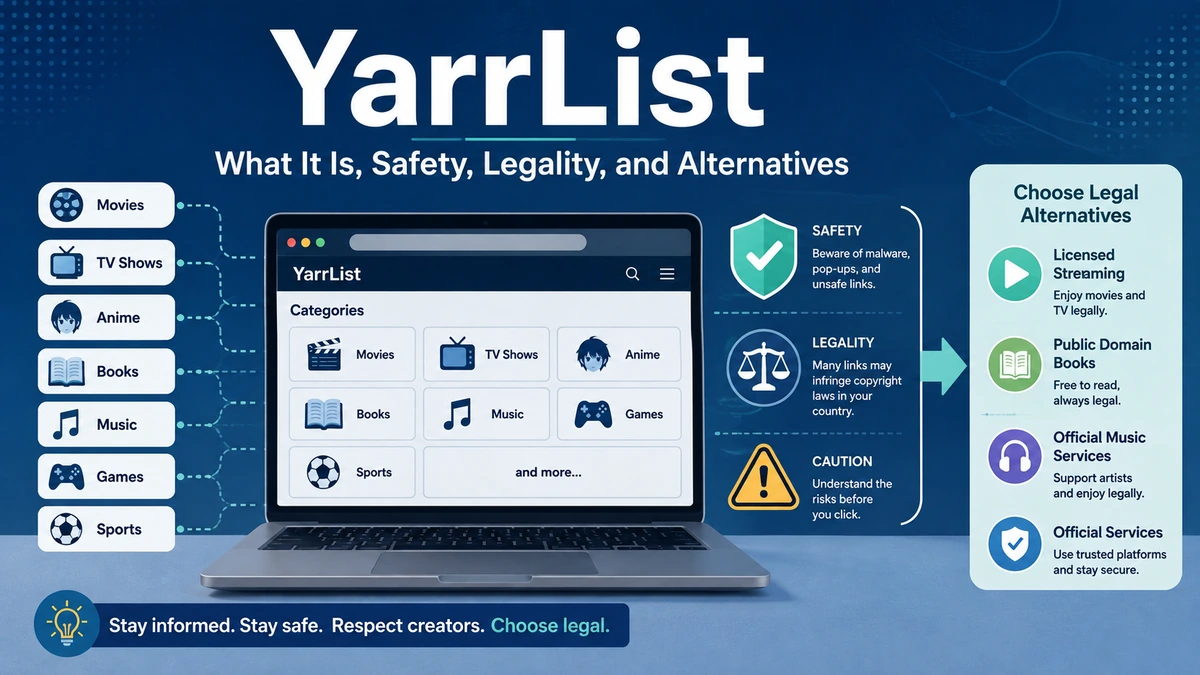
I see YarrList as one of those internet resources that can look simple at first but becomes much more complicated once we examine what it actually does. Instead of operating primarily as a conventional streaming platform, online store, or media library, YarrList presents itself as a directory containing links organized around movies, TV shows, anime, manga, live sports, torrents, games, music, eBooks, comics, Asian drama, VPNs, ad blockers, and other categories. Its public GitHub repository currently describes the project in piracy-focused terms and points users toward a primary domain plus several backup domains.
In my analysis, the most important point is that finding something through a directory is not the same as knowing that the destination is safe, authorized, reliable, or legal in your location. That distinction matters especially with YarrList because many of the categories involve copyrighted entertainment. The directory may organize links, but users still need to evaluate the individual service behind each link. Security risks, copyright questions, changing domains, intrusive advertising, deceptive downloads, and regional laws can all affect the experience.
This guide explains what YarrList is, why people search for it, how its directory model works, what risks deserve attention, how copyright affects the picture, and what legal alternatives exist for readers who mainly want convenient access to free entertainment.
Key Takeaways About YarrList
- YarrList is primarily a categorized directory that points users toward other websites rather than functioning as one unified streaming or download service.
- Its GitHub repository currently lists movies, television, anime, sports, live TV, manga, torrents, comics, games, music, eBooks, Asian drama, VPNs, and ad blockers among its categories.
- The project’s own GitHub description explicitly associates YarrList with piracy, which is important context when evaluating copyright and legal questions.
- A website appearing in a curated directory does not automatically prove that the destination is safe or legally licensed.
- YarrList itself advises users to consider an ad blocker and VPN, while another YarrList-branded directory warns that linked sites can change and recommends avoiding executable downloads from streaming websites.
- A VPN can affect privacy and network routing, but it does not turn unauthorized access to copyrighted material into authorized access.
- Copyright rules vary between countries, so readers should check the law applying where they live.
- Legal free alternatives exist for several common YarrList use cases, including ad-supported video streaming and public-domain books and audiobooks.
What Is YarrList?
YarrList is a web directory built around categorized links to external websites. The primary site currently presents a relatively minimal interface with categories such as Movies, TV Shows, Anime, Manga, Live Sports, Live TV, Torrents, Games, Music, eBooks, Comics, Asian Drama, Adult, VPN, and AdBlockers. Its GitHub repository provides similar category descriptions and identifies a primary domain along with several backup locations.
That directory structure is central to understanding YarrList. When someone searches for a film on a traditional licensed streaming service, the platform normally controls or licenses the playback experience. A directory works differently. It sends the visitor elsewhere. As a result, the security practices, copyright status, advertising system, privacy policy, operators, hosting infrastructure, and reliability can differ significantly from one destination to another.
The project’s own GitHub description gives particularly useful context.
“Yarrlist: Explore World Of Piracy”
YarrList GitHub repository
I think this description is more informative than vague claims that YarrList is simply a free entertainment directory. It tells us that piracy-related resources are part of the project’s identity. That does not establish the legal status of every individual link, but it means readers should not assume that everything found through the directory has been licensed by the relevant copyright owners.
Why YarrList Attracts Search Interest
The appeal of a directory like YarrList is easy to understand. Digital entertainment has become fragmented across subscription services, regional catalogs, gaming platforms, sports broadcasters, publishers, and specialist media applications. A person searching for one movie, match, book, game, or anime series may have to check several services before finding out where it is available.
YarrList attempts to reduce that search friction by putting numerous categories in one place. One YarrList-branded directory describes itself as a hand-curated collection of streaming, download, and browsing websites and claims that listings are regularly reviewed. That version currently displays 14 categories and 187 listed sites. Those numbers should be treated as the site’s own current claims because directories can change quickly.
From my perspective, convenience is the main attraction, but convenience should not be confused with verification. A directory can make a destination easier to find without proving that the destination has permission to distribute its content.
How YarrList Works as a Link Directory
The basic YarrList model is straightforward. A visitor opens the directory, chooses a content category, and receives links associated with that subject. YarrList itself therefore operates more like an index or navigation layer than a single media provider.
That distinction creates a distributed experience. A user might begin on one YarrList interface but end up visiting websites run by entirely different operators. Each destination can have different terms, advertising practices, tracking technologies, account requirements, download formats, domain histories, and content policies.
YarrList’s GitHub repository also lists multiple backup domains. As of September 2, 2026, the repository identifies yarrlist.net as the new domain and lists several backups. The existence of backups can help a project remain reachable when one domain changes or disappears, but frequent domain changes are also a reason for users to verify that they are visiting the intended service rather than an imitation.
YarrList Does Not Equal Every Website It Links To
I believe this is the single most useful conceptual distinction for readers. YarrList and an outbound website are separate entities.
Suppose, as a hypothetical example, a directory contains links to Site A and Site B. Site A may be a legitimate free service supported through advertising. Site B may offer copyrighted movies without transparent licensing information. Site C might merely imitate another site’s branding and attempt to push unwanted software.
The directory can group all three links under one category, but that does not give all three the same safety or legal characteristics.
This is why evaluating YarrList requires two separate questions:
- What does YarrList itself do?
- What does the destination behind a particular link do?
Readers who combine those questions into one are more likely to make incorrect assumptions.
What YarrList Includes and Why Each Category Requires Different Judgment
The following table summarizes the major categories currently identified through YarrList’s primary site and GitHub documentation. The purpose is not to recommend using any specific linked service. Instead, I want to show why each category raises different questions.
| YarrList category | Typical content involved | Main question I would ask |
|---|---|---|
| Movies and TV | Films and television programs | Is the service authorized to stream the title in my region? |
| Anime | Animated series and films | Does the destination identify licensing or distribution rights? |
| Manga | Digital manga chapters and volumes | Is the material officially published or publicly authorized? |
| Live Sports | Live sporting events | Does the provider hold broadcast rights for the event? |
| Live TV | Television channels | Is the stream distributed by the broadcaster or a licensed partner? |
| Torrents | Peer-to-peer file sharing | What exactly is being shared, and do participants have permission to distribute it? |
| Games | PC or console games | Is the download offered by the publisher, developer, or authorized distributor? |
| Music | Songs and albums | Is the recording being streamed or distributed with permission? |
| eBooks | Digital books | Is the book licensed, freely released, or legitimately in the public domain? |
| Comics | Digital comics | Is the publisher or rights holder authorizing distribution? |
| Asian Drama | Television drama and related media | Is the service licensed for the relevant country? |
| VPN | Privacy and network-routing tools | What does the VPN log, collect, secure, and actually promise? |
| Ad blockers | Browser or device tools | Is the software distributed through a trustworthy official source? |
The most important takeaway is that “free” describes price, not authorization. A movie can be legally free because an authorized streaming service earns money through advertisements. A book can be legally free because its copyright has expired. A game can be legally free because its developer chose a free-to-play model. At the same time, copyrighted material can also be offered without permission.
Is YarrList Safe to Use?
I would not describe YarrList or every site connected to it as universally safe because the evidence does not support such a broad conclusion. The more accurate answer is that the risk depends heavily on which domain a visitor reaches, which outbound link they follow, what the destination asks them to do, and what files or permissions they accept.
YarrList itself appears aware of security concerns. Its primary page tells visitors to use an ad blocker and VPN if needed. Another YarrList-branded directory goes further, recommending that users keep an ad blocker active and avoid downloading executable files from streaming websites.
That warning matters because executable files are not necessary for ordinary browser video playback. If a page claiming to offer a movie suddenly asks someone to install a mysterious program, browser extension, codec, “special player,” or system utility, I see that as a strong reason to leave.
Directory Curation Is Not the Same as a Security Audit
A directory can manually test whether a link opens without conducting a full technical security audit of the destination. These are different standards.
A site might work today but become compromised next week. Advertising networks can change. A domain can expire. A mirror can be copied. Redirect chains can change after a directory last checked them. An external operator can add new scripts or downloads without informing the directory.
This is why I would not interpret terms such as “tested,” “working,” or “curated” as equivalent to an independent cybersecurity certification.
A Familiar Name Does Not Guarantee the Same Operator
YarrList currently exists across a number of domains and YarrList-branded sites. The GitHub repository is therefore more useful than a random search result when someone is trying to understand which domains the project itself currently identifies.
Even then, users should remain cautious because search engines can surface lookalike domains, copies, outdated mirrors, or unrelated projects using similar names.
For me, the practical lesson is simple: a familiar logo or brand name is not enough evidence. The actual domain matters.
Is YarrList Legal?
Whether using YarrList is legal cannot be answered with a universal yes or no because copyright rules vary by jurisdiction and because YarrList links to many different types of websites.
The directory itself and the content behind an outbound link are also separate legal questions. A directory may not directly host a copyrighted movie, but a destination it references could still distribute or publicly perform copyrighted material without authorization. The legal consequences of linking, streaming, downloading, uploading, or participating in peer-to-peer distribution can also differ depending on local law and the specific facts.
The U.S. Copyright Office provides a useful foundation for understanding why authorization matters.
“Copyright is a type of intellectual property that protects original works of authorship.”
U.S. Copyright Office
The Copyright Office explains that U.S. copyright owners generally receive exclusive rights that include reproduction, distribution, certain public performances, certain public displays, and authorization of others to exercise those rights. It also explains that exceptions, limitations, licenses, and public-domain status can permit uses that would otherwise involve protected works.
A VPN Does Not Decide Whether Content Is Licensed
One misconception I frequently see around piracy-related directories is the idea that using a VPN changes the legal status of the underlying activity.
It does not.
A VPN primarily changes how internet traffic is routed and can provide privacy or security benefits depending on the provider and configuration. Whether a movie stream, game download, television broadcast, book copy, or music file is authorized depends on rights and applicable law, not on whether a VPN is active.
The same principle applies to ad blockers. Blocking intrusive advertisements may reduce exposure to certain advertising risks, but an ad blocker cannot transform an unauthorized copy into a licensed one.
Free Content Can Be Completely Legal
It is equally important not to make the opposite mistake and assume that every free service is illegal.
Some services are financed through advertising. Others distribute material placed in the public domain. Developers can release games for free. Musicians can offer downloads under permissive licenses. Public institutions can distribute documents without charge.
The relevant question is therefore not simply, “Does this cost money?”
The better question is, “Why is this free, and does the provider appear to have the right to offer it?”
How I Would Evaluate YarrList Before Following an Outbound Link
When I assess a directory like YarrList, I prefer a simple verification process instead of assuming every link deserves the same level of trust.
1. Identify the Actual Domain
I would first check the domain carefully. YarrList’s GitHub project currently identifies its primary domain and backup domains, which gives readers a reference point for understanding the project’s present structure.
Typos, extra words, unusual subdomains, and copied branding deserve scrutiny.
2. Separate YarrList From the Destination Website
Once a link leaves YarrList, I treat the destination as a new website requiring a separate judgment.
Its security, ownership, privacy practices, content authorization, and reputation do not automatically come from YarrList.
3. Look for Evidence of Legitimate Distribution
For copyrighted content, I would consider whether the service clearly identifies itself as the broadcaster, publisher, studio, developer, rights holder, or licensed partner.
For public-domain materials, I would look for an established institution that explains why the material can legally be distributed.
4. Avoid Unexpected Software Installations
If a page claims that a movie or television program requires an unfamiliar executable file, browser extension, or “special player,” I would leave rather than installing it.
This recommendation is consistent with YarrList’s own warning against downloading executable files from streaming sites.
5. Treat Browser Warnings Seriously
Modern browsers and security products may warn about deceptive pages, unsafe downloads, invalid certificates, or suspicious behavior. I would not bypass those warnings merely because a link appeared in a directory.
6. Question Requests for Sensitive Information
A supposedly free media site generally should not need cryptocurrency wallet recovery phrases, remote computer access, banking passwords, system administrator credentials, or unrelated identity information.
Unexpected requests for sensitive data are a reason to stop.
7. Check Local Copyright Rules
Copyright law differs between jurisdictions. I would therefore avoid assuming that advice written for one country applies everywhere.
Where the legal stakes matter, readers should consult official copyright guidance for their jurisdiction or obtain appropriate legal advice.
8. Prefer Authorized Alternatives When They Meet the Same Need
If a legal free service already offers the content or type of entertainment I want, I see little reason to accept additional uncertainty from an unknown third-party site.
Convenience is valuable, but predictable security and transparent licensing are usually more valuable.
Practical Examples of How YarrList Decisions Can Differ
Hypothetical scenarios make the distinction easier to understand.
Scenario 1: Someone Wants a Free Movie
Imagine a reader searching YarrList for a movie. One outbound site offers the movie but provides no clear information about licensing, while an established ad-supported service legally offers the same title.
In that situation, I would choose the authorized service. Both options may cost the viewer nothing, but only one provides clear evidence about why the movie is available for free.
The important decision is not “free versus paid.” It is “transparent authorization versus uncertain authorization.”
Scenario 2: Someone Wants an Old Book
Consider a reader searching for a nineteenth-century novel. A random download site offers a PDF, while Project Gutenberg provides a carefully digitized edition of a work whose U.S. copyright has expired.
Project Gutenberg currently describes itself as a library containing tens of thousands of free eBooks and focuses heavily on older works that are in the U.S. public domain.
In this case, a legitimate public-domain library solves the same problem without relying on an uncertain download source.
Scenario 3: A Streaming Page Requests an EXE File
Suppose a user follows a link expecting to watch television in a browser. Instead, the destination says a Windows executable must be downloaded to continue.
I would consider that inconsistent with normal browser streaming and leave. The site’s promise of free access would not outweigh the risk of installing unknown software.
Common YarrList Mistakes and Misconceptions
Several assumptions can make YarrList seem simpler than it really is.
Mistake 1: Assuming Every Listed Site Is Safe
A functioning website is not necessarily a secure website.
A directory can check whether a page loads, but security depends on many additional factors, including code, advertising, redirects, file downloads, browser permissions, domain ownership, and changes made after the listing was reviewed.
I would treat curation as one signal rather than a guarantee.
Mistake 2: Assuming a VPN Makes Everything Legal
A VPN changes networking and privacy characteristics. It does not grant copyright licenses.
If a provider lacks authorization to distribute a copyrighted film, turning on a VPN does not give that provider permission from the copyright owner.
Mistake 3: Assuming Free Always Means Pirated
This assumption is also incorrect.
Authorized free streaming services can earn revenue through advertisements, while libraries and archives can distribute public-domain material without charging readers.
Tubi, for example, explicitly describes itself as a legal free streaming service supported by advertising.
“100% free, 100% legal streaming service.”
Tubi Help Center
That model demonstrates why price alone tells us very little about copyright status.
Mistake 4: Assuming a Directory Hosts Everything It Lists
YarrList’s structure is fundamentally link-based. The content categories point toward external destinations. That means a question about YarrList itself can have a different answer from a question about one of its listed sites.
This distinction is especially important for safety reviews because the outbound website may be operated independently.
Mistake 5: Assuming a Working Mirror Is an Official Mirror
When a popular domain becomes unavailable, copies and lookalikes can appear.
I would compare any claimed YarrList mirror with the domains currently documented through the project’s GitHub repository rather than trusting the first search result carrying the YarrList name.
Safer Legal Alternatives to YarrList
Readers often search for YarrList because they want free entertainment rather than because they specifically want piracy. If that describes the goal, there are legitimate alternatives worth considering first.
The table below focuses on the underlying need rather than trying to reproduce every YarrList category.
| What you want | Lower-risk legal direction | Why I would consider it |
|---|---|---|
| Free movies and TV | Authorized ad-supported streaming services such as Tubi where available | The service explains that advertising funds licensed content. |
| Classic eBooks | Project Gutenberg | It focuses on free eBooks, particularly older works whose U.S. copyright has expired. |
| Public-domain audiobooks | LibriVox | Volunteers record public-domain texts and distribute the resulting audiobooks free. |
| Free games | Official publisher, developer, or recognized storefront free-to-play sections | Distribution comes directly from a party with clear authority to provide the game. |
| Free music | Official artist pages and authorized ad-supported streaming platforms | The licensing relationship is normally clearer than an anonymous download source. |
| Live television | Broadcaster websites and licensed streaming applications | Rights and regional availability are easier to identify. |
| Sports | Official broadcaster or league-authorized streaming services | Broadcast rights are clearer, although availability and pricing vary by region. |
The biggest practical difference is transparency. A legitimate provider normally has an identifiable business model, rights relationship, public-domain basis, or direct connection to the content owner.
Why Project Gutenberg and LibriVox Are Useful Comparisons
Project Gutenberg and LibriVox demonstrate that “free” and “legal” can coexist without ambiguity when the source explains its rights model.
Project Gutenberg states that its collection focuses on older works for which U.S. copyright has expired, while LibriVox records public-domain texts and releases its recordings freely. LibriVox also warns international users that copyright status can differ between countries, which is a useful reminder that public-domain rules are not always identical worldwide.
I think this transparency is what readers should look for whenever they encounter a free media service. A trustworthy explanation should answer why the content can be distributed, not merely promise that the download or stream works.
What YarrList’s GitHub Presence Tells Us
YarrList’s GitHub repository is useful because it provides a public reference for the project’s current domain structure and advertised categories. As of September 2, 2026, the repository identifies yarrlist.net as the new domain and lists several backup domains. It also describes categories covering movies, TV, anime, sports, live TV, manga, torrents, comics, games, music, eBooks, Asian drama, ad blockers, and VPNs.
I would still avoid interpreting GitHub presence as proof that every external resource linked by the project is safe or legally licensed. GitHub hosting tells us something about the directory project’s public documentation, not the independent security or copyright status of every destination it references.
The repository is most useful as a source for understanding what YarrList currently claims to be and which domains the maintainers publicly identify.
My Recommendations for Anyone Researching YarrList
Based on the available evidence, I would approach YarrList as a discovery directory that requires independent verification rather than as a trusted certification layer.
First, I would decide whether the thing I want is available through an authorized free or paid provider. For movies, books, games, sports, and music, legitimate alternatives are often easier to find than people expect.
Second, I would never install unexpected executable software simply because a streaming page requests it. YarrList’s own safety guidance supports caution around executable downloads.
Third, I would separate privacy tools from copyright questions. VPNs and ad blockers have legitimate uses, but neither one answers whether a particular stream or download has been authorized.
Fourth, I would verify the domain rather than trusting branding alone. Projects that maintain multiple mirrors create opportunities for confusion when outdated or imitation sites appear.
Finally, I would remember that laws vary. A general article can explain copyright principles, but it cannot determine the legal position of every user, country, link, or piece of content.
Conclusion
I view YarrList as a useful example of why internet directories require more judgment than their simple interfaces suggest. YarrList can organize a large number of entertainment and digital-resource categories in one place, but organization alone does not establish that every linked destination is secure, reliable, or authorized to distribute copyrighted content.
The strongest practical lesson is to separate the directory from the websites it lists. I would verify the actual domain, question unexpected downloads, look for clear evidence of content authorization, treat VPNs as privacy tools rather than legal permission, and prefer established legal alternatives whenever they satisfy the same need.
YarrList’s own public materials acknowledge the piracy context and recommend security precautions, which should encourage readers to evaluate outbound links carefully rather than interpreting inclusion as a guarantee.
For anyone considering YarrList, my next step would be simple: identify the specific movie, book, game, music, or sporting event you want, then check whether an official, licensed, ad-supported, or public-domain source can provide it first.
Frequently Asked Questions
What Is YarrList?
YarrList is a categorized web directory that provides links related to movies, TV shows, anime, manga, live sports, live television, torrents, games, music, eBooks, comics, Asian drama, VPNs, ad blockers, and other resources. Its GitHub repository explicitly describes the project in piracy-related terms and currently identifies a primary domain plus several backups. I would think of YarrList as a navigation index rather than a single streaming or download platform because users are commonly directed toward external websites.
Is YarrList Safe?
I would not call every YarrList link universally safe. Safety depends on the specific domain and external website a visitor opens. YarrList itself recommends an ad blocker and VPN if needed, while another YarrList-branded directory warns users to avoid downloading executable files from streaming websites. Those warnings show why independent caution remains necessary. A listed website can also change after it was added, so readers should treat directory inclusion as a starting point for evaluation rather than a permanent security guarantee.
Is YarrList Legal?
The legality of YarrList-related activity depends on the specific website, content, activity, and jurisdiction involved. Copyright owners generally control important rights involving reproduction, distribution, and public performance, subject to licenses, exceptions, limitations, and public-domain rules. I therefore would not assume that every YarrList destination is authorized merely because it appears in a directory. Users should check local copyright law and determine whether the provider appears to have permission to distribute the material.
Does YarrList Host Movies and TV Shows Directly?
YarrList is primarily structured as a directory that links users toward other resources rather than operating as one unified content host. Its public pages organize links into categories such as movies, TV shows, anime, sports, games, music, and eBooks. That distinction matters because the destination website can have different operators, security practices, advertising systems, and copyright arrangements. Readers therefore need to evaluate the external website separately from YarrList itself.
Why Does YarrList Mention VPNs and Ad Blockers?
YarrList’s current primary page tells visitors to use an ad blocker and VPN if needed, and another YarrList-branded directory recommends these tools while discussing advertising, privacy, and potentially risky outbound sites. An ad blocker may reduce exposure to intrusive advertising, while a reputable VPN can provide certain privacy and network-security benefits. Neither tool, however, guarantees that a website is safe or that copyrighted content has been legally authorized.
Are There Legal Alternatives to YarrList?
Yes. The best alternative depends on what you want to access. Tubi states that it provides free, legal ad-supported video streaming where available. Project Gutenberg offers a large collection of free eBooks with a focus on older works whose U.S. copyright has expired, while LibriVox provides free recordings of public-domain books. Official broadcasters, publishers, game developers, artists, and authorized storefronts are also good places to check before relying on an uncertain third-party source.
Does Using a VPN Make YarrList Legal?
No. A VPN does not determine whether material is legally licensed. It routes network traffic differently and may provide privacy or security features depending on the provider. Copyright permission is a separate issue. If a website does not have authorization to distribute a protected movie, television program, game, book, or music recording, using a VPN does not grant that authorization. I recommend treating VPN choice and copyright compliance as two different decisions rather than assuming one solves the other.
Why Does YarrList Have Multiple Domains?
YarrList’s GitHub repository currently identifies a main domain and several backup domains. Projects sometimes maintain backups so users can still locate their resources if a primary domain changes or becomes unavailable. From a user’s perspective, however, multiple domains also make verification more important because old mirrors, copies, and unrelated lookalikes can appear in search results. I would compare any claimed YarrList address with the project’s current public documentation instead of assuming every similarly named domain belongs to the same operator.
Sources and References
- YarrList GitHub repository, used to verify the project’s current description, listed categories, primary domain, and backup domains.
- YarrList primary website, used to verify its current directory categories and recommendation concerning ad blockers and VPNs.
- YarrList-branded directory information, used for its published explanation of curation and safety guidance.
- U.S. Copyright Office, used for general copyright definitions, exclusive-right principles, exceptions, limitations, and public-domain context.
- Tubi Help Center, used as an example of an authorized free, advertising-supported streaming model.
- Project Gutenberg, used as an example of a free eBook library focused heavily on works whose U.S. copyright has expired.
- LibriVox, used for information concerning free public-domain audiobooks and international copyright considerations.
- READ: Delta Connection DL3543 Emergency Landing: What Really Happened
Disclaimer
This article is provided for general informational and educational purposes only. I do not encourage copyright infringement, unauthorized downloading, illegal streaming, or bypassing lawful restrictions. Website availability, security conditions, licensing arrangements, and domain ownership can change, while copyright and online-access laws differ between jurisdictions. References to YarrList or any other service do not constitute an endorsement of individual websites or their content. Readers should independently verify website safety, content authorization, and applicable local law before accessing or downloading material. When legal or security consequences are significant, consult an appropriately qualified professional or an official authority in your jurisdiction.
-

 Health2 weeks ago
Hemp Gummies for Soothing Relief 750mg / 30 Count: Facts, Safety, Ingredients, and Evidence
-

 Education2 weeks ago
Quizlet NC Permit Test: 2026 North Carolina Permit Study Guide
-

 AI5 days ago
vrgamegirl19/comfyui-vrgamedevgirl: Features, Setup, Installation, and Safety Guide
-

 Education2 weeks ago
Kinematic Equations: Complete Guide With Formulas, Examples, and Solutions
-

 Guide2 weeks ago
Best Laptops for Writers in 2026: 7 Top Picks for Writing, Research, and Travel
-

 Technology1 week ago
Techmeshnews.com: Guide to Content, Ownership, Safety, & Trust
-

 AI2 weeks ago
Open CoDesign: What It Is, Features, Setup, and How It Works
-
 Technology2 weeks ago
Best Coding YouTube Channels in 2026: 12 Channels I Recommend for Learning to Code