
Education
Shalon Seeds: Meaning, Uses, Benefits, Growing Guide & More


I’ve reviewed the uploaded prompt and will follow its article structure, first-person voice, 3,000-word minimum, tables, verified quotations, conclusion-before-FAQ order, and other requirements. I’ll also remove the separator lines after paragraphs, as you requested. The term “shalon seeds” is somewhat ambiguous online; it commonly refers to seeds of Gaultheria shallon (salal/shallon), so I’ll use that botanical meaning rather than inventing a different identity.
SEO Metadata
SEO Title: Shalon Seeds: Meaning, Uses, Benefits, Growing Guide & More
Meta Description: Discover what shalon seeds are, their botanical identity, uses, growing requirements, benefits, propagation methods, common mistakes, and practical tips for gardeners.
Primary Keyword: shalon seeds
Suggested URL Slug: shalon-seeds
Shalon Seeds: Meaning, Uses, Benefits, Growing Guide & Everything You Should Know
When I first come across the phrase “shalon seeds,” one of the first things I notice is that the name can create confusion. The term is not as standardized in everyday gardening language as names such as sunflower seeds, chia seeds, or pumpkin seeds. In botanical references, however, “shallon” is associated with Gaultheria shallon, a North American evergreen shrub commonly known as salal. Oregon State University and North Carolina State University both identify Gaultheria shallon as salal, while “shallon” appears as an alternate common name. Based on the available evidence, this is the botanical meaning I find most useful when discussing shalon seeds.
The plant belongs to the Ericaceae, or heath, family, and it is naturally associated with western North America. It is an evergreen shrub with leathery green leaves, hanging urn-shaped flowers, and dark berry-like fruits. Those fruits contain numerous tiny seeds, which can be used for propagation. The plant is particularly interesting because it combines ornamental value, wildlife value, ecological importance, and a history of traditional food use.
In my analysis, understanding the plant behind the name is more important than simply treating “shalon seeds” as another generic seed product. The seeds have specific propagation requirements, the mature plant prefers particular growing conditions, and successful cultivation depends on understanding its natural woodland habitat.
Key Takeaways About Shalon Seeds
- Shalon generally refers to Gaultheria shallon, commonly called salal or shallon.
- The plant is an evergreen shrub native to western North America.
- Shalon seeds are very small and occur inside the plant’s berry-like fruits.
- Light is important for successful germination, and research indicates that salal seeds can begin germinating after several weeks under suitable conditions.
- The plant generally prefers acidic, moist, well-drained soil and partial to full shade.
- Mature salal can provide food and cover for birds and other wildlife.
- The dark berries are edible, although their flavor is often described as relatively bland.
- Salal foliage has significant value in the floral industry because the leaves remain attractive for a long time.
- Growing the plant from seed can be slower and less predictable than vegetative propagation.
- I would not treat shalon seeds as a conventional culinary seed like chia or flaxseed; they are primarily propagation material for a shrub.
What Are Shalon Seeds?
Shalon seeds are the seeds associated with Gaultheria shallon, an evergreen shrub commonly known as salal. North Carolina State University lists “Shallon” among the plant’s common names, while Oregon State University identifies the species as Gaultheria shallon and gives salal as its common name.
The plant belongs to the Ericaceae family, which also includes many familiar shrubs and plants adapted to acidic soils. Salal is naturally found along the Pacific coast of North America, extending from Alaska through British Columbia, Washington, Oregon, and into California.
The mature plant has glossy, leathery leaves and small hanging flowers that can range from white to pinkish. After flowering, it produces small dark fruits that look like berries. These fruits contain the seeds used for reproduction.
The United States Forest Service notes that salal seeds are dispersed by birds and mammals. This makes sense when we consider the plant’s ecology: animals consume the fruits and can move the seeds to new locations.
A useful point to understand is that “shalon seeds” are not generally marketed or used in the same way as edible food seeds. When someone searches for them, the intended meaning should therefore be established before discussing benefits, preparation, or consumption.
Shalon Seeds and the Botanical Identity of Gaultheria shallon
Correct identification matters because common plant names can vary from one region to another. In the case of shalon, the connection with Gaultheria shallon is well documented by university and botanical sources.
Oregon State University describes salal as a broadleaf evergreen shrub that can remain relatively short in full sun and poor soil but become substantially taller in shaded conditions with better soil. The plant develops dense growth and can form thickets.
North Carolina State University similarly describes salal as an evergreen shrub native to western North America. Its natural habitat includes moist acidic soils and shaded woodland environments.
This tells me something important about shalon seeds: their eventual success is closely connected to the ecology of the plant. A seed does not simply need water and warmth. It needs a germination environment compatible with the species.
The United States Forest Service reports that light is important for salal seed germination and that stratification is not necessarily essential. Research summarized by the Forest Service also reports that germination can begin within roughly 27 to 45 days under appropriate laboratory conditions, although germination percentages vary considerably between studies and conditions.
That variation is one reason I would avoid promising a fixed germination time for every packet of shalon seeds.
What Does the Shalon Plant Look Like?
The mature shalon or salal plant is an evergreen shrub with a distinctive appearance.
Its leaves are among its most noticeable features. They are typically oval, leathery, glossy, and dark green, with finely toothed edges. The foliage remains on the plant throughout the year, making salal useful as an evergreen landscape plant.
The flowers are smaller but equally distinctive. They are usually white to pinkish and have an urn-like shape. They hang downward from stems in clusters.
The fruits develop later and become dark purple, blue-black, or nearly black. They are technically berry-like fruits rather than ordinary botanical berries. Their appearance helps explain why birds and mammals are attracted to the plant.
The mature plant can also develop dense growth. Depending on conditions, it may remain relatively low or become a larger shrub several feet tall.
For gardeners, the visual structure is important because salal is not simply a plant grown for its seeds. The long-term objective is usually a healthy evergreen shrub that can provide ground cover, wildlife habitat, ornamental foliage, or fruit.
Shalon Seeds vs. Salal Berries
It is easy to confuse the seeds with the fruits because the seeds are contained inside the berry-like fruits.
| Feature | Shalon Seeds | Salal Berries/Fruits |
|---|---|---|
| Botanical association | Gaultheria shallon | Gaultheria shallon |
| Main role | Plant reproduction | Fruit containing seeds |
| Appearance | Very small seeds | Dark blue-black or purple berry-like fruit |
| Main gardening purpose | Propagation | Wildlife food and traditional food use |
| Typical handling | Used for sowing | Fresh, dried, or processed in traditional uses |
| Visibility | Difficult to see individually | Easily visible on mature plants |
The key takeaway is simple: the seed is the reproductive material inside the fruit. When people discuss “shalon seeds,” they may be referring to seeds purchased for propagation, while references to salal berries describe the mature fruit.
Where Does Gaultheria shallon Naturally Grow?
Natural habitat provides some of the best clues for growing shalon successfully.
Salal is strongly associated with western North American forests, particularly coastal and woodland environments. It commonly occurs as an understory shrub beneath larger trees.
The University of Washington describes salal as a dense evergreen shrub found in woods and forests at low to mid elevations. It can grow alongside other native woodland vegetation and provides cover for birds and small mammals.
The plant’s natural preference for shade is especially relevant. Although salal can tolerate some sun, intense exposure combined with unsuitable soil can make cultivation more difficult.
Oregon State University notes that salal grows well in sun or part shade but performs differently depending on soil and light conditions.
From my perspective, gardeners should think of shalon as a woodland shrub rather than a typical full-sun vegetable or annual flower.
What Are Shalon Seeds Used For?
The main use of shalon seeds is propagation.
A gardener can potentially use the seeds to produce new salal plants. This is useful for establishing an ornamental planting, restoring native vegetation where appropriate, creating wildlife habitat, or learning about native plant propagation.
The plant itself has several other uses.
Its evergreen foliage is widely valued in floristry. North Carolina State University lists floral use as an ethnobotanical application, and the University of Washington notes that salal foliage is commercially important in floral arrangements.
The berries also have a history of traditional food use. The University of Washington describes their importance to Pacific Northwest Indigenous peoples and notes that berries were eaten fresh or dried and preserved for later use.
The plant also provides wildlife value. Birds and mammals eat the fruits, while the evergreen structure provides cover.
This means shalon seeds can ultimately lead to a plant with several ecological and practical functions.
Potential Benefits of Growing Shalon From Seed
Growing plants from seed can provide advantages beyond simply obtaining a mature plant.
First, seeds allow gardeners to produce plants from the earliest stage of development. This can be useful when cultivating a native shrub from locally appropriate seed.
Second, seeds can provide genetic diversity. When multiple seeds are used rather than relying on a single clone, the resulting plants may represent different genetic individuals.
Third, growing from seed can be educational. I find that seed propagation makes it easier to observe the complete life cycle of a plant, from germination to seedling establishment and eventually mature flowering and fruiting.
Fourth, salal itself can contribute to habitat. Mature plants can provide food and shelter for wildlife.
However, these advantages should not be confused with guaranteed success. The Forest Service reports that although salal can germinate reasonably well under laboratory conditions, natural seedling establishment can be poor. In other words, getting a seed to germinate is only the beginning.
Growing Requirements for Shalon Seeds
Before sowing shalon seeds, I would focus on four major factors: light, moisture, soil, and patience.
Light
Light is particularly important during germination. Forest Service research indicates that salal seeds require periods of light for germination.
This is different from the common practice of burying seeds deeply. Because the seeds are tiny, placing them too far below the growing medium can interfere with successful emergence.
Soil
The mature plant generally prefers acidic soil with good drainage and consistent moisture.
A compacted or waterlogged medium can create problems. At the same time, allowing the germination medium to dry completely can reduce the chance of successful establishment.
Moisture
The goal is consistent moisture rather than standing water.
A fine-textured seed-starting medium can help maintain adequate moisture while allowing drainage.
Patience
This may be the most important requirement.
Shalon seeds are not necessarily a fast-growing option. Forest Service information indicates that germination can take several weeks and that seedling establishment may be difficult.
Step-by-Step Guide to Planting Shalon Seeds
Step 1: Obtain Correctly Identified Seeds
Before planting, confirm that the seeds are actually associated with Gaultheria shallon.
Because “shalon” can be confused with other names, the botanical name is useful for verification.
Step 2: Prepare a Suitable Growing Medium
Use a clean, well-drained medium appropriate for acid-loving woodland plants.
The medium should retain enough moisture to prevent rapid drying without becoming saturated.
Step 3: Sow the Seeds Shallowly
Because light supports germination, avoid burying the tiny seeds deeply.
A surface sowing or extremely light covering can be more appropriate than deep planting.
Step 4: Provide Light
Place the seed container where it receives suitable light.
The goal is to provide the light conditions required for germination without exposing the container to damaging heat or rapid drying.
Step 5: Maintain Moisture
Keep the medium consistently moist.
Checking the container regularly is more useful than following an inflexible watering schedule because evaporation varies with temperature, humidity, airflow, and container size.
Step 6: Allow Time for Germination
Do not assume that a lack of seedlings after a few days means the seeds have failed.
Research summarized by the Forest Service reports germination beginning in roughly 27 to 45 days in some tests.
Step 7: Protect Emerging Seedlings
Once seedlings appear, avoid sudden environmental changes.
Very small seedlings can be vulnerable to drying, excessive heat, and physical disturbance.
Step 8: Gradually Establish Young Plants
As plants develop, they can gradually be moved toward the growing conditions appropriate for mature salal.
The transition should be gradual rather than abrupt.
Common Mistakes When Growing Shalon Seeds
Several mistakes can reduce the likelihood of successful propagation.
Planting Too Deep
Tiny seeds generally should not be treated like large beans or peas. Deep planting can reduce access to light.
Overwatering
Moist soil does not mean saturated soil. Excess water can reduce oxygen around roots and encourage problems.
Letting the Medium Dry Out
The opposite mistake is also common. A small seed container can dry quickly, especially in warm indoor conditions.
Expecting Instant Germination
Seeds can require time. Germination should be evaluated according to the biology of the species rather than the expectations created by fast-growing garden seeds.
Ignoring the Botanical Name
If a seller lists only a vague common name, I would verify the scientific name before purchasing.
Moving Seedlings Too Quickly
Young plants are more delicate than established shrubs. Sudden exposure to different light, temperature, moisture, or wind can cause stress.
First Table: Shalon Seed Growing Conditions
The following table summarizes the main factors I would monitor when planning propagation.
| Growing Factor | General Requirement | Practical Approach |
|---|---|---|
| Seed identity | Correct species | Confirm Gaultheria shallon |
| Light | Important for germination | Sow shallowly and provide suitable light |
| Soil | Acidic and well-drained | Use a suitable woodland-style growing medium |
| Moisture | Consistent but not waterlogged | Monitor regularly |
| Germination | Can take several weeks | Avoid premature disposal of seed trays |
| Transplanting | Requires care | Move established seedlings gradually |
| Mature habitat | Woodland/shaded conditions often suitable | Recreate compatible conditions |
| Patience | Important | Expect establishment to take time |
The main lesson from these requirements is that shalon propagation is more about creating the right environment than simply watering seeds every day.
What Benefits Does the Mature Shalon Plant Provide?
Although the seeds themselves are primarily propagation material, the mature plant offers several interesting benefits.
One is wildlife support. Birds and mammals consume the fruits, while the dense evergreen structure provides shelter.
Another is ornamental value. The glossy foliage remains attractive throughout the year, and the hanging flowers add seasonal interest.
The plant also has ecological value in its native range. The United States Forest Service describes salal as shade tolerant and notes its relationships with wildlife, including seed dispersal by birds and mammals.
The foliage has commercial importance as well. Salal leaves are used extensively in floral arrangements because they provide durable greenery.
The berries also have cultural and historical significance. The University of Washington notes that Pacific Northwest Indigenous peoples relied heavily on salal fruits and used them in several traditional ways.
These uses demonstrate why the plant should not be viewed only as a source of seeds.
Are Shalon Berries Edible?
Yes, sources such as North Carolina State University and Oregon State University describe the fruits of Gaultheria shallon as edible.
However, edible does not automatically mean universally desirable or suitable for casual consumption from an unknown plant.
The berries are often described as bland or somewhat mealy. They have nevertheless been used traditionally and can be processed into products such as jams and jellies.
I would also distinguish between identifying a plant in a reliable botanical source and identifying an unknown wild berry in the field. Anyone considering wild-food use should be certain of the plant’s identity and local safety considerations.
The seeds themselves should not automatically be assumed to be a food ingredient simply because the fruit is edible.
Shalon Seeds and Traditional Uses of Salal
Salal has a long history of traditional use in the Pacific Northwest.
The University of Washington’s plant information describes the berries as an important traditional food for Indigenous peoples in the region. Fruits could be eaten fresh, dried, and incorporated into preparations intended for later consumption.
This history gives the plant cultural significance beyond modern gardening.
The foliage also had practical uses. Historical and ethnobotanical references describe branches and leaves being incorporated into traditional food preparation and other uses.
When discussing these traditions, I think it is important to distinguish historical documentation from modern health claims. Traditional use does not automatically establish a medical effect.
What Does Scientific Research Say About Salal Fruit?
Scientific research has examined the phytochemical composition of salal berries.
A peer-reviewed study indexed by PubMed investigated salal berries for phytochemical content and antioxidant capacity. The researchers reported substantial levels of proanthocyanidins and anthocyanins, with the concentrations changing as the berries developed.
The study is interesting because it shows that salal fruit contains a variety of plant compounds.
However, I would be careful about turning this information into broad medical claims. Finding antioxidant compounds in a fruit is not the same as demonstrating that eating the fruit prevents or treats a particular disease.
This distinction is particularly important for online articles about unusual plants, where nutritional research can easily be exaggerated.
Second Table: Practical Uses of the Shalon Plant
| Use | Plant Part | Practical Value |
|---|---|---|
| Propagation | Seeds | Producing new plants |
| Landscaping | Whole plant | Evergreen structure and ground cover |
| Wildlife habitat | Whole plant | Shelter and food |
| Wildlife food | Fruits | Eaten by birds and mammals |
| Traditional food | Fruits | Fresh or preserved use |
| Floristry | Leaves and stems | Long-lasting greenery |
| Ecological planting | Whole plant | Suitable for compatible woodland settings |
| Educational gardening | Seeds and seedlings | Demonstrating plant development |
The important distinction here is that most direct uses belong to the mature plant rather than the seeds themselves.
Verified Historical Perspective on Shalon
Historical records provide an interesting perspective on the plant.
Oregon State University records a statement from plant explorer David Douglas after encountering Gaultheria shallon in the Pacific Northwest:
“Gaultheria Shallon was the first plant I took in my hands.”
David Douglas, as quoted by Oregon State University
The quotation matters because it illustrates how striking the plant was to an early European botanical explorer. Oregon State University also notes that Douglas later brought seed to Britain, where the plant could be cultivated as an ornamental.
This historical record helps explain why salal eventually became known outside its native range.
A second useful source of historical context comes from the University of Washington, which documents the importance of salal berries to Indigenous peoples of the Pacific Northwest. The plant therefore has a history that extends far beyond modern ornamental gardening.
Can Shalon Seeds Be Stored?
Seed storage can be challenging.
The United States Forest Service reports that salal seed viability in storage can be limited and that germination capacity varies with storage conditions and time.
This means I would not assume that seeds remain equally viable for many years simply because they have been kept dry.
For anyone purchasing shalon seeds, checking packaging information, harvest information where available, and storage recommendations is sensible.
If collecting seeds personally, careful identification and appropriate storage become even more important.
Seed Propagation vs. Other Propagation Methods
Seeds are not the only way to propagate salal.
The Forest Service notes that salal can reproduce vegetatively through roots, rhizomes, underground stems, and layering. Cuttings can also be used.
| Propagation Method | Main Advantage | Main Limitation |
|---|---|---|
| Seeds | Produces new genetic individuals | Germination and establishment can be inconsistent |
| Cuttings | Can produce plants from selected material | Requires suitable plant material and technique |
| Layering | Can encourage rooting while attached to parent plant | Slower and less convenient for large-scale propagation |
| Rhizomes/vegetative growth | Reflects natural spreading ability | May not be appropriate for every gardening situation |
The choice depends on the objective. If I wanted to study the complete development of the species, seeds would be particularly interesting. If the goal were simply to establish a specific plant efficiently, another propagation method could be more practical.
How Long Do Shalon Seeds Take to Germinate?
There is no single guaranteed number of days.
The Forest Service summarizes research in which salal seeds began germinating after approximately 27 days or within 30 to 45 days. Other tests produced different overall germination percentages.
This variation is normal in seed propagation.
Seed age, storage history, temperature, moisture, light, substrate, and seed quality can all affect results.
Therefore, I would treat the published timeframes as useful biological guidance rather than a promise.
Is Shalon Easy to Grow?
The answer depends on whether we mean germinating seeds or maintaining an established plant.
Once established under suitable conditions, salal can be a vigorous shrub and can spread naturally through vegetative growth.
Seedling establishment is more complicated. The Forest Service specifically notes that natural reproduction from seed can be poor even when large numbers of seeds germinate.
This is an important distinction.
A gardener may achieve germination but still experience losses during the transition from seedling to established plant.
How to Choose Shalon Seeds
When buying seeds, I would check several details.
First, look for the botanical name Gaultheria shallon.
Second, check whether the seller provides information about seed origin, freshness, storage, or germination.
Third, be cautious about listings that make extraordinary health claims about the seeds without identifying the species.
Fourth, determine whether you are purchasing seeds for propagation or a product intended for consumption. These are fundamentally different purposes.
Finally, consider whether the species is appropriate for your local climate and growing conditions.
Expert Recommendations for Growing Shalon
Based on the available botanical and forestry information, my practical recommendations are straightforward.
Start with correct identification. The botanical name gives you much more reliable information than a common name alone.
Next, recreate the ecological conditions the plant naturally prefers. Salal is strongly associated with woodland environments, acidic soils, and shade or partial shade.
For seeds, avoid deep sowing. Light is important to germination, and the seeds are very small.
Maintain consistent moisture while avoiding saturation.
Do not judge success after only a few days. Several weeks may be necessary.
Finally, give young plants time to establish before expecting vigorous growth.
Read More: Bilieter Meaning: What Does Bilieter Mean? Definition,Guide
Common Questions About Shalon Seeds
Are Shalon Seeds the Same as Salal Seeds?
Yes, when “shalon” is being used as the alternate common name for Gaultheria shallon. North Carolina State University lists Shallon among the common names for salal. Because common names can vary, I recommend checking the botanical name before purchasing or planting seeds.
What Plant Do Shalon Seeds Grow Into?
Shalon seeds can grow into Gaultheria shallon, commonly called salal. It is an evergreen shrub native to western North America. The plant produces leathery green leaves, hanging pinkish-white flowers, and dark berry-like fruits.
Do Shalon Seeds Need Light to Germinate?
Yes. Research summarized by the United States Forest Service indicates that periods of light are important for salal seed germination. For that reason, the tiny seeds should generally be sown very shallowly rather than buried deeply.
How Long Do Shalon Seeds Take to Germinate?
Published research summarized by the Forest Service reports germination beginning in approximately 27 days in one study and around 30 to 45 days in another. Actual results can vary considerably according to seed condition and growing environment.
Can Shalon Seeds Be Eaten?
I would not treat shalon seeds as a conventional edible seed. The edible part discussed in botanical and ethnobotanical sources is the fruit of Gaultheria shallon. If the purpose is food use, correct plant identification is essential.
Are Salal Berries Edible?
Yes, several botanical and university sources describe the fruits as edible. Oregon State University describes the fruit as edible but bland, while North Carolina State University notes that the fruits can be eaten raw or used for jams and jellies.
Do Shalon Plants Need Full Sun?
Not necessarily. Salal is particularly well adapted to woodland and shaded environments. It can tolerate sun under suitable conditions, but its growth and appearance depend on factors such as soil quality, moisture, and climate.
Are Shalon Seeds Good for Wildlife Gardening?
They can be useful indirectly because the mature plant provides habitat and produces fruits eaten by birds and mammals. The evergreen structure can also provide cover.
Can Shalon Be Grown in a Container?
Young plants can potentially be grown in containers when their basic requirements are met, but salal is ultimately a shrub capable of forming dense growth. Container cultivation therefore requires appropriate space, acidic well-drained growing medium, moisture management, and eventual consideration of the plant’s mature size.
What Is the Scientific Name for Shalon?
The scientific name is Gaultheria shallon Pursh. It belongs to the Ericaceae family. The plant is commonly called salal, with shallon used as an alternate common name.
Conclusion
In my view, the most important thing to understand about shalon seeds is that they are best considered in the context of Gaultheria shallon, the evergreen shrub commonly known as salal. Rather than being a conventional food seed, shalon seeds are primarily valuable as propagation material for a plant with ornamental, ecological, wildlife, historical, and floricultural importance.
The available evidence shows that successful propagation depends on several details. The seeds are tiny, light can be important for germination, and several weeks may pass before seedlings appear. At the same time, seedling establishment can be more difficult than simply achieving germination.
For anyone interested in growing shalon, I would begin by verifying the botanical identity, providing a suitable acidic and well-drained medium, maintaining consistent moisture, and avoiding deep sowing. Patience is equally important.
The practical next step is to decide whether the goal is seed propagation, ornamental planting, wildlife habitat, or learning about this fascinating native shrub. Once that objective is clear, the appropriate growing method becomes much easier to choose.
Frequently Asked Questions
What Are Shalon Seeds Used For?
Shalon seeds are primarily used to propagate Gaultheria shallon, commonly known as salal. They can be used by gardeners, native-plant enthusiasts, and restoration projects where the species is appropriate. The mature plant has additional uses as wildlife habitat, ornamental greenery, and a source of edible fruit. I would distinguish these uses from claims that the seeds themselves are a nutritional supplement.
Are Shalon Seeds the Same as Salal Seeds?
Yes. When “shalon” refers to Gaultheria shallon, shalon seeds and salal seeds refer to the same plant’s reproductive seeds. The name salal is more widely used in botanical and horticultural references, while shallon is an alternate common name.
Where Does Gaultheria shallon Grow Naturally?
Gaultheria shallon is native to western North America, particularly coastal and woodland regions extending from Alaska through British Columbia, Washington, Oregon, and California. It commonly grows as an understory shrub in forest environments.
Do Shalon Seeds Need Cold Stratification?
Not necessarily. The United States Forest Service reports that stratification is not essential for salal germination, although prechilling may help under some conditions. Light appears to be particularly important. Because recommendations can vary according to seed source and propagation method, I would follow reliable instructions associated with the specific seed lot when available.
Why Are My Shalon Seeds Not Germinating?
Possible causes include old or poorly stored seed, unsuitable moisture, inadequate light, incorrect sowing depth, inappropriate temperature, or simply insufficient time. Salal germination can take several weeks, and natural seedling establishment is known to be relatively poor.
Can Shalon Plants Grow in Shade?
Yes. Shalon is well adapted to shaded woodland conditions. North Carolina State University lists deep shade and partial shade among suitable conditions, although the plant’s performance depends on the broader environment.
Are Salal Berries Nutritious?
Salal berries contain various phytochemicals, including proanthocyanidins and anthocyanins, according to published research. However, the presence of these compounds should not be interpreted as proof that salal berries prevent or treat specific diseases. Nutritional and medical claims require evidence appropriate to the particular claim.
Can Shalon Seeds Be Used for Landscaping?
Yes. The seeds can be used to propagate salal for appropriate landscaping situations. The mature plant offers evergreen foliage, dense growth, wildlife value, and seasonal flowers and fruits. It is particularly suited to environments that resemble its natural woodland conditions.
Sources and References
- North Carolina State University Extension Gardener Plant Toolbox — Gaultheria shallon / Salal.
- Oregon State University Landscape Plants — Gaultheria shallon.
- United States Forest Service Research and Development — Gaultheria shallon species review.
- University of Washington — Salal (Gaultheria shallon) plant information and ethnobotanical background.
- University of British Columbia Botanical Garden — Gaultheria shallon plant database.
- PubMed-indexed research on the phytochemical composition and antioxidant capacity of salal berries.
Disclaimer
This article is provided for general educational and gardening information. Common plant names can vary by region, so identification by the scientific name Gaultheria shallon is recommended when discussing shalon or salal seeds. Information about edible fruits should not be treated as medical advice, and wild plants should never be consumed solely on the basis of a common name or an online description. Local climate, regulations, plant availability, and cultivation conditions can affect growing results.
I can also create a 1200×675 featured image for “Shalon Seeds: Meaning, Uses, Benefits, Growing Guide & Everything You Should Know.”

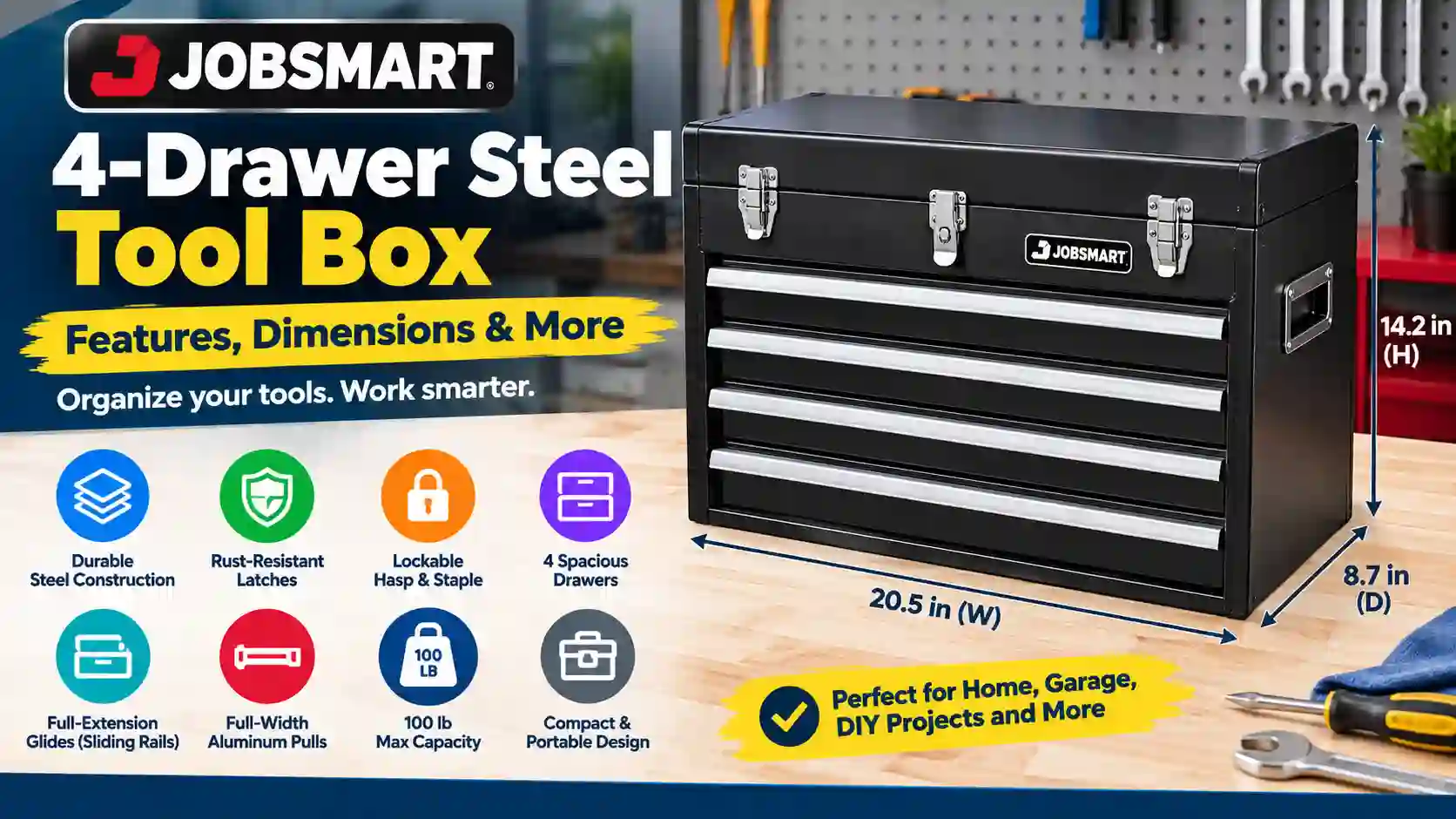
JobSmart 4-Drawer Steel Tool Box: Complete Guide, Features, Uses & Buying Advice
Introduction
When I look at compact tool storage for a garage, workshop, maintenance area, or home project space, I think the most important question is not simply how many tools a box can hold. The better question is whether the storage system makes those tools easier to organize, protect, access, and return to their proper place. The JobSmart 4-drawer steel tool box is designed around that basic idea, combining a steel body with four drawers in a relatively compact format.
The current Tractor Supply listing identifies this model as the JobSmart 20.5 in. x 8.7 in. 4-Drawer Steel Tool Box. The listed specifications include four drawers, steel construction, full-extension glides, a full-width aluminum drawer pull, rust-resistant steel latches, and a lockable hasp-and-staple arrangement. Tractor Supply currently lists the box at 20.5 x 8.7 x 14.2 inches and gives a maximum weight capacity of 100 lb.
In my view, those specifications make this product particularly interesting for people who need more organization than a basic single-compartment toolbox but do not necessarily need a large rolling tool cabinet. It occupies a middle ground: substantially organized, but still much smaller and simpler than a full-size shop cabinet.
I also want to distinguish the product’s documented specifications from personal testing. I have not physically tested this toolbox, so I will not claim that I personally verified drawer smoothness, long-term durability, corrosion resistance, or real-world load performance. Instead, I will use the manufacturer’s and retailer’s published information, along with general tool-storage principles, to explain where this toolbox may fit.
Key Takeaways About the JobSmart 4-Drawer Steel Tool Box
The JobSmart 4-drawer steel tool box is a compact black steel storage box with four drawers. Tractor Supply identifies the primary material as steel, the finish as powder-coated, the durability classification as light duty, and the maximum weight capacity as 100 lb. The listed product weight is 25.7 lb.
The four drawers are one of its most useful features because they allow a user to separate tools into categories rather than placing everything into one deep compartment. For example, one drawer could hold sockets and ratchets, another pliers and cutters, another screwdrivers, and another measuring or specialty tools.
The drawers use sliding rails rather than ball-bearing drawer slides. Tractor Supply’s current Q&A specifically states that the drawers are not ball bearing and instead use sliding rails. That distinction matters because shoppers often assume that every modern multi-drawer tool box uses ball-bearing slides.
The box does not have wheels. Tractor Supply lists the number of wheels as zero, so it should be considered a stationary or manually portable storage box rather than a rolling cabinet. Its approximately 25.7-lb product weight also means that users should consider the total weight after adding tools.
What Is the JobSmart 4-Drawer Steel Tool Box?
The JobSmart 4-drawer steel tool box is a compact metal tool-storage product sold under the JobSmart brand. Tractor Supply identifies JobSmart as an exclusive brand and describes its product range as being intended for DIY users, professional tradespeople, and people maintaining tool collections.
The four-drawer design is the central feature. Instead of opening one large lid and searching through a pile of tools, a user can divide equipment between several horizontal storage areas.
This arrangement can make a significant difference in everyday organization. A toolbox with a single large cavity may technically hold many tools, but retrieving a small screwdriver from underneath several heavier items can become frustrating. Drawers create separate zones and make frequently used items easier to identify.
The steel construction is another important characteristic. Steel provides a rigid enclosure and is commonly used in tool-storage products where resistance to ordinary shop wear is desirable. The current listing identifies the box as powder-coated black steel.
From my perspective, the product should be viewed as a compact organizational toolbox rather than as a replacement for a heavy-duty rolling tool cabinet.
JobSmart 4-Drawer Steel Tool Box Dimensions and Specifications
The published dimensions are important because compact tool storage often looks smaller or larger in photographs than it actually is. Tractor Supply lists the overall dimensions as approximately 20.5 x 8.7 x 14.2 inches, while its specification section separately lists product depth at about 9 inches and product height at about 15 inches. The page therefore presents both product dimensions and rounded specification measurements.
The product weight is listed at 25.7 lb, and the maximum weight capacity is listed at 100 lb. The listing also identifies the box as light-duty rather than heavy-duty.
That distinction is worth emphasizing. A 100-lb maximum capacity does not mean that every drawer is designed to carry 100 lb individually. It is the listed maximum capacity for the product, so users should avoid assuming an equal capacity per drawer.
Published Specification Table
| Specification | Published information |
|---|---|
| Brand | JobSmart |
| Product | 20.5 in. x 8.7 in. 4-Drawer Steel Tool Box |
| Material | Steel |
| Color | Black |
| Finish | Powder-coated |
| Number of drawers | 4 |
| Product weight | 25.7 lb |
| Maximum weight capacity | 100 lb |
| Wheels | 0 |
| Drawer mechanism | Sliding rails |
| Drawer pulls | Full-width aluminum pull |
| Security | Hasp and staple for lockable storage |
| Latches | Rust-resistant steel latches |
| Approximate dimensions | 20.5 x 8.7 x 14.2 in. |
| Durability classification | Light duty |
| Manufacturer part number | 20210900125 |
| Country of origin | Imported / Made in China according to listing |
The most important takeaway is that this is a compact, four-drawer, light-duty steel toolbox rather than a wheeled heavy-duty cabinet. That distinction should guide expectations before purchase.
How the Four Drawers Improve Tool Organization
I believe the four-drawer arrangement is the strongest reason to consider this model. Organization is not just about appearance; it can change how quickly a person can locate a tool.
Imagine a homeowner working on several maintenance tasks. One drawer could contain screwdrivers, another could contain pliers, another could hold wrenches, and the fourth could contain measuring tools and miscellaneous accessories. The exact arrangement can be adapted to the user’s collection.
A mechanic or DIY enthusiast could create a different system. Socket-related tools could occupy one drawer, combination wrenches another, electrical hand tools another, and specialty equipment another.
The advantage is that the user establishes a consistent location for each category. Once that system becomes familiar, the toolbox becomes easier to use.
There is also a practical benefit when multiple people use the same workspace. A clearly organized drawer system reduces the need to ask where particular tools have been placed.
Full-Extension Drawer Glides
Tractor Supply lists full-extension glides as a feature of the JobSmart four-drawer toolbox. Full-extension movement is useful because it allows the drawer to travel farther outward, giving the user better access to the contents rather than restricting access to only the front portion.
However, I would not describe these as ball-bearing slides. The retailer’s Q&A specifically indicates that the drawers use sliding rails rather than ball-bearing drawer slides.
That difference is relevant when comparing this box with larger premium tool cabinets. Ball-bearing slides are often marketed for smooth operation and heavier drawer loads, while this product is positioned as light duty.
For a homeowner or occasional DIY user, the sliding-rail design may be perfectly adequate depending on the tools being stored. Someone planning to fill the box with heavy mechanic’s tools should pay closer attention to the published capacity and the product’s light-duty classification.
Steel Construction and Powder-Coated Finish
The JobSmart toolbox uses a steel body with a powder-coated finish. Tractor Supply lists the primary material as steel and the finish as powder-coated.
Steel provides a rigid storage enclosure that is appropriate for many garage and workshop environments. The powder-coated finish also gives the exterior a finished surface rather than leaving bare steel exposed.
The product listing specifically identifies rust-resistant steel latches. That is useful because latches are frequently handled and can be exposed to moisture and dirt in garage environments.
Still, rust resistance should not be interpreted as complete immunity to corrosion. I would keep any steel toolbox in a reasonably dry environment, wipe away moisture, and avoid leaving it exposed to standing water.
Security Features and Locking
The JobSmart four-drawer toolbox includes a hasp and staple arrangement that allows the box to be secured with a lock. Tractor Supply describes the product as lockable.
This feature can be useful when the toolbox is kept in a shared garage, workshop, utility area, or work environment where users want an additional barrier against casual access.
However, a lockable toolbox should not automatically be considered theft-proof. A small portable box can still be moved, carried away, or physically attacked. I would therefore treat the lock as one layer of security rather than a complete security system.
If the toolbox contains expensive equipment, additional measures such as keeping the box in a secure location or attaching it appropriately to a suitable work surface may be worth considering.
Full-Width Aluminum Drawer Pull
The product listing identifies a full-width aluminum drawer pull.
A full-width pull gives the user a broad surface for opening each drawer. This can be more convenient than a very small handle because the user does not need to position their hand precisely.
The aluminum component also creates a visual contrast with the black steel body.
I would nevertheless avoid making unsupported claims about the pull’s long-term strength because that would require actual testing. The useful point is simply that the manufacturer specification identifies the pull as an aluminum, full-width design.
How Much Can the JobSmart Toolbox Hold?
The published maximum weight capacity is 100 lb.
That figure should be treated as an overall product specification rather than a recommendation to load every drawer to an extreme level.
Tool density varies significantly. A drawer filled with screwdrivers and pliers can weigh very differently from a drawer packed with large sockets, ratchets, metal accessories, or other dense equipment.
I recommend distributing heavier tools across the four drawers rather than concentrating most of the weight in one location. Balanced loading can also make the toolbox easier to operate.
A practical example would be to put heavier wrench and socket collections toward the lower drawers while keeping lighter accessories, measuring tools, and frequently accessed items in upper drawers.
What Type of User Is This Toolbox For?
The product’s light-duty classification gives us an important clue about its intended use.
I would consider it most suitable for people who need organized storage without requiring a large rolling cabinet.
Potential users include:
- Homeowners
- DIY enthusiasts
- Hobbyists
- Students learning mechanical or technical skills
- Small workshop users
- Maintenance workers with modest tool collections
- People organizing hand tools in a garage
- Users who want separate drawers without purchasing a full tool chest
It can also serve as a secondary storage box. Someone who already owns a large rolling cabinet could use a smaller four-drawer box for a specific category of frequently used tools.
Where the JobSmart 4-Drawer Steel Tool Box May Be Less Suitable
The same characteristics that make this product compact can limit its usefulness for demanding professional applications.
A technician with a very large collection of heavy tools may quickly exceed the available storage space. Someone who needs mobile storage may also prefer a wheeled cabinet because this toolbox has no wheels.
Similarly, users specifically looking for ball-bearing drawer slides should understand that the retailer identifies this model as using sliding rails.
The product’s light-duty classification is another reason not to confuse it with a heavy-duty shop cabinet.
In my view, matching the product to the job is more important than simply counting drawers.
Comparison With a Three-Drawer Tool Box
JobSmart also sells a 20.5-inch x 8.7-inch three-drawer steel toolbox. Tractor Supply’s current brand listing shows the three-drawer model alongside the four-drawer version.
The extra drawer gives the four-drawer model more organizational separation. That can be valuable when a user has several categories of small tools.
The three-drawer model may still make sense for someone with a smaller tool collection or who wants fewer compartments.
Four-Drawer vs. Three-Drawer Storage
| Factor | JobSmart 4-Drawer | JobSmart 3-Drawer |
|---|---|---|
| Number of drawers | 4 | 3 |
| Organization | More category separation | Simpler organization |
| Compact format | Yes | Yes |
| Steel construction | Yes | Yes |
| Full-extension glides | Listed | Listed |
| Lockable design | Listed | Listed |
| Best use | Larger organized hand-tool collection | Smaller or simpler collection |
| Current Tractor Supply listing | Yes | Yes |
The key difference is organizational flexibility. If the additional drawer allows you to separate tool categories that would otherwise be mixed together, the four-drawer design can be more convenient.
Step-by-Step: How I Would Organize the Four Drawers
If I were setting up a four-drawer toolbox for general household and DIY use, I would begin by sorting the tools before putting anything inside.
Step 1: Remove Everything From Existing Storage
Place the tools on a clean surface and group similar items together.
Do not immediately start filling drawers. First identify how many categories you actually have.
Step 2: Separate Frequently Used Tools
Create a group for tools used regularly and another for specialty equipment.
Frequently used tools should generally be positioned where they can be accessed quickly.
Step 3: Create Four Main Categories
A possible system might be:
- Screwdrivers and hex keys
- Pliers and cutters
- Wrenches and sockets
- Measuring and specialty tools
The exact categories should reflect the owner’s collection.
Step 4: Place Heavier Items Carefully
Distribute heavy items rather than concentrating them in a single drawer.
Because the manufacturer lists a maximum overall capacity, I would avoid treating every drawer as independently rated for the maximum weight.
Step 5: Label the Drawers
Labels can be particularly helpful if multiple people use the toolbox.
A simple label such as “Sockets,” “Wrenches,” “Pliers,” or “Electrical” can make retrieval faster.
Step 6: Leave Some Room
Do not fill every drawer to the point that adding one small tool becomes difficult.
A little unused space makes organization easier to maintain.
Verified Safety Guidance for Tool Storage
Tool storage is not just about convenience. Safe tool use also depends on keeping tools in appropriate condition.
OSHA’s general-industry standard states:
“Each employer shall be responsible for the safe condition of tools and equipment used by employees.”
Occupational Safety and Health Administration, 29 CFR 1910.242(a).
This quotation matters because a toolbox is part of a broader tool-management system. Simply placing tools into a drawer does not make damaged or unsafe equipment acceptable.
A cracked handle, badly worn wrench, damaged electrical cord, or defective powered tool should be evaluated according to the appropriate safety requirements rather than simply stored away.
OSHA also states that compressed air used for cleaning has specific requirements and should not be treated as an unrestricted cleaning method.
For a general toolbox, ordinary cleaning methods are usually preferable unless the tool manufacturer’s instructions or workplace procedures require something different.
Tool Maintenance and the Role of Storage
A good storage system can support maintenance because it gives users a predictable place to inspect and return equipment.
When tools are scattered across benches, floors, vehicles, and drawers, damaged equipment can be overlooked.
With a four-drawer system, users can periodically inspect each category.
For example, a homeowner could open the screwdriver drawer and check handles and tips. The wrench drawer could be checked for damage or excessive wear. Measuring tools could be kept away from heavy equipment that might damage them.
The toolbox itself should also be inspected. Check latches, drawer movement, handles, and visible corrosion periodically.
A Second Relevant OSHA Quote
OSHA’s hand and power tools guidance emphasizes that tools should be maintained in serviceable condition.
“The employer shall assure that each hand and portable powered tool … is maintained in serviceable condition.”
Occupational Safety and Health Administration, hand and portable powered tools guidance.
I find this principle useful even for people using tools at home because organized storage makes inspection and maintenance easier. The quotation concerns workplace responsibilities, so homeowners should not interpret it as a direct legal requirement for their private toolbox. Instead, it provides a useful safety principle.
Advantages of the JobSmart 4-Drawer Steel Tool Box
One of the biggest advantages is the four-drawer configuration. Four separate compartments can make a modest tool collection substantially easier to organize.
The steel construction is another positive feature for users who prefer a metal storage box.
The compact dimensions also make it easier to fit into a garage, workbench area, shelf, or workshop location than a full-size rolling cabinet.
The lockable hasp-and-staple design provides an additional layer of access control.
The full-width aluminum pulls are another practical detail because they provide a broad opening surface.
The product also has a published 100-lb maximum capacity, giving buyers a defined reference point rather than having to guess how much weight the box can support.
Potential Disadvantages to Consider
The light-duty classification may make this less appropriate for users with extremely heavy tool collections.
The absence of wheels means it is not designed to function like a rolling cabinet.
The drawers use sliding rails rather than ball-bearing slides, which matters to shoppers specifically seeking ball-bearing hardware.
The box itself weighs 25.7 lb before tools are added, so a fully loaded unit can become significantly heavier.
Another consideration is that compact dimensions necessarily limit storage volume. Four drawers can improve organization, but they cannot provide the same total storage space as a large multi-drawer cabinet.
Second Table: Pros, Limitations and Best Uses
| Area | Advantage | Limitation | Best Approach |
|---|---|---|---|
| Organization | Four separate drawers | Less space than a large cabinet | Divide tools by category |
| Construction | Steel body | Classified as light duty | Use for appropriate tool loads |
| Access | Full-extension glides | Sliding rails are not ball-bearing slides | Use for general hand-tool storage |
| Security | Lockable hasp and staple | Not a complete theft-prevention system | Use with secure placement |
| Portability | Compact compared with cabinets | No wheels | Place on a stable work surface |
| Capacity | 100-lb listed maximum | Capacity should not be interpreted per drawer | Distribute weight |
| Appearance | Black powder-coated finish | Finish still needs reasonable care | Keep dry and clean |
| Handle design | Full-width aluminum pulls | Long-term durability requires real-world use | Operate drawers without excessive force |
The table shows why the product should be judged according to its intended role. It offers organized steel storage in a relatively compact package, but it is not a substitute for every type of professional tool cabinet.
Current Price and Availability
The current Tractor Supply listing shows a price of $89.99 at the time of research, although online prices and availability can change by location, promotion, membership status, or date.
I would therefore avoid treating $89.99 as a permanent price.
The product listing also displays store-specific availability information, which means local inventory can differ from the general online listing.
For anyone considering purchase, the sensible approach is to check the current retailer page, enter the intended delivery or pickup location, and confirm the current price before ordering.
What About the Product Warranty?
The current Tractor Supply specification page does not provide a simple fixed warranty period in the main specifications. Instead, it says to refer to manufacturer documentation for warranty information.
That means I would not describe the toolbox as having a lifetime warranty or any other specific warranty period unless the manufacturer documentation confirms it.
This is a good example of why product descriptions should be read carefully. A retailer’s statement that a product is “satisfaction guaranteed” is not necessarily the same thing as a specific manufacturer’s warranty term.
If warranty coverage is important to you, verify the current warranty documentation before purchase.
What Do Customer Reviews Suggest?
The current Tractor Supply listing displays a 4.6-star rating based on 201 reviews.
Customer reviews can provide useful information about practical ownership, but I do not treat them as controlled product testing.
Some reviews on the listing praise the box’s size and four-drawer organization, while at least one recent review describes difficulty with a drawer opening. These individual experiences should not be generalized into a universal product conclusion.
This is why I prefer combining reviews with published specifications.
Reviews can reveal issues that specifications cannot, while specifications provide consistent information that individual reviews cannot guarantee.
Is It Suitable for a Garage?
Yes, the basic design is well suited to many garage organization situations, provided the user stays within its capacity and light-duty positioning.
A garage user might keep common household repair tools in the four drawers and place the box on a stable bench or shelf.
The compact width can be useful when floor space is limited.
I would keep the toolbox away from persistent moisture and avoid treating a rust-resistant latch as proof that the entire box can tolerate wet conditions indefinitely.
Is It Suitable for Professional Mechanics?
That depends heavily on the mechanic’s tool collection and workload.
For a small set of commonly used hand tools, the four-drawer design may provide useful organization.
For a professional mechanic with a large collection of heavy sockets, impact accessories, specialty tools, and other equipment, a larger rolling cabinet may be more appropriate.
The product’s light-duty classification and 100-lb maximum capacity should be taken seriously when making that decision.
I would therefore consider this a compact supplemental or moderate-use storage option rather than automatically calling it a professional heavy-duty cabinet.
How to Keep a Steel Toolbox in Good Condition
Keeping the toolbox clean is straightforward.
Wipe away dust, dirt, and moisture rather than allowing debris to accumulate around drawer rails and latches.
If a drawer begins to feel abnormal, investigate rather than repeatedly forcing it.
Avoid overloading the box.
Keep liquids away from the interior whenever possible.
If the box is used in a humid environment, inspect exposed metal periodically for signs of corrosion.
The exact cleaning or lubrication method should follow the product’s manufacturer instructions. If those instructions specify a particular lubricant or maintenance procedure, follow them rather than applying a random chemical product.
What Should You Store in Each Drawer?
A good drawer system depends on the tools owned, but a general arrangement might look like this:
Drawer 1: Screwdrivers and precision tools
Keep standard screwdrivers, small drivers, hex keys, and similar hand tools together.
Drawer 2: Pliers and cutters
This can hold combination pliers, long-nose pliers, locking pliers, cutters, and related hand tools.
Drawer 3: Wrenches and sockets
Heavier hand tools can be grouped together here, with attention to balanced loading.
Drawer 4: Measuring and specialty tools
Tape measures, levels, specialty accessories, small inspection tools, and less frequently used equipment can occupy this drawer.
The best system is the one that reflects actual use. If you frequently work on electrical projects, for example, dedicating a drawer to electrical hand tools may make more sense.
What Should Not Be Stored Without Consideration?
The toolbox is primarily intended for tool storage, but not every object belongs inside it.
Avoid placing leaking chemical containers inside a metal tool drawer.
Do not store damaged batteries or other potentially hazardous items simply because there is room.
Avoid mixing sharp cutting tools loosely with delicate equipment.
If a particular tool has storage requirements specified by its manufacturer, those requirements should take priority.
For workplace environments, hazardous materials and specialized equipment may also have separate storage requirements.
How to Decide If Four Drawers Are Enough
I recommend starting with the tool collection rather than the toolbox.
Lay out the tools you intend to store and divide them into categories.
If you have four major categories, a four-drawer box may naturally fit your needs.
If you have ten categories and a large collection of heavy tools, four drawers may quickly become crowded.
Think about future expansion as well. Tool collections tend to grow.
A box that fits perfectly today may become cramped after several months of additional purchases.
A Practical Buying Checklist
Before purchasing the JobSmart 4-drawer steel tool box, I would check the following:
- Confirm the current model number.
- Confirm the current dimensions.
- Check the current price.
- Confirm local availability.
- Check the maximum listed capacity.
- Decide whether four drawers are enough.
- Consider the 25.7-lb empty weight.
- Determine whether sliding rails meet your expectations.
- Confirm that a non-wheeled design suits your workspace.
- Review current warranty information.
- Consider where the toolbox will be placed.
- Estimate the weight of the tools you intend to store.
This checklist helps prevent a common purchasing mistake: buying a toolbox based only on appearance or drawer count.
How It Compares With a Large Rolling Cabinet
A large rolling cabinet and a compact four-drawer toolbox serve different purposes.
A rolling cabinet generally provides much greater storage capacity, mobility, and workspace integration. It can be appropriate for a dedicated garage or professional workshop.
The JobSmart four-drawer box is much smaller and does not have wheels.
That makes the smaller box easier to integrate into a limited space, but it also limits total storage volume.
In my view, the choice should be based on tool quantity and workspace rather than assuming that a larger cabinet is automatically better.
If your main problem is that screwdrivers, pliers, wrenches, and small accessories are mixed together, four organized drawers may solve the problem without requiring a large cabinet.
Final Buying Perspective
The JobSmart 4-drawer steel tool box has a straightforward purpose: provide organized, compact steel storage for a moderate hand-tool collection.
The published specifications give it four drawers, full-extension sliding glides, a full-width aluminum drawer pull, rust-resistant latches, a lockable hasp-and-staple arrangement, a 100-lb maximum capacity, and a compact footprint.
The main limitations are equally clear. It is classified as light duty, has no wheels, and uses sliding rails rather than ball-bearing drawer slides.
That combination makes the product easiest to understand when viewed as a compact organizational toolbox.
I would not judge it against a large professional rolling cabinet because the two products are designed around different storage requirements. Instead, I would ask whether four drawers, steel construction, a 100-lb listed capacity, and a compact design match the tools I actually need to store.
Conclusion
The JobSmart 4-drawer steel tool box stands out primarily because it combines a compact footprint with four separate storage drawers. Based on the current published specifications, it offers steel construction, a powder-coated finish, full-extension glides, a full-width aluminum pull, rust-resistant latches, lockable storage, and a 100-lb maximum capacity.
In my view, the most important thing is to match those characteristics with the intended workload. This is listed as a light-duty product, so I would consider it particularly relevant for homeowners, DIY users, hobbyists, and people who need organized hand-tool storage without purchasing a large rolling cabinet.
I would also pay attention to the details that are easy to overlook: the toolbox has no wheels, the drawers use sliding rails rather than ball-bearing slides, and the 100-lb capacity should not be interpreted as a per-drawer rating.
Before buying, I recommend checking the current retailer listing for price, inventory, dimensions, and warranty information. If those specifications match your tool collection and workspace, the four-drawer format can provide a practical way to create a consistent storage system.
Read More : GD7 Playz Blogspot 2025/03/RBS.html: Complete Guide
Frequently Asked Questions
What is the JobSmart 4-drawer steel tool box?
The JobSmart 4-drawer steel tool box is a compact steel storage box with four drawers designed to organize hand tools and accessories. The current Tractor Supply listing identifies the model as a 20.5-inch x 8.7-inch four-drawer steel toolbox, with a listed maximum capacity of 100 lb. It includes sliding drawer glides, aluminum drawer pulls, rust-resistant latches, and a lockable hasp-and-staple design.
What are the dimensions of the JobSmart 4-drawer steel tool box?
The current listing gives the overall dimensions as approximately 20.5 x 8.7 x 14.2 inches. Tractor Supply’s separate specification fields list rounded product measurements of about 9 inches in depth and 15 inches in height. Because retailers can present dimensions differently depending on measurement conventions, buyers should check the current product page before planning a tightly fitted storage location.
How much weight can the JobSmart 4-drawer steel tool box hold?
The current Tractor Supply specification lists a maximum weight capacity of 100 lb. I would treat that as the maximum product capacity rather than assuming each drawer can independently support 100 lb. Heavier tools should be distributed across the drawers, and users should avoid loading the toolbox beyond the published limit.
Does the JobSmart 4-drawer steel tool box have ball-bearing slides?
No. Tractor Supply’s current product Q&A states that the drawers are not ball-bearing drawers and instead use sliding rails. This is an important distinction for buyers comparing the toolbox with larger cabinets that use ball-bearing drawer slides.
Does the JobSmart 4-drawer steel tool box have wheels?
No. The current product specifications list zero wheels. It is therefore better suited to a stationary workbench, shelf, or other stable location than to users who specifically need a rolling tool-storage system.
Is the JobSmart 4-drawer steel tool box lockable?
Yes. The current product description identifies a hasp and staple for lockable security. A lock can provide additional access control, although it should not be treated as a complete theft-prevention system.
Is the JobSmart 4-drawer steel tool box heavy duty?
The current Tractor Supply specification classifies its durability as light duty. That means I would avoid describing this particular model as a heavy-duty professional tool cabinet. Users with large collections of heavy mechanic’s equipment should compare its capacity and drawer construction with larger tool cabinets before purchasing.
What is the JobSmart 4-drawer steel tool box made from?
The primary material is steel, and the current specification identifies a powder-coated finish. The retailer also identifies the latches as rust-resistant steel. These features make the box appropriate for many normal garage and workshop storage situations, although reasonable protection from persistent moisture is still advisable.
Who should consider this toolbox?
I would consider it for homeowners, DIY enthusiasts, hobbyists, maintenance users, and others who need organized hand-tool storage without the size of a rolling cabinet. It can also work as supplemental storage for someone who already owns a larger toolbox and wants a dedicated location for frequently used tools.
What is the current price of the JobSmart 4-drawer steel tool box?
The Tractor Supply listing currently shows $89.99, but product prices can change based on promotions, location, membership offers, and availability. I recommend checking the current listing before purchasing rather than treating that amount as a permanent price.
Does the toolbox come with a warranty?
The current Tractor Supply specification does not provide a fixed warranty period. Instead, it directs buyers to manufacturer documentation for warranty information. I therefore would not claim a specific warranty duration without checking the current manufacturer terms.
How should I organize the four drawers?
A practical system is to assign each drawer to a tool category. For example, one drawer can hold screwdrivers and hex keys, another can contain pliers and cutters, another can store wrenches and sockets, and the fourth can contain measuring and specialty tools. The best arrangement depends on the tools you use most often.
Can the JobSmart 4-drawer steel tool box be used in a garage?
Yes. Its compact steel construction and four-drawer organization can make it useful for many garage-storage situations. I would place it on a stable surface, keep it reasonably dry, avoid exceeding the published capacity, and periodically inspect the drawers, latches, and exterior for wear or corrosion.
Is a four-drawer toolbox better than a three-drawer toolbox?
The answer depends on the size and organization of the tool collection. Four drawers provide an additional category, which can make it easier to separate different types of tools. Someone with a smaller collection may not need the extra drawer. I would choose based on the actual number of categories and the amount of equipment being stored rather than drawer count alone.
Sources and References
- Tractor Supply Co., JobSmart 20.5 in. x 8.7 in. 4-Drawer Steel Tool Box, including current specifications, features, price, capacity, dimensions, drawer information, and product Q&A.
- Tractor Supply Co., JobSmart Tool Boxes, for current brand and product-category information.
- Occupational Safety and Health Administration, 29 CFR 1910.242 — Hand and portable powered tools and equipment, general, for workplace tool-safety requirements.
- Occupational Safety and Health Administration, Hand and Power Tools — Standards, for applicable workplace standards.
Disclaimer
This article is provided for informational purposes and is based on product information available at the time of research. Prices, availability, specifications, retailer information, and warranty terms can change. Product specifications should be confirmed with the current retailer or manufacturer before purchase. The author has not personally tested the JobSmart 4-drawer steel tool box, so statements about real-world performance are based on published specifications and general tool-storage considerations rather than firsthand product testing. OSHA references describe workplace safety requirements and should not be interpreted as personalized legal or safety advice.

GD7 Playz Blogspot 2025/03/RBS.html: Meaning, URL Structure, Safety & What to Know
Introduction
When I first look at a search phrase such as gd7 playz.blogspot/2025/03/rbs.html, the most important thing is to separate what the URL actually tells us from what people may assume it means. The phrase looks like a specific webpage address associated with a Blogger or Blogspot site, but the address alone does not provide enough information to establish exactly what the original page contains.
The structure is interesting because it appears to combine a blog name, a Blogger-style domain, a year and month path, and an individual post ending in “rbs.html.” Blogger supports individual posts, post URLs, timestamps, titles, labels, and permalinks, so this general structure is consistent with the way Blogger organizes blog content.
My goal in this guide is therefore to explain the keyword carefully rather than invent a definition for “RBS.” I will break down the URL, explain what can reasonably be inferred from its structure, discuss why people may search for an obscure Blogspot address, examine different interpretations of the term, and show readers how to evaluate an unfamiliar webpage before trusting it.
Key Takeaways About gd7 playz.blogspot/2025/03/rbs.html
The keyword gd7 playz.blogspot/2025/03/rbs.html appears to refer to a specific Blogger-style webpage rather than a general software term or universally recognized technology. The URL structure can provide clues about the platform and post organization, but it cannot independently establish the content, author, purpose, or credibility of the page.
The “gd7 playz” portion may represent the blog name or publishing identity. The “2025/03” portion resembles a date-based Blogger path. The “rbs.html” portion looks like an individual post permalink or slug. Blogger documentation confirms that individual posts have URLs and permalink information, and that publishers can configure parts of their post URLs.
I believe the most important point for readers is simple: a URL is an identifier, not proof of what is behind it. A technically formatted address can lead to useful information, ordinary blog content, outdated material, or something that deserves caution.
The exact expansion of “RBS” should also be treated carefully. The acronym has many possible meanings in different contexts, and the keyword alone does not establish which one was intended by the original publisher.
What Is gd7 playz.blogspot/2025/03/rbs.html?
The phrase gd7 playz.blogspot/2025/03/rbs.html appears to be a shortened or imperfectly formatted representation of a Blogspot-style webpage address. A complete Blogger address normally contains a blog subdomain followed by the Blogger domain and then a path identifying the post.
The important distinction is between the search phrase and the actual live URL. When people type a URL into a search engine, they may remove punctuation, spaces, or parts of the domain accidentally. For example, “gd7 playz.blogspot/2025/03/rbs.html” contains a space between “gd7” and “playz,” which makes it look different from a conventional web address.
That does not necessarily mean the phrase is meaningless. Search engines frequently interpret incomplete or incorrectly formatted queries and attempt to find pages associated with the terms. A person may also have copied the phrase from another website, social media post, video description, comment, or message.
From my perspective, the safest description is that the keyword points toward a particular Blogger-style page associated with the name “GD7 Playz” and the path “2025/03/rbs.html,” but the exact page content needs to be verified separately.
Breaking Down the URL Structure
Looking at each component separately makes the keyword much easier to understand.
| URL Component | What It Appears to Represent | What We Can Safely Infer |
|---|---|---|
| gd7 playz | Possible blog or publisher name | It appears to identify the publishing site or brand |
| Blogspot | Blogger hosting domain | The address appears associated with Blogger-style hosting |
| 2025 | Year component | It resembles a year-based post path |
| 03 | Month component | It resembles a March date component |
| rbs.html | Post path or slug | It appears to identify an individual page |
| Full phrase | Search keyword | It combines the above elements into one query |
The key takeaway from this breakdown is that most of the information comes from the URL’s structure rather than from verified information about the article itself.
Blogger’s official documentation describes post data including a post title, body, author, URL, timestamp, labels, comments, and other information. It also documents permalink settings for posts.
What Does “GD7 Playz” Mean?
The phrase “GD7 Playz” appears to function like a blog, channel, creator, or publishing identity. The word “Playz” naturally resembles language used by gaming creators, entertainment publishers, or online communities, but that wording alone does not prove that the page is exclusively about gaming.
This distinction matters because search results can encourage readers to make assumptions. If a name contains a word associated with gaming, readers may automatically conclude that every page on the site contains game guides or gaming tools. That conclusion would go beyond what the URL itself establishes.
In my analysis, “GD7 Playz” should therefore be treated as the apparent identity associated with the URL rather than as a confirmed description of the site’s complete subject matter.
A publisher can also change its content over time. A blog that once discussed one topic may later publish unrelated posts. Consequently, a site’s name should not be treated as a complete description of a particular article.
What Does “2025/03” Tell Us?
The 2025/03 portion is one of the clearest clues in the keyword. It resembles the date-based URL pattern commonly associated with Blogger posts.
Blogger’s documentation shows that posts have timestamps and URLs, while its help resources explain that publishers can configure post permalinks. Official Blogger community discussions also document the familiar year/month/post-name format used by Blogger posts.
This means that “2025/03” can reasonably be interpreted as a path associated with March 2025. However, I would avoid treating the URL alone as definitive proof of the exact publication date of the content currently visible on a page.
There can be situations involving republishing, permalink settings, redirects, or changes to posts. For that reason, the page’s own visible publication information is stronger evidence than simply reading numbers in a URL.
What Does “RBS.html” Mean?
The rbs.html portion is more difficult to interpret.
The “.html” ending is consistent with a webpage filename-style structure. The “rbs” portion may be a shortened title, abbreviation, identifier, or term chosen by the publisher. Blogger allows publishers to work with post permalinks, meaning the final part of a post URL can be related to the post’s chosen URL or title.
What I cannot responsibly conclude is that “RBS” definitely stands for one particular phrase.
RBS is an acronym used in many unrelated contexts. It can refer to different concepts in banking, education, technology, gaming, organizations, and other areas. Without a verified explanation from the original page, assigning one meaning would risk turning speculation into misinformation.
For SEO content, this is particularly important. An article can rank for a strange keyword by repeating an invented explanation, but ranking does not make the explanation correct.
Why Are People Searching for This Keyword?
There are several reasonable explanations for searches involving an obscure URL.
First, a person may have encountered the address somewhere else and wants to know what it is before opening it. This is common with unfamiliar links.
Second, the person may be looking for a page that was previously shared in a gaming community, group, video, comment, or forum.
Third, someone may have seen the phrase in search results and wants to understand why it appears there.
Fourth, the person may have copied the address incorrectly and is trying different versions of the keyword to locate the original page.
Finally, a searcher may simply be researching an unfamiliar phrase because it has started appearing repeatedly online.
The important lesson is that search demand does not automatically establish authority. A phrase can receive searches because people are confused about it, not because the underlying page represents a major technology or established product.
Is gd7 playz.blogspot/2025/03/rbs.html a Framework?
Some third-party pages found in search results describe the keyword using technical language, including claims that it relates to an HTML framework or modular gaming structure. Other pages describe it more generally as a Blogspot article or gaming-related page.
These descriptions conflict with one another, which is itself useful evidence: there is not a sufficiently reliable basis for presenting the “framework” interpretation as an established fact.
A framework normally has identifiable technical characteristics. Depending on the technology, readers would expect documentation, version information, code examples, installation instructions, a repository, API references, or other evidence showing that a reusable software system exists.
A Blogspot post can discuss a framework without being a framework itself. A page can also contain HTML without being an “HTML framework.”
Therefore, I would not describe gd7 playz.blogspot/2025/03/rbs.html as an established framework unless the original publisher provides clear technical documentation supporting that claim.
Why the Difference Between a Blog Post and a Tool Matters
Imagine two webpages.
The first is an article explaining how a gaming dashboard might be designed. The second is an actual downloadable framework containing reusable code, documentation, and implementation instructions.
Both pages could mention HTML, dashboards, gaming, and modular design. Yet they serve completely different purposes.
This distinction prevents a common mistake in online research: confusing an article about a technology with the technology itself.
If a reader searches for GD7 Playz RBS expecting software, the reader should look for concrete evidence such as installation steps, code repositories, documentation, or a demonstrable working project. If none exists, the page may simply be informational content.
How to Evaluate the Page Before Trusting It
When I evaluate an unfamiliar webpage, I look at several independent signals rather than relying on the URL alone.
Check the Exact Domain
Start by confirming the complete domain name. A genuine Blogger address and an unrelated domain containing similar words are not the same thing.
Pay attention to spelling, additional characters, unexpected subdomains, and redirects.
Check the Page Title
The title should explain what the page is about. If the title has nothing to do with the search phrase, investigate further.
Check the Author or Publisher
A transparent page should provide some indication of who created the content when authorship matters. Blogger supports post author information as part of its post data.
Check the Date
If the article discusses software, games, security, or online services, date information can matter significantly. A page from March 2025 may no longer reflect the current situation in September 2026.
Check External Links
Look at where the page sends visitors. Links to recognized documentation or established resources can provide context. Unexpected download links, suspicious redirects, or requests for credentials deserve additional caution.
Check for Download Requests
A page that unexpectedly asks users to download executable files should be treated more carefully than an ordinary informational article.
Check for Login Requests
Never enter a password simply because a webpage asks for one. Confirm that the login destination belongs to the service you intended to use.
A Practical Safety Checklist
| Check | What to Look For | Recommended Response |
|---|---|---|
| Domain | Correct spelling and expected host | Continue only if it matches your expectation |
| Page title | Clear relationship to the keyword | Investigate if unrelated |
| Author | Identifiable publisher or author | Look for additional credibility signals |
| Date | Publication or update information | Consider whether information may be outdated |
| Links | Relevant and recognizable destinations | Avoid suspicious redirects |
| Downloads | Unexpected executable or archive files | Do not download without verification |
| Login | Requests for passwords or credentials | Verify the destination first |
| Claims | Strong technical or financial claims | Look for independent evidence |
The table is useful because no single signal is perfect. A legitimate page can have a simple design, while a deceptive page can look professional. I prefer a combined assessment.
How Blogger Pages Work
Blogger is a publishing platform that allows users to create and manage blogs. Google’s official Blogger documentation explains that users can create a blog, choose a blog address, publish posts, and manage blog settings.
Blogger also provides tools for search visibility. Google explains that publishers can make blogs visible to search engines and use relevant keywords in titles and text.
This explains why an obscure Blogger page can potentially appear in search results. A page does not need to be hosted on a large corporate website to be discoverable.
At the same time, search visibility should not be confused with endorsement. A page appearing in a search engine does not automatically mean that its claims have been independently verified.
Why Blogspot URLs Can Look Technical
A URL such as gd7 playz.blogspot/2025/03/rbs.html can look more technical than a modern URL because it exposes structural elements.
The year and month create a recognizable path. The “.html” ending resembles an older static webpage structure. The short “rbs” segment looks like a file or technical identifier.
But appearance can be misleading.
A URL does not necessarily describe the technology running the page. It mainly provides an address that helps identify and retrieve content.
For that reason, I would not infer software architecture, programming language, database technology, or framework capabilities solely from the URL.
What If the Page No Longer Opens?
An old or obscure webpage may become unavailable for many reasons.
The blog could have been deleted. The post could have been removed. The owner could have changed settings. A domain or subdomain could have become unavailable. The page might also redirect somewhere else.
Blogger provides tools for redirects and URL management, which means URL behavior can change when publishers modify their sites. Google’s Blogger help documentation specifically discusses changing or redirecting URLs.
If the exact page no longer loads, I would not replace missing evidence with speculation. Instead, search for the exact URL in quotation marks, look for references from reliable sources, and compare cached or archived descriptions where appropriate.
Can Search Results Prove What the Original Page Says?
Search snippets can be useful, but I would treat them as clues rather than complete evidence.
A search engine may display text generated from a page, surrounding context, metadata, or other signals. Third-party websites may also create pages targeting the same keyword without having any direct connection to the original publisher.
This is especially important with unusual keywords. Once a phrase becomes searchable, multiple websites may publish articles about it. Some writers may copy assumptions from earlier pages, causing the same unsupported claim to appear repeatedly.
Ten websites repeating the same statement do not necessarily equal ten independent confirmations.
Why Third-Party Articles Need Careful Reading
During research for this topic, I found several third-party pages discussing the same keyword. Their explanations were not consistent.
Some presented the phrase as a normal Blogspot page. Others described it as gaming-related. Another set of pages made stronger technical claims about frameworks or modular HTML systems.
Because those claims do not agree, I would not use the strongest version as a fact without primary evidence.
This is an important research principle for unusual SEO keywords: repetition is not verification.
If the original source is unavailable, the responsible approach is to distinguish between what is observable, what other websites claim, and what remains unknown.
What Could “RBS” Stand For?
Without the original page’s explanation, “RBS” has no single reliable expansion in this context.
It could theoretically be an abbreviation chosen by the blog author. It could represent the title of a game-related topic, an internal label, a project name, or a completely unrelated abbreviation.
For example, if a hypothetical publisher created a post called “RBS Gaming Guide,” the resulting slug could contain “rbs.” That would not mean that RBS is a recognized technology.
Similarly, if “RBS” were the initials of a phrase used by a particular gaming community, readers outside that community might not recognize it.
The practical answer is therefore straightforward: the keyword does not provide enough evidence to define RBS conclusively.
Common Misconceptions About gd7 playz.blogspot/2025/03/rbs.html
Misconception 1: The URL Must Be a Software Tool
A webpage address does not prove that the page is software.
A blog post can contain explanations, screenshots, code snippets, reviews, or links without being a tool itself.
Misconception 2: “HTML” Means It Is an HTML Framework
The “.html” ending identifies a webpage-style filename or URL pattern. It does not establish that the page represents an HTML framework.
Misconception 3: Search Ranking Means Verification
Search engines can index a wide variety of content. Ranking or appearing in search results does not independently verify every claim made on a page.
Misconception 4: Every Blogspot Page Is Unsafe
Blogger is a legitimate publishing platform. Individual pages should still be evaluated based on their content and behavior rather than judged solely because they use Blogspot.
Misconception 5: Every Blogspot Page Is Automatically Safe
The opposite assumption is also incorrect. A legitimate hosting platform can contain user-generated content, so readers should still use normal online safety practices.
How to Research the Keyword More Effectively
If I were investigating gd7 playz.blogspot/2025/03/rbs.html from scratch, I would use a structured process.
First, I would search the exact phrase in quotation marks. This helps distinguish exact-match references from pages merely containing some of the same words.
Second, I would search variations such as “GD7 Playz RBS,” “GD7 Playz Blogspot,” and “RBS GD7 Playz.”
Third, I would look for the original Blogspot domain rather than relying exclusively on articles written about it.
Fourth, I would compare dates. If an article discussing the page was published long after the supposed original post, it should not automatically be treated as evidence of what the original page contained.
Fifth, I would look for independent references. If a gaming community, official developer, documentation site, or established publisher refers to the page, that can provide additional context.
Finally, I would clearly separate verified facts from interpretations.
How to Read an Unfamiliar Gaming Blog
If the GD7 Playz name is indeed associated with gaming content, readers can apply a few additional checks.
Look at whether the article identifies the game being discussed. Check whether screenshots match the game. Look for update dates if the article discusses current features. If it recommends a download, determine whether that download comes from the game’s official source.
Gaming communities often share unofficial guides, mods, tools, files, and links. Some may be useful, while others may be outdated or unsafe.
I believe readers should be particularly cautious when a gaming page asks them to disable security software, provide account credentials, install unknown applications, or complete unrelated surveys before receiving a supposed file.
How to Distinguish Information From Promotion
A page may look like an informational guide while primarily encouraging visitors to click advertisements or external links.
That does not automatically make the page fraudulent. Advertising is a normal part of online publishing.
The useful distinction is whether the article answers the reader’s question independently.
For example, an informative article about a game feature should explain the feature. A page that repeatedly tells readers to click external links without providing meaningful information is less useful as a reference.
When evaluating GD7 Playz-related content, I would therefore look at the actual information density rather than judging the page solely by its appearance.
What Readers Should Do If They Encounter a Suspicious Redirect
If an unfamiliar page immediately redirects through several unrelated domains, I would close the page rather than continuing through each redirect.
Do not enter credentials simply because a redirected page displays a familiar-looking logo. If you need to access a game, social network, email account, or other service, navigate to the service’s known official website independently.
Similarly, do not install browser extensions or applications simply because an unfamiliar page says they are required to continue.
A normal article generally should not need unusual security changes just to display text.
How the Keyword Relates to SEO
From an SEO perspective, gd7 playz.blogspot/2025/03/rbs.html is an example of a highly specific long-tail search phrase.
It contains what appears to be a brand or blog name, a platform identifier, a date path, and a specific slug. Such queries can have very different intent from broad terms such as “gaming blog” or “HTML framework.”
Google’s official Blogger guidance states that publishers can use relevant keywords in titles and text to help search engines understand their blog content. It also provides tools for controlling search visibility and post URLs.
However, keyword targeting should not be confused with factual authority. A publisher can target an unusual phrase successfully while still needing to provide accurate, useful information.
For this reason, an article targeting the keyword should focus on clarity, evidence, and the actual questions readers are asking.
Recommended Content Structure for This Keyword
If I were creating an SEO page around this query, I would organize it around the user’s likely questions rather than repeating the keyword excessively.
A useful structure would include:
- What is gd7 playz.blogspot/2025/03/rbs.html?
- How to understand the URL structure
- What GD7 Playz may refer to
- What the RBS portion means or does not establish
- Why people search for the page
- Whether the page should be trusted
- How to check an unfamiliar Blogspot page
- Common misconceptions
- Frequently asked questions
This approach provides topical coverage without keyword stuffing.
Practical Example: Evaluating the URL
Imagine a reader receives the phrase from a friend.
The reader searches the exact phrase and finds several pages describing it differently. One page calls it a gaming resource, another calls it a technical framework, and another simply describes it as a Blogspot article.
Instead of choosing the most detailed description automatically, I would return to the primary source.
If the original page clearly says it is a gaming article, that supports the gaming interpretation.
If it contains technical documentation, code, and implementation instructions, that may support a technical interpretation.
If the page is unavailable, I would state that the exact purpose cannot be confirmed.
This method protects readers from accepting a confident explanation simply because it contains more technical vocabulary.
First Table: Evidence Strength for Different Claims
| Claim About the Keyword | Evidence Available From the URL | Confidence |
|---|---|---|
| It resembles a Blogger/Blogspot post address | Strong structural indication | Relatively high |
| “2025/03” resembles a year/month path | Strong structural indication | High |
| “rbs.html” identifies a page or slug | Strong structural indication | High |
| GD7 Playz is a gaming brand | Name suggests it, but not sufficient proof | Low to moderate |
| RBS has one specific meaning | Not established by URL alone | Low |
| It is an HTML framework | Conflicting third-party descriptions | Low |
| It contains a downloadable tool | Not established | Unknown |
| It is safe or unsafe | Requires page-level examination | Unknown |
The most important takeaway from this table is that URL structure can provide useful information, but it cannot answer every question about the underlying page.
What I Believe Readers Should Take From the Evidence
In my view, the strongest conclusion is not a complicated technical definition. It is a methodological one.
When a keyword looks mysterious, start with what can actually be verified.
The phrase appears to identify a Blogger-style post. The date path resembles March 2025. The final “rbs.html” portion appears to identify an individual page. Beyond those structural observations, the available evidence becomes less certain.
That does not mean the page is unimportant. It simply means readers should not confuse online repetition with verification.
A careful article can still be highly useful even when the original page is difficult to verify. The value comes from explaining what is known, identifying what remains uncertain, and giving readers a reliable way to investigate further.
Verified Quote: Why Search Visibility Matters
Google’s official Blogger guidance explains how publishers can improve discoverability by making their blogs visible to search engines and using relevant keywords in titles and text.
“You can make it easier for people to find your blog on search engines like Google and Bing.”
Google Blogger Help
This matters because it explains why even a small Blogger publication can become searchable. Visibility is a publishing and SEO feature, not proof that every claim on a page has been independently checked.
How Bloggers Can Make Pages Easier to Understand
A page targeting an obscure keyword should explain the topic immediately.
The title should tell readers what they will learn. The introduction should answer the main question. Headings should organize the supporting information. Important claims should have evidence where appropriate.
Google’s Blogger documentation also provides publishers with the ability to customize post permalinks, which means URL structure can be part of how a publisher organizes and presents content.
For a phrase such as GD7 Playz RBS, a clear title would be more helpful than repeating the raw URL throughout the page.
What Makes a Good Explanation of an Unknown URL?
A strong explanation should accomplish four things.
First, it should identify the type of URL.
Second, it should explain what can be inferred from its structure.
Third, it should identify uncertainties rather than hiding them.
Fourth, it should give the reader practical steps for verifying the original source.
This is especially important for SEO articles about unusual search terms. The temptation is to invent a complete story around an incomplete keyword. I believe the better strategy is to make the distinction between evidence and interpretation visible to the reader.
Second Table: What to Check Before Using Information From the Page
| Area | Questions to Ask | Why It Matters |
|---|---|---|
| Original source | Can the exact page be opened? | Confirms whether the source is accessible |
| Author | Who published it? | Helps establish accountability |
| Publication date | When was it published or updated? | Indicates how current the information may be |
| Topic | Does the content actually explain RBS? | Prevents assumptions based on the URL |
| Technical claims | Is documentation provided? | Helps distinguish a real tool from a description |
| Downloads | Are files offered? | Requires additional security caution |
| External links | Where do they lead? | Reveals whether the page redirects elsewhere |
| Independent sources | Do reliable sources confirm the claims? | Provides additional verification |
The practical lesson is that readers should evaluate the page as a source rather than judging it by its unusual URL.
Common Questions About GD7 Playz RBS
Is gd7 playz.blogspot/2025/03/rbs.html a real URL?
The phrase resembles a Blogger-style URL, but the version written with a space between “gd7” and “playz” is not a conventional complete web address. The exact live URL should be verified before treating the phrase as a direct link.
What does gd7 playz mean?
“GD7 Playz” appears to be a publishing or blog identity associated with the keyword. The name may suggest gaming because of the word “Playz,” but the name alone does not establish the exact subject of the website.
What does RBS mean in gd7 playz?
The meaning of “RBS” cannot be confirmed from the keyword alone. It may be an abbreviation or short identifier chosen by the publisher. Because RBS has many meanings in different contexts, it would be misleading to assign one expansion without evidence from the original page.
Is gd7 playz.blogspot/2025/03/rbs.html a gaming website?
The name “Playz” can suggest gaming-related content, and some third-party search results describe the keyword in a gaming context. However, the URL itself does not prove that the entire site or particular page is gaming-focused.
Is GD7 Playz RBS an HTML framework?
There is insufficient reliable evidence to establish that it is a recognized HTML framework. Some third-party pages make technical claims about the keyword, but those descriptions are inconsistent. A real framework would normally have clearer documentation or other technical evidence.
Is Blogspot safe?
Blogger is a legitimate Google blogging platform, but individual pages should still be evaluated separately. A platform being legitimate does not mean every user-created page contains accurate or trustworthy information.
Why does the URL contain 2025/03?
The year/month pattern resembles Blogger’s date-based post URL structure. It is consistent with a post associated with March 2025, although readers should use the page’s own publication information when an exact date matters.
Should I download files from an unfamiliar GD7 Playz page?
I would not download an unknown file simply because a page recommends it. Check the source, file type, destination, and reputation first. Executable files and unexpected installers deserve particular caution.
Can the RBS page be trusted?
Trust should be determined from the actual page and supporting evidence rather than from the Blogspot name or URL alone. Check authorship, claims, links, dates, downloads, and independent references before relying on important information.
Why are so many websites discussing this keyword?
An unusual keyword can generate curiosity when people encounter it in search results, social media, forums, or other websites. Once a phrase becomes searchable, additional sites may publish content targeting it. That does not mean every article has independently verified the original information.
Conclusion
When I examine gd7 playz.blogspot/2025/03/rbs.html, the most useful conclusion is that it appears to be a specific Blogger-style webpage address whose structure provides some clues but does not reveal everything about the original content. The “2025/03” section resembles a date-based path, while “rbs.html” appears to identify an individual page or post.
I believe readers should be particularly careful about claims that go beyond those basic observations. Search results contain conflicting descriptions of the keyword, including claims that it represents gaming content or a technical framework. Without reliable primary evidence, those interpretations should remain descriptions of what others claim rather than established facts.
For anyone researching the page, the best next step is to verify the exact original URL, inspect the publisher and article, check the date, examine external links, and avoid downloads or credential requests that cannot be independently verified.
The broader lesson is useful beyond this one keyword: when an unfamiliar URL becomes popular, the right response is not to assume that it is either important or dangerous. Instead, I recommend separating observable facts from speculation and allowing reliable evidence to determine the final interpretation.
Read More : C.S.I. Las Vegas Cast: Actors, Characters & Guide
Frequently Asked Questions
What is gd7 playz.blogspot/2025/03/rbs.html?
It appears to be a Blogger-style webpage address associated with a blog or publisher identified as GD7 Playz. The “2025/03” portion resembles a year/month path, while “rbs.html” appears to identify an individual post. The exact content and purpose of the original page should be verified directly rather than inferred solely from the URL.
What is the purpose of the GD7 Playz RBS page?
The exact purpose cannot be established confidently from the keyword alone. Some third-party pages associate it with gaming or technical content, but their descriptions are inconsistent. I would therefore avoid presenting one particular purpose as confirmed unless the original page or a reliable primary source clearly establishes it.
Does RBS have a confirmed meaning on this page?
No confirmed meaning can be established from the URL itself. RBS is a widely used acronym with different meanings across different fields. Unless the original publisher explains the abbreviation, assigning a specific expansion would be speculation.
Is gd7 playz.blogspot/2025/03/rbs.html safe to visit?
The safety of an individual webpage cannot be determined simply from the fact that it uses Blogger or from the URL structure. Readers should verify the exact domain, watch for redirects, avoid entering credentials, and be cautious about downloads or requests to disable security protections.
Is GD7 Playz a Blogger website?
The keyword is formatted like a Blogger or Blogspot address, so that is a reasonable interpretation of its structure. Google’s Blogger documentation confirms that Blogger provides blog addresses, individual post URLs, timestamps, authors, and permalink functionality. The exact live domain should still be checked before making a definitive claim about a particular site.
Can I use information from the RBS page?
You can use information from any webpage as a starting point for research, but important claims should be independently verified. This is especially relevant when the page concerns software, downloads, financial information, account security, or other topics where inaccurate information could cause harm.
Why is the keyword written as gd7 playz instead of a normal domain?
The phrase may have been copied, typed, or indexed with a spacing variation. A normal domain cannot generally contain an ordinary space, so readers should verify the complete original web address before attempting to open it.
Is the March 2025 date still relevant?
The date may be relevant for understanding when a post was originally organized or published, but information from March 2025 may be outdated by September 2026. For current software, gaming, security, or platform information, readers should check newer documentation and current sources.
Sources and References
Google Blogger Help provides documentation on Blogger post data, including URLs, titles, authors, timestamps, post bodies, and other post properties.
Google Blogger Help also explains search visibility, keyword use, and Blogger permalink customization.
Google’s Blogger Help documentation explains that users can create and manage blogs and choose a blog address or URL.
Third-party search results were reviewed to identify how the keyword is being described online. Because those sources provide conflicting interpretations, their claims were not treated as definitive evidence of what “RBS” means or what the original page contains.
Disclaimer
This article is intended for informational and research purposes. The exact content, ownership, meaning, and current availability of gd7 playz.blogspot/2025/03/rbs.html should be verified from the original webpage or other reliable primary sources. References to possible meanings or third-party descriptions should not be treated as confirmation of claims that cannot be independently verified.
-

 Entertianment2 months ago
YarrList: What It Is, Safety, Legality, and Alternatives
-

 AI2 months ago
vrgamegirl19/comfyui-vrgamedevgirl: Features, Setup, Installation, and Safety Guide
-

 Business2 months ago
410 Terry Avenue N Seattle WA 98109: What Is at This Address?
-

 Health2 months ago
Hemp Gummies for Soothing Relief 750mg / 30 Count: Facts, Safety, Ingredients, and Evidence
-

 AI2 months ago
Open CoDesign: What It Is, Features, Setup, and How It Works
-

 Technology2 months ago
Application Compatibility Toolkit 5.0: Features, Installation, Testing, Fixes, and Modern Alternatives
-

 Guide2 months ago
Best Laptops for Writers in 2026: 7 Top Picks for Writing, Research, and Travel
-

 Business2 months ago
Doubtnut Valuation: From $154M Peak to $10M ALLEN Acquisition