Food & Drinks
Kamado Grill vs Offset Smoker Comparison: Which Is Better in 2026?

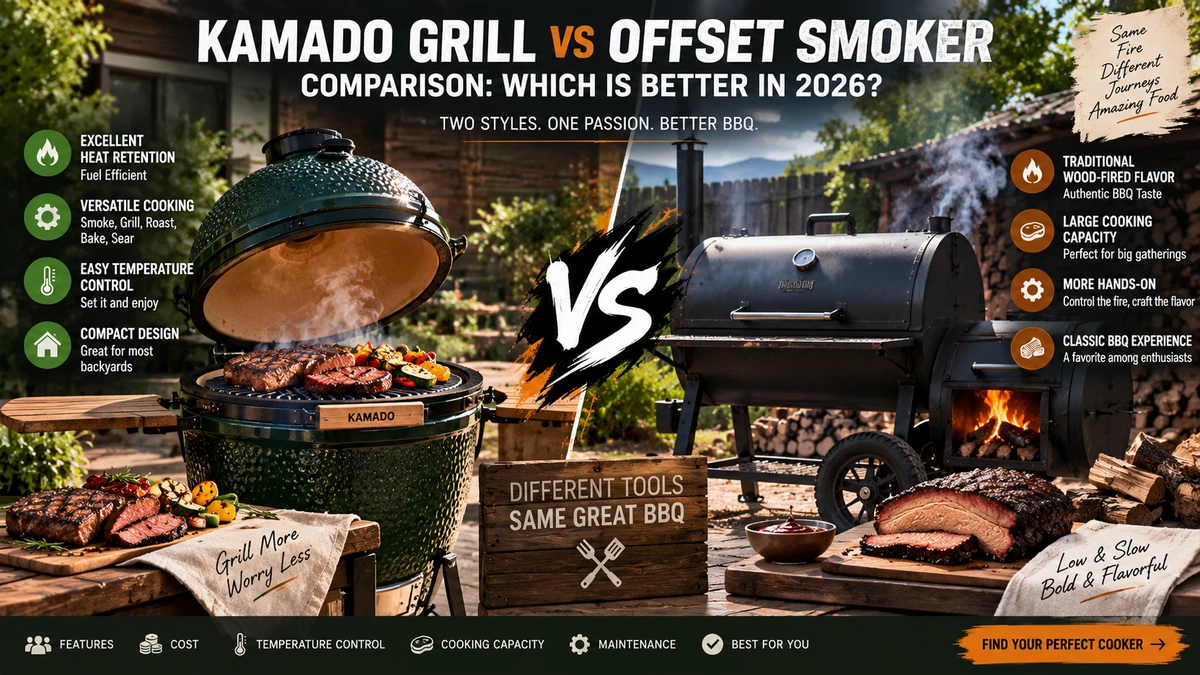
Choosing between a kamado grill and an offset smoker is really a choice between two different approaches to live-fire cooking. Both can produce excellent brisket, pork shoulder, ribs, chicken, and other smoked foods, but they ask very different things from the person running the fire.
In my Kamado Grill vs Offset Smoker Comparison, I give the advantage to a kamado for most people who want one outdoor cooker that can smoke, grill, roast, bake, and sear without demanding constant fire management. I give the offset smoker the advantage to barbecue enthusiasts whose priority is traditional wood-fire smoking, large cooking capacity, and direct control over the combustion process.
That distinction becomes much clearer once we look at how each cooker works. A kamado is a compact, highly insulated charcoal cooker, commonly made from ceramic or insulated steel. Air enters near the bottom, passes through the charcoal, and exits through a top vent. Because the body retains heat so efficiently, relatively small vent adjustments can hold low temperatures for long cooks or support very high heat for grilling and pizza.
An offset smoker takes the opposite architectural approach. Its fire burns in a separate box mounted beside the main cooking chamber. Heat and smoke move from the firebox through the food chamber and eventually leave through a chimney. Oklahoma Joe’s describes the basic design this way:
“An offset smoker features a separate firebox positioned to the side of the main cooking chamber.”
Oklahoma Joe’s
That separate firebox is what makes an offset smoker so attractive to people who enjoy traditional barbecue. I can add wood, adjust the fire, influence airflow, watch the smoke, and manage the cooking chamber without opening the main chamber every time the fire needs attention.
Neither design is universally better. A small family cooking steaks on Friday and brisket once a month has very different needs from someone smoking six racks of ribs every weekend. The better cooker is the one whose strengths match how often you cook, what you cook, how much space you have, and how much attention you want to give the fire.
Key Takeaways From This Kamado Grill vs Offset Smoker Comparison
If I had to reduce the comparison to the most practical conclusions, these would be the points I would remember:
- Choose a kamado grill if you want one cooker for smoking, grilling, roasting, pizza, and high-temperature searing.
- Choose an offset smoker if traditional wood-fired barbecue is the main reason you are buying a cooker.
- Kamados generally use fuel efficiently because their insulated construction reduces heat loss.
- Offset smokers typically require more active fire management.
- Offset smokers often provide much more horizontal cooking space for briskets, ribs, and large gatherings.
- Kamados are usually easier to operate once the vents are understood.
- Offset smokers give the cook more direct control over the fire and smoke.
- Kamados can reach very high grilling temperatures. Current models such as the Kamado Joe Classic Joe III are specified from 225°F to 750°F.
- Offset smokers are designed primarily around indirect low-and-slow cooking, although many include firebox grilling or other direct-grilling capabilities.
- Ceramic kamados are heavy and can be vulnerable to ceramic damage if mishandled.
- Steel offset smokers can occupy considerably more patio space and may require protection against corrosion.
- An offset smoker is often the more rewarding tool for someone who actually enjoys tending a live wood fire.
- A kamado is usually the easier recommendation when only one outdoor cooker will be owned.
- Both require proper food-temperature monitoring during low-and-slow cooking.
My overall decision is therefore not “kamado good, offset bad” or the reverse. It is versatility and efficiency versus capacity and traditional fire management.
What Is a Kamado Grill?
A kamado is an insulated charcoal cooker based on a vertically oriented, egg-shaped or rounded cooking chamber.
Traditional premium models use thick ceramic walls. Big Green Egg, for example, describes its Large model as having ceramic construction that retains heat and moisture, with a stated operating range from 200°F to 750°F.
Kamado Joe’s Classic Joe III is another ceramic example. The current manufacturer specifications list an 18-inch cooking surface, 250 square inches of standard cooking space, a weight of about 281 pounds with the cart configuration, and a heat range from 225°F to 750°F.
Not every kamado is ceramic.
The Weber Summit Kamado E6 uses dual-wall insulated steel rather than thick ceramic. Weber says that this design maintains heat while reducing charcoal consumption, and the E6 provides a 24-inch diameter grate with 452 square inches of cooking area.
Char-Griller’s AKORN is another steel kamado option. Its current U.S. price is $399.99, showing why it is inaccurate to assume that every kamado costs more than $1,000.
How a Kamado Controls Temperature
Temperature is primarily managed through airflow.
The lower vent regulates how much oxygen enters the fire. The upper vent controls how quickly hot gases leave.
Opening the vents gives the charcoal more oxygen and raises the temperature.
Closing them restricts combustion and lowers the temperature.
The insulated body means the cooker does not need a large fire to maintain a relatively high chamber temperature.
This is one of the reasons kamados can be surprisingly economical with charcoal.
Weber describes its dual-wall Summit Kamado as maintaining heat for extended smoking while:
“minimizing the amount of charcoal burned during a cook.”
Weber
I consider that efficiency one of the strongest arguments for a kamado if long overnight cooks are common.
What Is an Offset Smoker?
An offset smoker generally consists of two connected sections:
- A smaller firebox.
- A larger cooking chamber.
Wood, charcoal, or a combination of both burns in the firebox.
Hot gases and smoke then travel through the cooking chamber before leaving through a smokestack.
Oklahoma Joe’s explains that its offset smokers can use charcoal and hardwood splits or chunks and that the separate firebox creates indirect heat suitable for low-and-slow barbecue.
The cook therefore has a dedicated fire-management area.
I can add another split of wood without lifting the cooking chamber lid. I can manipulate the intake vent, fuel size, coal bed, and chimney airflow while leaving the brisket or ribs relatively undisturbed.
That is a fundamentally different cooking experience from running a kamado.
Traditional Offset Versus Reverse-Flow Offset
Traditional offset smokers move heat from the firebox across the cooking chamber toward a chimney on the opposite side.
Reverse-flow smokers add internal baffles or plates that guide the heat farther through the cooker before reversing its direction and traveling toward the chimney.
The goal is to improve heat distribution across the chamber.
For example, Oklahoma Joe’s current Highland Reverse Flow model includes removable baffles and adjustable smokestack positions so it can be configured for either reverse-flow or traditional offset cooking.
I would not automatically assume reverse flow is “better.” Some cooks prefer traditional offsets because they like controlling different temperature zones. Others appreciate the more even cooking environment of reverse flow.
Kamado Grill vs Offset Smoker Comparison Table
This table summarizes the major differences before I examine them individually.
| Feature | Kamado Grill | Offset Smoker |
|---|---|---|
| Primary fuel | Charcoal, usually with wood chunks | Hardwood splits, charcoal, or both |
| Main strength | Versatility and efficiency | Traditional wood-fired smoking |
| Heat retention | Excellent | Depends heavily on steel thickness |
| Fuel consumption | Generally low | Generally higher |
| Fire tending | Relatively infrequent | Usually frequent |
| Smoke control | Wood chunks mixed with charcoal | Direct control of burning wood |
| Cooking capacity | Usually moderate | Often large |
| High-heat searing | Excellent | Model dependent |
| Pizza and baking | Excellent | Possible but not a core strength |
| Low-and-slow BBQ | Excellent | Excellent |
| Learning curve | Moderate | Higher |
| Portability | Limited for ceramic units | Limited due to overall size |
| Weather performance | Very strong when insulated | More affected by cold and wind |
| Footprint | Compact | Long horizontal footprint |
| Typical maintenance | Ash, grates, gasket, ceramics or finish | Ash, grates, seasoning, rust prevention |
| Best for | One-cooker households | Dedicated barbecue enthusiasts |
The biggest distinction for me is that a kamado is designed as a multi-purpose cooking chamber, while an offset smoker is fundamentally designed around moving heat and wood smoke from one chamber into another.
Smoke Flavor: Which Produces Better Barbecue?
If smoke flavor is my only criterion, I give the advantage to the offset smoker.
The reason is not that a kamado cannot produce excellent smoke flavor. It absolutely can.
A kamado normally burns lump charcoal or briquettes, with hardwood chunks added for smoke. The tight cooker and limited airflow make that fuel last a long time.
An offset typically burns a more active fire, often using hardwood splits continuously. That gives the cook considerably more control over the wood itself.
I can choose:
- Oak
- Hickory
- Pecan
- Maple
- Apple
- Cherry
- Other suitable cooking woods
I can also adjust split size, fire intensity, coal-bed depth, and how frequently wood is added.
That style of combustion is central to traditional offset barbecue.
Oklahoma Joe’s describes offset smoking as using charcoal and hardwood to create indirect heat and “authentic BBQ flavor.”
Does More Smoke Mean Better Flavor?
No.
One of the mistakes I would avoid is deliberately creating thick clouds of dirty smoke.
Good barbecue smoke is not about filling the cooking chamber with the maximum possible amount of visible smoke. Combustion quality matters.
A properly burning offset fire often produces relatively clean exhaust rather than dense white smoke.
A kamado can also suffer from poor smoke if airflow is restricted excessively while wood is smoldering.
In other words, either cooker can produce unpleasant food when operated badly.
The offset gives me more control over the wood fire, but that control is valuable only if I am willing to learn how to manage it.
Temperature Control and Stability
For temperature stability with minimal intervention, I give the advantage to the kamado.
Its insulation works almost like a thermal battery.
Once the cooker itself becomes hot, the body stores substantial heat. Small fluctuations in the fire therefore have less immediate impact on the temperature surrounding the food.
Models illustrate the range of temperatures possible.
The Big Green Egg Large is specified for approximately 200°F to 750°F.
Kamado Joe lists its Classic Joe III at 225°F to 750°F.
Char-Griller provides guidance for its AKORN covering low-and-slow operation around 200°F to 250°F and high-temperature grilling as high as 700°F.
That is a remarkable range for one charcoal cooker.
Why an Offset Requires More Attention
An offset smoker relies more heavily on the active fire.
When a wood split burns down, heat falls.
When a large new split ignites aggressively, temperatures can increase.
Wind affects chimney draw.
Cold air increases heat loss.
Fuel size matters.
Airflow matters.
Metal thickness matters.
Oklahoma Joe’s own fire-management advice tells users to start with charcoal and add wood or chunks, with additional fuel required during the cook.
For someone who enjoys managing a fire, that is part of the appeal.
For someone who wants to start a brisket and then spend several hours doing something else, it can feel like work.
Fuel Efficiency
This category strongly favors the kamado grill.
Thick ceramic or insulated steel reduces the amount of heat escaping from the cooker.
Less heat loss means the fire does not need to burn as aggressively to maintain chamber temperature.
Char-Griller, for example, recommends approximately 1 to 3 pounds of lump charcoal for certain low-and-slow sessions in its AKORN guidance, although actual consumption depends on weather, temperature, and cook duration.
An offset smoker is typically feeding a larger chamber while also losing more heat through its steel surfaces.
Traditional offsets also work best with a clean, active fire, so the objective is not necessarily to make the fire consume as little wood as possible.
That difference becomes noticeable during long cooks.
If I smoke meat every weekend and fuel cost matters, a kamado’s efficiency can add up.
If I have inexpensive access to suitable hardwood and enjoy managing a fire, offset fuel consumption may be much less important.
Cooking Capacity
For large amounts of barbecue, the advantage usually goes to the offset smoker.
A typical 18-inch kamado has limited horizontal space.
Kamado Joe’s Classic Joe III lists 250 square inches of standard cooking space.
Big Green Egg’s Large model provides 262 square inches.
A larger steel kamado such as the Weber Summit Kamado E6 improves that dramatically with 452 square inches.
Offset smokers can provide much more room.
Oklahoma Joe’s Longhorn Reverse Flow lists 751 square inches of primary cooking area and 1,060 square inches when its additional cooking area is included.
That difference matters if I regularly cook:
- Multiple briskets
- Several pork shoulders
- Full racks of ribs
- Large quantities of chicken
- Food for parties
- Competition-style batches
A kamado can be expanded through tiered racks and accessories, but horizontal space is still constrained by the round body.
For a family of four or six, that might never matter.
For catering or large gatherings, it can become the deciding factor.
Grilling, Searing, Pizza, and Everyday Cooking
This is where the kamado wins decisively.
A kamado is not merely a smoker.
It can operate as:
- A low-temperature smoker
- A charcoal grill
- A high-heat searing cooker
- A roasting oven
- A pizza oven
- A bread oven
- An indirect cooker
Kamado Joe’s 225°F to 750°F operating range illustrates that flexibility.
The Weber Summit Kamado similarly allows the fuel grate to be moved between a lower smoking position and a higher grilling position.
I find this important because many buyers initially think they are purchasing a smoker, then realize that most weeknight cooks involve burgers, steaks, chicken, vegetables, or pizza rather than 12-hour briskets.
A kamado handles those jobs naturally.
Can an Offset Smoker Grill?
Yes, depending on the model.
Some offsets allow direct grilling over the firebox.
Oklahoma Joe’s Highland Classic, for example, is marketed as both an offset smoker and charcoal grill.
But I still would not consider an offset the equal of a kamado for everyday high-temperature grilling.
The offset’s major engineering purpose is indirect wood-fired smoking.
Ease of Use and Learning Curve
I give the kamado the advantage for most beginners, but it has its own learning curve.
A kamado requires understanding vent control.
The most common beginner mistake is allowing the temperature to overshoot badly.
Because the body stores so much heat, cooling an overheated kamado can take time.
Char-Griller specifically cautions in its temperature guidance that going from low temperature to high temperature is easier than bringing the cooker back from high heat to low heat.
That is a useful lesson.
When aiming for 250°F, I begin restricting airflow before the thermometer reaches 250°F rather than waiting until it overshoots to 400°F.
Learning an Offset Fire
An offset demands more fire-management knowledge.
I need to learn:
- How large the coal bed should be
- What size wood splits work best
- How dry the wood should be
- How frequently fuel needs to be added
- How intake adjustments change combustion
- How chimney draw behaves
- Where hotter and cooler zones exist
- How weather affects the cooker
- What clean combustion looks and smells like
I think that learning process can be deeply satisfying.
It can also be frustrating if convenience is the goal.
Kamado Versus Offset Smoker Costs in 2026
Price comparisons require care because both categories range from relatively inexpensive consumer models to very expensive premium cookers.
Current manufacturer pricing illustrates the range.
Char-Griller’s full-size AKORN steel kamado is listed at $399.99.
The Large Big Green Egg is currently listed at $1,199.99 before considering the broader accessory configuration a buyer may want.
Weber’s Summit Kamado E6 is listed at $1,399 in the United States.
Kamado Joe currently lists the Classic Joe III at $2,199.99 in its U.S. collection.
Offset smokers also cover a wide range.
Oklahoma Joe’s currently lists the Highland Classic Offset Smoker at a regular price of $429.99, with a lower promotional price shown at the time of research.
Its larger Longhorn Reverse Flow is listed at $899.99 before a current promotional discount.
Char-Griller’s Grand Champ Offset Smoker is currently $729.
These are examples rather than universal category prices. Heavy custom offsets made from thick steel can cost considerably more than mainstream backyard models.
Practical Buying Comparison
This second table focuses on the type of owner rather than the mechanical differences.
| Your Priority | Better Choice | Why |
|---|---|---|
| One cooker for everything | Kamado | Smokes, grills, roasts, bakes and sears |
| Traditional wood-fire BBQ | Offset | Dedicated firebox gives direct wood-fire control |
| Brisket for a small family | Kamado | Stable, efficient and compact |
| Multiple briskets at once | Offset | Greater horizontal capacity |
| Long overnight smoking | Kamado | Efficient and relatively stable |
| Enjoy tending a fire | Offset | Fire management is central to the experience |
| High-heat steak searing | Kamado | Easily reaches very high temperatures |
| Pizza | Kamado | Insulated oven-like chamber works well |
| Small patio | Kamado | Usually shorter overall footprint |
| Cold-weather smoking | Kamado | Insulation reduces heat loss |
| Lowest fuel use | Kamado | High heat retention |
| Maximum cooking-space-per-dollar | Often offset | Large horizontal racks can be relatively affordable |
| Learning traditional pit skills | Offset | Requires active combustion management |
| Beginner seeking convenience | Kamado | Easier to stabilize once vents are understood |
If I could ask a buyer only one question, it would be: Do you want to manage a wood fire, or do you mainly want excellent smoked food?
Someone excited by the first part should seriously consider an offset.
Someone mainly interested in the second will often be happier with a kamado.
Maintenance and Durability
Both cookers need maintenance, but the problems are different.
Kamado Maintenance
A ceramic kamado generally avoids the large rust-prone exterior surface of a traditional steel offset.
Maintenance commonly involves:
- Removing ash
- Cleaning grates
- Inspecting gaskets
- Keeping vents clear
- Protecting metal bands and hardware
- Checking ceramic firebox components
- Using a cover where recommended
Ceramic itself does not rust, but it is heavy and can crack if severely impacted or mishandled.
The Kamado Joe Classic Joe III weighs about 280.6 pounds in the cart configuration.
That is not something I would casually move around a patio.
Offset Smoker Maintenance
Steel offsets need:
- Ash removal
- Grease cleanup
- Grate maintenance
- Seasoning
- Rust prevention
- Paint or finish inspection
- Drain cleaning
- Firebox cleaning
Oklahoma Joe’s recommends seasoning the cooking chamber with oil and heat to create a protective internal coating.
Because the firebox experiences very intense heat, its exterior finish can also age faster than other parts of the smoker.
I would therefore budget for a cover and routine corrosion inspection when buying a steel offset.
Weather Performance
The kamado generally performs better in cold or windy weather.
Its insulation reduces heat loss.
Weber specifically emphasizes that the Summit Kamado’s insulated construction maintains heat for long smoking sessions.
An offset has far more exposed metal surface.
Cold temperatures and wind can therefore affect it more noticeably, particularly on lighter models.
Oklahoma Joe’s even sells an insulated jacket for its Highland offset, describing it as a way to retain heat and increase fuel efficiency in challenging conditions.
A thick, heavy offset will outperform a thin budget offset in this area, so construction quality matters.
Step-by-Step: How I Would Choose Between Them
Step 1: Decide What You Will Cook Most Often
Write down the five foods you realistically expect to make most frequently.
If the list is:
- Burgers
- Steaks
- Chicken
- Pizza
- Occasional ribs
I would buy a kamado.
If the list is:
- Brisket
- Pork shoulder
- Spare ribs
- Beef ribs
- Smoked sausage
I would give the offset much stronger consideration.
Step 2: Estimate Your Normal Serving Size
Do not buy around the biggest party you might host once every three years.
Buy around normal use.
A medium kamado can handle a surprisingly large family meal.
An offset makes more sense if cooking several large cuts simultaneously is routine.
Step 3: Consider How Much Attention You Enjoy Giving the Fire
This question is critical.
An offset smoker rewards involvement.
A kamado rewards careful setup.
If tending a live wood fire sounds relaxing, the offset may become a hobby rather than an appliance.
If it sounds like an interruption, choose the kamado.
Step 4: Measure the Patio
Offsets can be long.
The current Oklahoma Joe’s Highland Reverse Flow is roughly 59 inches wide, while the larger Longhorn Reverse Flow is over 64 inches wide.
Do not buy either cooker without checking clearances and safe outdoor placement.
Step 5: Price the Complete Setup
The base cooker price is not necessarily the real purchase price.
You may also want:
- Cover
- Thermometers
- Heat deflector
- Pizza stone
- Charcoal basket
- Extra racks
- Wood storage
- Chimney starter
- Grill tools
- Gloves
Compare total ownership cost rather than sticker price alone.
Food Safety Matters With Either Cooker
The cooker style does not change basic food-safety requirements.
The USDA recommends monitoring both smoker temperature and food temperature during smoking.
Its guidance states:
“you’ll need two types of thermometers: one for the food and one for the smoker.”
USDA Food Safety and Inspection Service
USDA guidance says smoker or grill air temperature should generally remain between 225°F and 300°F during the smoking process.
Safe minimum internal temperatures vary by food. Current USDA guidance lists 145°F with a three-minute rest for whole cuts of beef, pork, veal, and lamb, 160°F for ground meats, and 165°F for poultry.
Those figures concern food safety, not necessarily barbecue tenderness.
A brisket, for example, is often cooked substantially beyond the minimum safe temperature because collagen breakdown and texture are part of the cooking objective.
I would use a reliable grate-level thermometer and a food thermometer regardless of which cooker I buy.
Common Mistakes in a Kamado Grill vs Offset Smoker Comparison
Assuming Kamados Cannot Produce Serious Barbecue
They can.
With charcoal, hardwood chunks, indirect heat, and proper airflow, a kamado can produce excellent ribs, pork, brisket, and poultry.
The offset’s advantage is more direct control over a continuously burning wood fire, not exclusive ownership of smoke flavor.
Assuming Every Offset Produces Better Food
A poorly managed offset can produce worse results than a properly managed kamado.
Cooker design does not compensate for bad combustion or poor temperature control.
Comparing Cooking Area Without Understanding the Numbers
Manufacturers may report primary cooking area, warming racks, firebox grilling area, or maximum multi-level capacity differently.
I pay more attention to whether the cooker physically fits the food I make than to the largest marketing number.
Assuming Every Kamado Is Ceramic
Models such as the Weber Summit Kamado and Char-Griller AKORN use insulated steel.
Buying an Offset Because It Looks More “Professional”
An offset is worthwhile when its operating style matches the owner.
A large smoker that rarely gets used is less valuable than a versatile cooker that is fired several times per week.
Buying a Kamado Without Considering Capacity
An 18-inch round grate can become crowded quickly when laying out long racks of ribs or several briskets.
Accessories help, but they do not change the basic geometry.
Which One Would I Buy?
If I were recommending one cooker to the average backyard cook, I would choose a kamado.
Its combination of heat retention, charcoal efficiency, smoking capability, high-temperature grilling, roasting, and pizza cooking makes it exceptionally useful.
I would particularly recommend a kamado when patio space is limited or when the owner already knows they do not want to tend a wood fire every 30 to 60 minutes during long cooks.
If the person told me that barbecue itself is the hobby, that they enjoy working with hardwood, and that brisket and ribs are more important than pizza or weeknight grilling, I would recommend a well-built offset smoker instead.
There is also nothing wrong with eventually owning both.
In fact, their strengths complement one another unusually well.
The kamado can handle grilling, vegetables, poultry, searing, pizza, and smaller smoking sessions.
The offset can be reserved for large traditional barbecue cooks where wood-fire character and capacity matter most.
Conclusion
My Kamado Grill vs Offset Smoker Comparison comes down to what kind of outdoor cook you want to become. A kamado is the stronger all-purpose machine. Its insulated construction conserves fuel, stabilizes temperature, handles low-and-slow smoking, and can quickly move into grilling, roasting, baking, pizza, or high-temperature searing. For someone buying only one charcoal cooker, I believe that versatility is difficult to beat.
An offset smoker offers something different. It gives the cook a separate live-fire system, larger horizontal capacity in many models, and direct control over hardwood combustion. That makes it particularly attractive for brisket, ribs, pork shoulders, and the traditional process of tending a wood fire throughout a barbecue session.
Neither cooker automatically produces better food. Technique, fuel quality, airflow, seasoning, temperature management, and food safety matter more than the shape of the grill.
My recommendation is to choose based on the cooking process you actually want. If you value convenience, efficiency, and versatility, buy the kamado. If managing a fire is part of the experience you are looking for, buy the offset smoker.
READ: 410 Terry Avenue N Seattle WA 98109: What Is at This Address?
Frequently Asked Questions
Is a Kamado Better Than an Offset Smoker?
A kamado is better for versatility, fuel efficiency, heat retention, high-temperature grilling, and relatively low-maintenance smoking. An offset smoker is better when the priority is traditional hardwood barbecue, direct fire management, and large cooking capacity. In my view, the kamado is the stronger single-cooker choice for most households, while the offset is more appealing to dedicated barbecue enthusiasts who specifically enjoy tending a live wood fire.
Which Produces More Smoke Flavor, a Kamado or Offset Smoker?
An offset smoker generally provides greater control over wood-smoke flavor because hardwood splits can burn continuously in a dedicated firebox. A kamado typically burns charcoal with hardwood chunks added for smoke. Both can produce excellent barbecue, but the offset gives the cook more direct control over the wood fire. Smoke quality still depends on clean combustion, so simply producing more visible smoke does not necessarily improve flavor.
Is a Kamado Grill Good for Brisket?
Yes. A kamado grill can be excellent for brisket because its insulated construction holds low cooking temperatures efficiently for long periods. Models such as the Kamado Joe Classic Joe III are designed to operate around smoking temperatures as low as 225°F. The primary limitation is cooking area. A large brisket can occupy much of an 18-inch kamado grate, while an offset smoker may accommodate several briskets simultaneously.
Is an Offset Smoker Difficult for a Beginner?
An offset smoker has a steeper learning curve because the cook must manage fuel, airflow, wood combustion, and temperature throughout the session. That does not mean beginners cannot use one. Oklahoma Joe’s describes its entry-level offsets as approachable for backyard cooks. I would simply expect more active learning than with a well-sealed kamado.
Which Uses Less Fuel, a Kamado or Offset Smoker?
A kamado generally uses less fuel because its insulated body retains heat exceptionally well. Steel and ceramic kamados are specifically designed to minimize heat loss, allowing a relatively small charcoal fire to maintain cooking temperature. Weber, for example, describes its Summit Kamado as maintaining low heat while reducing charcoal use. Offset smokers normally burn a more active fire and have a larger exposed cooking chamber.
Can You Grill Steaks on an Offset Smoker?
Yes, if the offset smoker includes an appropriate direct-grilling area, commonly over the firebox. Several Oklahoma Joe’s models are sold as smoker and grill combinations. However, I would still choose a kamado if steaks and high-temperature grilling are frequent priorities. Kamados routinely reach temperatures around 700°F to 750°F depending on the model.
Can a Kamado Replace a Smoker?
For most households, yes. A kamado can operate as a highly capable charcoal smoker when configured for indirect heat and supplied with hardwood chunks. It can handle brisket, ribs, pork shoulders, poultry, and other traditional smoked foods. What it does not fully reproduce is the process of continuously burning hardwood splits in a dedicated offset firebox. Whether that distinction matters depends on how traditional you want your barbecue process to be.
Which Is Better for Ribs, Kamado or Offset?
Both are excellent for ribs. I would choose a kamado for one or two family-size batches because temperature control and fuel efficiency are convenient. I would choose an offset when preparing several racks simultaneously or when I specifically wanted traditional wood-fired smoke. The larger rectangular racks in many offsets also make laying out long rib racks easier than working with a smaller circular kamado grate.
Which Is Better for Cold Weather?
A kamado usually performs better in cold conditions because its insulated construction reduces heat loss. Ceramic walls or insulated steel help protect the cooking environment from outside temperature changes. A lighter offset smoker can consume substantially more fuel in cold or windy weather. Oklahoma Joe’s even sells an insulation jacket for its Highland specifically to improve heat retention and fuel efficiency.
Is an Offset Smoker Cheaper Than a Kamado?
It can be, but there is substantial overlap. Current examples range from the $399.99 Char-Griller AKORN steel kamado to ceramic kamados exceeding $1,000, while mainstream offset smokers can begin around several hundred dollars and rise well beyond $1,000 for heavier designs. Construction quality is often more important than simply comparing the two categories by their lowest prices.
Which Is Easier to Clean?
A kamado is usually simpler because its compact chamber mainly requires ash removal and grate maintenance. Many current models include dedicated ash-removal systems. An offset adds a separate firebox, a larger horizontal chamber, more exposed steel, and greater need for seasoning and rust prevention. Neither is particularly difficult to maintain, but an offset generally requires more total surface and firebox care.
What Is the Best Choice in a Kamado Grill vs Offset Smoker Comparison?
For most buyers, I would choose a kamado if only one outdoor cooker is planned. It combines smoking, grilling, searing, roasting, and baking in a compact and fuel-efficient design. I would choose an offset smoker instead for someone whose main objective is traditional wood-fired barbecue and who enjoys managing a live fire. That distinction is the most useful answer to the Kamado Grill vs Offset Smoker Comparison.
Sources and References
- Big Green Egg, Large Big Green Egg, for current U.S. pricing, 262-square-inch cooking area, ceramic construction, weight, and stated 200°F to 750°F temperature range.
- Kamado Joe, Classic Joe III, for ceramic construction, 18-inch grate, cooking area, weight, vent design, and 225°F to 750°F operating range.
- Weber, Summit Kamado E6, for insulated steel construction, 24-inch diameter, 452-square-inch cooking area, charcoal efficiency, smoking configuration, and current pricing.
- Char-Griller, AKORN Kamado, for current lower-cost steel-kamado pricing, fuel guidance, high-temperature capability, and charcoal-efficiency claims.
- Oklahoma Joe’s Offset Smokers, for the definition of an offset smoker, separate-firebox design, hardwood and charcoal use, and traditional smoking operation.
- Oklahoma Joe’s Highland and Longhorn models, for current offset-smoker pricing, cooking-area examples, construction, fuel management, and traditional versus reverse-flow configurations.
- USDA Food Safety and Inspection Service, for smoking-temperature guidance, thermometer recommendations, and safe minimum internal food temperatures.
Disclaimer
This article is an independent educational comparison and is not affiliated with Big Green Egg, Kamado Joe, Weber, Char-Griller, Oklahoma Joe’s, or any other grill or smoker manufacturer. Product prices, specifications, availability, cooking capacity, accessories, warranties, and promotional discounts can change by model, country, retailer, and date. Manufacturer performance descriptions should not be interpreted as guarantees that every user will obtain identical cooking results. Outdoor charcoal and wood-burning equipment should only be operated in appropriate outdoor locations according to the manufacturer’s instructions, and food should be cooked to applicable safe internal temperatures using reliable thermometers.

-

 Health2 weeks ago
Hemp Gummies for Soothing Relief 750mg / 30 Count: Facts, Safety, Ingredients, and Evidence
-

 Education2 weeks ago
Quizlet NC Permit Test: 2026 North Carolina Permit Study Guide
-

 AI6 days ago
vrgamegirl19/comfyui-vrgamedevgirl: Features, Setup, Installation, and Safety Guide
-

 Education2 weeks ago
Kinematic Equations: Complete Guide With Formulas, Examples, and Solutions
-

 Guide2 weeks ago
Best Laptops for Writers in 2026: 7 Top Picks for Writing, Research, and Travel
-

 AI2 weeks ago
Open CoDesign: What It Is, Features, Setup, and How It Works
-

 Technology2 weeks ago
Best Coding YouTube Channels in 2026: 12 Channels I Recommend for Learning to Code
-

 Technology2 weeks ago
Menu Mate: What It Is, Features, Pricing, Safety, and How It Works