
General
Weiser’s Market: History, 2026 Closure, and What Happened Next


I see Weiser’s Market as a useful example of how deeply a locally owned grocery store can become connected to the community around it. For years, people searching for Weiser’s Market were usually looking for store hours, groceries, fresh meat, deli food, bakery products, weekly shopping information, or directions to the Lititz location. That search intent changed significantly in 2026. The longtime Lancaster County grocery store permanently closed on May 23, 2026, bringing nearly three decades of the Weiser family’s grocery business under the Weiser’s Market name to an end. The closure means that some older online listings, store hours, department pages, and shopping information should now be treated as historical rather than current.
In my analysis, the most useful way to understand Weiser’s Market today is to look at three things together: what the business was, why customers knew it, and what happened after the doors closed. The store’s story began in Akron in 1998, expanded to Lititz in 2002, contracted back to one location after the Akron store was sold in 2023, and concluded with the closing of the Lititz market in May 2026. The former store then entered another chapter through an equipment liquidation and plans involving the property itself.
Key Takeaways About Weiser’s Market
For readers who simply want the essential facts, these are the points I believe matter most:
- Weiser’s Market was a family-operated independent grocery business based in Lancaster County, Pennsylvania.
- Tim Weiser established the business in 1998 after purchasing a grocery store in Akron.
- The company expanded in 2002 by purchasing a 21,000-square-foot grocery store near Lititz.
- The family operated both locations for more than 20 years.
- The Akron location was sold in 2023, leaving Lititz as the remaining Weiser’s Market.
- The Lititz store was located at 680 Furnace Hills Pike, Lititz, PA 17543.
- Weiser’s Market historically offered groceries, dairy products, frozen foods, fresh produce, meat cut in-store, deli products, prepared foods, and a scratch bakery.
- The family announced in April 2026 that the Lititz store would close.
- Weiser’s Market permanently closed on May 23, 2026.
- A complete liquidation of grocery, bakery, meat, deli, refrigeration, and other equipment was scheduled for June 20, 2026.
- Later reporting said Arc One Lititz Partners acquired the former market property, with potential hotel and extended-stay development discussed subject to approvals.
The biggest practical takeaway is simple. Anyone searching for Weiser’s Market because they intend to shop there should know that the Lititz grocery store is no longer operating. Older business directories can still display historical hours or other information, but more recent reporting and post-closure activity confirm that the market closed in May 2026.
What Was Weiser’s Market?
Weiser’s Market was an independent, family-operated grocery store associated primarily with Lancaster County communities including Akron and Lititz, Pennsylvania. Unlike a large national supermarket chain with hundreds or thousands of locations, Weiser’s Market grew from a relatively small local operation. Its official history says Tim Weiser established the business in 1998 when, after 25 years in the grocery industry, he purchased his first store in Akron.
That local ownership matters when trying to understand the business. A neighborhood grocery store competes on more than the number of products on its shelves. It can develop its identity through familiar employees, specialty departments, prepared foods, fresh products, convenient access, and the ability to respond to what nearby shoppers buy. Weiser’s official description emphasized the family’s involvement throughout the operation and its effort to build relationships within the community.
The name can also create confusion for online searchers. Weiser’s Market should not be confused with Weis Markets, the much larger Pennsylvania-based supermarket company whose name is spelled without the final “er.” A search for “Weiser’s Market Lititz” or “Weiser’s Market Lancaster County” is therefore more precise than simply searching for a similarly spelled supermarket name.
The History of Weiser’s Market in Lancaster County
Understanding the timeline makes the current status much clearer. I find that the story divides naturally into four stages: the Akron beginning, the Lititz expansion, consolidation into one store, and the final closure.
Weiser’s Market Began in Akron in 1998
According to the company’s official history, Weiser’s Market was established in 1998 when Tim Weiser purchased a grocery store in Akron, Lancaster County. At that point, the company’s website described him as having already accumulated 25 years of experience in the grocery business.
The Akron store represented the beginning of the Weiser’s Market name, but grocery retail activity at the property itself predated Weiser’s ownership. A historical independent-supermarket profile described the Akron operation as a relatively compact market on Main Street and noted that the building had served as a supermarket before Weiser’s opened there.
That distinction is useful. When people say Weiser’s Market had been around for decades, they may sometimes be referring either to the Weiser family’s operation or to the longer history of grocery retail at a particular site. The Weiser’s Market business itself dates to 1998.
The Business Expanded to Lititz in 2002
The next major development came in 2002. The Weiser family acquired a 21,000-square-foot grocery store on the northern side of Lititz in Lancaster County. This gave the business two stores and substantially expanded its presence beyond the smaller Akron location.
The Lititz store ultimately became the location most closely associated with Weiser’s Market in its final years. Its address was 680 Furnace Hills Pike, Lititz, PA 17543. Historical store pages listed a broad range of grocery departments and services there, including fresh meat, produce, deli foods, baked goods, dairy items, frozen food, gift cards, lottery services, and more.
Weiser’s Market Sold the Akron Store in 2023
After operating both locations for more than two decades, the family sold the Akron store in 2023. The company’s history explained that the family then concentrated its time and energy on the Lititz operation.
This was a major turning point. Instead of remaining a two-store local grocery company, Weiser’s Market entered its final period as a single-location market.
For a hypothetical example, consider a customer who had shopped at the Akron market in 2022 and searched for Weiser’s Market again in 2024. That person could easily find an old directory entry and assume the Akron store remained part of the company. The 2023 sale means checking the date of business information became increasingly important even before the final Lititz closure.
The Lititz Store Closed in May 2026
On April 28, 2026, Weiser’s Market announced that the remaining Lititz location would permanently close on Saturday, May 23. Local news coverage reported that retirement, family succession circumstances, outside pressures, and concerns about the future of small independent grocery stores all factored into the decision.
One part of the family’s announcement captured the personal dimension of the decision:
“After spending 53 years in the grocery business, it is time to retire.”
Weiser’s Market closure announcement, as reported by WHTM/ABC27.
I think this statement is important because it shows that the closure cannot be reduced to a single business metric. The announcement connected the decision with the owner’s retirement after a long grocery career, while also explaining that plans to transition the company to the next generation would not take place.
Weiser’s Market Timeline at a Glance
The table below provides the simplest way to follow the major events without confusing historical store information with the company’s current status.
| Year or Date | Development | Why It Matters |
|---|---|---|
| 1998 | Tim Weiser purchased the Akron store and established Weiser’s Market | Beginning of the Weiser’s Market business |
| 2002 | The family purchased a 21,000-square-foot grocery store near Lititz | Expanded the company to two Lancaster County locations |
| 1998-2023 | Akron and later Lititz formed the core of the business | Established the company’s long-running local presence |
| 2023 | The Akron store was sold | Weiser’s Market became focused solely on Lititz |
| April 28, 2026 | The family announced the Lititz store would close | Confirmed the end of the remaining grocery operation |
| May 23, 2026 | The Lititz store permanently closed | Weiser’s Market ceased operating as the familiar Lititz supermarket |
| June 20, 2026 | Complete equipment liquidation scheduled | Confirmed the physical wind-down of the grocery operation |
| Summer 2026 | Former property became connected with Arc One Lititz Partners | Began the site’s post-market redevelopment chapter |
The table illustrates why an undated online listing can now be misleading. Information about departments, opening hours, contact numbers, and shopping services may accurately describe the former store but does not mean the supermarket remains open today.
What Shoppers Could Find at Weiser’s Market
Before its closure, Weiser’s Market operated much like a full-service neighborhood supermarket rather than a narrowly focused specialty shop. Its official departments page documented a combination of everyday packaged groceries and service departments that gave customers reasons to use the store for both routine shopping and prepared food purchases.
Grocery, Dairy, and Frozen Foods
The grocery aisles included nationally known products as well as private-label merchandise. The official store page identified Best Yet as a private-label option and also referenced related brands such as Everyday Value, Paws, and Top Care. Dairy and frozen sections covered common household grocery needs, while the store also highlighted products connected with Lancaster County producers.
For shoppers, this meant the store could function as a regular weekly supermarket instead of requiring customers to visit several specialty retailers.
Fresh Meat and In-Store Cutting
The meat department was one of the services that differentiated Weiser’s Market from a basic convenience-oriented grocer. The company’s department information said it carried beef, chicken, and pork and had a full-time butcher, allowing ground beef to be prepared in-store and steaks and roasts to be cut on-site. It also accepted special requests.
In practical terms, a shopper looking for a particular steak thickness or roast could potentially request preparation rather than being limited exclusively to factory-packed meat.
The company’s language about the department was particularly direct:
“In our meat department freshness comes first!”
Weiser’s Market, official departments page.
From my perspective, this short statement helps explain how the store positioned itself. The selling proposition was not simply access to meat. It was fresh preparation and the presence of an in-store butcher, services that can matter more to customers at an independent supermarket.
Produce and Prepared Fresh Items
The produce department carried seasonal fruits and vegetables while also offering convenience-oriented items. The official store description mentioned fresh-cut fruit, store-made guacamole, salsa, fruit baskets, vegetable trays, and seasonal plants.
That combination reflects a common strength of neighborhood grocery stores. Customers may visit for ordinary produce but also rely on the same department when preparing for a party, holiday, family gathering, or quick meal.
Weiser’s Fresh Deli and Kitchen
Weiser’s Market also maintained deli and prepared-food services. The company’s historical information described sliced-to-order lunch meats and cheeses alongside store-made products such as baked ham and roasted turkey. Ready-to-eat meals, sides, sandwiches, rotisserie chicken, and soups were also among the offerings.
A hypothetical lunchtime shopper illustrates why that mattered. Someone might enter intending to buy sandwich ingredients for later in the week but also leave with a ready-to-eat lunch or prepared dinner. That crossover between grocery shopping and convenient prepared food gave the market more than one role in a customer’s routine.
Scratch Bakery and Weiser’s Donuts
The bakery was another notable part of the store’s identity. Weiser’s Market said it produced scratch-baked goods and specifically highlighted its donuts. Other products included cookies, bread, pies, cream cakes, whoopie pies, and decorated cakes for birthdays and special occasions.
Independent reviews and local business listings also repeatedly associated the market with fresh donuts, suggesting that bakery products became one of the better-known elements of the customer experience.
Weiser’s Market Departments and Their Practical Uses
Looking at the departments together helps explain why customers could treat Weiser’s as a complete local grocery stop rather than merely a small food shop.
| Department or Service | What Weiser’s Market Historically Offered | Typical Customer Need |
|---|---|---|
| Grocery | National brands and private-label products | Weekly pantry shopping |
| Dairy | Everyday refrigerated groceries | Milk, eggs, cheese, and related staples |
| Frozen | Frozen meals, ice cream, and other products | Convenience and longer-term storage |
| Meat | Beef, chicken, pork, in-store cutting, special orders | Fresh meat and custom cuts |
| Produce | Fruits, vegetables, prepared produce, trays | Everyday cooking and gatherings |
| Deli | Sliced meats, cheeses, salads, store-made items | Sandwiches and convenient meals |
| Kitchen | Hot food, soups, rotisserie chicken, prepared dishes | Ready-to-eat lunch or dinner |
| Bakery | Donuts, cookies, bread, pies, cakes, whoopie pies | Breakfast, desserts, celebrations |
| Additional services | Gift cards, lottery, stamps, Rug Doctor | Convenience beyond groceries |
What stands out to me is the balance between routine staples and labor-intensive fresh departments. Meat cutting, deli preparation, scratch baking, and prepared foods require more operational effort than simply stocking packaged groceries. Those services also help explain why customers can develop strong preferences for a particular independent supermarket.
Why Did Weiser’s Market Close?
The closure announcement points to several factors rather than a single explanation. The family said the owner was ready to retire after 53 years in the grocery business. Reporting also said a hoped-for transition of the business to his daughter would not happen. In addition, the statement referred to forces outside the family’s control and concerns about the outlook for small independent grocers.
That combination is worth treating carefully. I would not claim that any specific operating expense, competitor, rent increase, revenue decline, or supplier issue caused the closure unless reliable evidence establishes it. The family’s public explanation is broader.
One report quoted the announcement as saying the decision came after:
“many heartfelt discussions and careful consideration.”
Weiser’s Market statement, reported by WGAL.
The wording suggests a deliberate final decision rather than an abrupt temporary shutdown.
Retirement Was a Major Part of the Decision
After more than five decades in grocery retail, retirement alone would have represented an important succession question for the business. For independent companies, ownership succession can be inseparable from continued operation because the owner and family may perform functions that a large corporation distributes across multiple management layers.
The Weiser family had also remained actively involved in the business. Its official history described family members as working throughout different aspects of the store.
The Planned Family Transition Did Not Happen
Local coverage reported that there had been an expectation or hope that the business would eventually pass to Weiser’s daughter, but that plan would not come to fruition.
This point helps explain why retirement translated into closure rather than simply a change of leadership. A family business may possess equipment, real estate, inventory, employees, and customers, but it still needs somebody willing and able to take responsibility for ownership and operations.
The Independent Grocery Environment Also Influenced the Decision
The family also referred to its view of the future for small independent grocers and to “uncontrollable forces.”
I think the safest interpretation is that broader industry conditions contributed to the decision without trying to invent a more specific explanation than the owners provided. Independent supermarkets generally must manage purchasing, labor, logistics, equipment, fresh-food operations, pricing, and competition without the same scale available to the largest chains. The Weiser statement indicates that the family considered that future environment when deciding not to continue.
What Happened After Weiser’s Market Closed?
The May 23 closure was not the final event associated with the store. Once retail operations ended, the equipment and property moved into separate post-business phases.
A Complete Liquidation Followed the Closure
Martin & Rutt Auctioneers advertised a complete Weiser’s Market liquidation for June 20, 2026, at the former Lititz location. The auction listing included equipment associated with the meat department, deli, bakery, grocery operation, refrigeration, food preparation, storage, and other supermarket functions.
Items advertised included meat grinders, slicers, ovens, butcher tables, sinks, refrigeration cases, walk-in coolers, freezers, and related equipment.
To me, this provides especially strong evidence that the May closure was permanent. A temporary shutdown normally would not be followed by an advertised complete liquidation of the operational equipment required to run the store.
The Former Property Entered a Redevelopment Phase
By July 2026, local reporting said Arc One Lititz Partners had acquired the 4.2-acre property at 680 Furnace Hills Pike for $3.2 million. The report connected the buyer with Rock Lititz and As One Management and said plans involved replacing the former market building with additional hotel rooms and extended-stay accommodations, subject to township approval.
The post-closure transition continued to surface in local government activity. An August 18, 2026 Warwick Township Municipal Authority agenda referenced a request involving the transfer of water and sewer capacity from the former Weiser’s Market site to Arc One Lititz Partners, L.P.
Because development plans depend on approvals and can change, I would describe the proposed hotel use as planned rather than guaranteed. The reliable conclusion as of September 2026 is that the property has moved beyond its former role as the operating Weiser’s Market and is being incorporated into a new development process.
How to Check Weiser’s Market Information Without Being Misled by Old Listings
Searching for a closed local business can be surprisingly confusing because online information disappears unevenly. Some sources update quickly, while others may display opening hours, phone numbers, photos, or service descriptions long after a business has closed.
I recommend using the following process when researching Weiser’s Market today.
Step 1: Check the Date of the Information
Start by looking at when the page or article was published or last updated. Information created before May 23, 2026 may accurately describe the store historically but cannot establish that it is currently open.
For example, an old page listing Monday-through-Saturday hours of 7 a.m. to 9 p.m. is useful for understanding how the store operated, but those hours should not be interpreted as current after the permanent closure.
Step 2: Separate the Official Historical Website From Current Status
The Weiser’s Market website remains valuable for learning about the company’s history and former departments. It documents the Akron beginning, Lititz expansion, grocery selection, meat department, deli, bakery, produce, and other offerings.
However, when current status conflicts with older operational pages, recent closure reporting should control the answer.
Step 3: Look for Post-Closure Evidence
The June 2026 liquidation is an excellent example. A complete auction of supermarket operating equipment provides independent confirmation that the business was being wound down after its announced closing date.
Step 4: Verify What Is Happening to the Property Separately
A business and its former real estate are different questions. The store’s closure occurred in May, while later transactions and development activity concern what happens to 680 Furnace Hills Pike afterward.
Keeping those questions separate prevents a common error: assuming that because something new is happening at the property, Weiser’s Market itself has reopened or changed ownership as an operating grocery store.
Common Misconceptions About Weiser’s Market
Several misunderstandings can arise because information from different periods remains online.
“Weiser’s Market Is Still Open Because Its Website Lists Store Hours”
This is no longer a reliable conclusion. Historical pages and directory records can remain available after a closure. Recent reporting confirms that the Lititz location was scheduled to close permanently on May 23, 2026, and subsequent liquidation activity supports that status.
“Weiser’s Market and Weis Markets Are the Same Company”
They are not the same grocery business. Weiser’s Market was the family-run Lancaster County operation discussed in this article. The spelling difference is small but important when searching maps, news, historical information, or grocery locations.
“The Akron Store Was Still Part of Weiser’s When Lititz Closed”
The company’s own history states that the Akron location was sold in 2023. From then until the 2026 closure, the family focused on the Lititz store.
“The Closure Happened Without Warning”
Public reporting indicates otherwise. The family announced the closure in late April 2026 and identified May 23 as the closing date. Customers therefore received advance notice before the final day.
“The Former Building Is Definitely Becoming a Hotel”
That statement is too absolute. Reporting has described plans for hotel rooms and extended-stay accommodations associated with the property, but those plans were described as subject to township approval. Municipal activity confirms Arc One Lititz Partners’ involvement with the former site, but development should still be described according to its approval status.
What I Think Made Weiser’s Market Distinctive
Based on the available evidence, I believe Weiser’s Market’s strongest identity came from the combination of family ownership and fresh-service departments.
It was not simply a collection of grocery aisles. The store maintained an in-house butcher function, sliced-to-order deli service, prepared meals, fresh produce options, and a bakery that emphasized scratch-made goods. Those features gave customers reasons to develop preferences that extended beyond price or convenience.
The family’s closing message also demonstrates how strongly the business connected its history with customers. One of its final statements said:
“Your loyalty has meant the world to us, and it has been an honor to serve you.”
Weiser family statement, reported by WGAL.
That wording matters because the business’s public identity had long emphasized community relationships. Its official history similarly described the family and staff as working to build a relationship with the community while providing customer service and quality products.
From my perspective, that is the broader lesson of the Weiser’s Market story. Independent grocery stores can occupy a space between ordinary retail businesses and community institutions. People may remember the butcher who prepared a special cut, a particular bakery item, a prepared meal, or simply the familiarity of shopping in the same store for years. When the business closes, customers lose more than another place to buy cereal or milk.
What Former Customers Should Do Now
People searching Weiser’s Market today generally fall into several groups, and the right next step depends on what they actually need.
If your goal is to buy groceries, treat the Lititz location as permanently closed and search for currently operating supermarkets, farm markets, bakeries, butchers, or specialty food stores near Lititz instead.
If you are looking for a product that Weiser’s previously carried, identify the manufacturer or brand first. Packaged national brands and products from regional suppliers may still be available through other retailers even though Weiser’s itself has closed.
If you are looking for prepared foods, deli items, bakery products, or the store’s well-known donuts, availability is more complicated because store-made products were tied to Weiser’s own departments. Historical recipes or similarly named products elsewhere should not automatically be presented as the original Weiser’s product without evidence.
If you are researching the property, use the address 680 Furnace Hills Pike and look for recent Warwick Township development records rather than relying on grocery-store directories.
If you are researching the business historically, the archived or still-accessible Weiser’s website remains useful because it documents the company’s own description of its history, departments, services, and operating philosophy.
What the Weiser’s Market Story Says About Local Grocery Businesses
I think there is a larger lesson here that goes beyond one Lancaster County supermarket. Local grocery stores often compete through specialization, relationships, service, and familiarity rather than sheer scale.
A large chain can spread technology, advertising, distribution, purchasing, and administrative costs across numerous stores. An independent market has fewer locations over which to distribute those burdens. At the same time, a smaller store can develop a very specific local identity.
Weiser’s illustrates that tradeoff well. The company promoted private-label value while also emphasizing local products, fresh meat preparation, made-in-store foods, seasonal produce, and bakery products. That assortment gave the store personality but also represented a complex operation requiring many different skills and pieces of equipment.
Succession adds another dimension. A business may remain recognizable because a founder or family is closely involved in daily operations. When that generation reaches retirement, continuing the business requires either another family member, an employee group, or an outside buyer willing to carry the operation forward. In the case of Weiser’s Market, the planned family transition did not occur, according to the closure announcement.
I therefore see the closure not merely as the disappearance of a grocery address but as the end of one particular model of family-operated retail at that location.
Conclusion
I believe the most important thing to understand about Weiser’s Market today is the difference between its lasting local history and its current business status. The company began in Akron in 1998, expanded to a much larger Lititz store in 2002, operated two Lancaster County locations for more than two decades, and focused on Lititz after selling the Akron store in 2023. Its grocery aisles were supported by services such as fresh meat cutting, a deli and kitchen, produce, dairy and frozen departments, and scratch-baked goods.
That chapter ended when the remaining Weiser’s Market permanently closed on May 23, 2026. The subsequent equipment liquidation and activity surrounding redevelopment of the former site make the closure unmistakably permanent.
For readers, my practical recommendation is to check the date whenever older store information appears online. Use historical pages to understand what Weiser’s Market offered, but rely on newer reporting for its present status. The store may be gone, yet its nearly three-decade story remains part of Lancaster County’s independent grocery history.
READ: Quizlet NC Permit Test: 2026 North Carolina Permit Study Guide
Frequently Asked Questions
Is Weiser’s Market Still Open?
No. Weiser’s Market in Lititz, Pennsylvania, permanently closed on May 23, 2026. The family announced the closure in late April after nearly three decades operating under the Weiser’s Market name. Some older webpages and directory listings may still show store hours, a telephone number, departments, or other operational information, so I recommend checking the date before relying on those listings. A complete liquidation of the market’s equipment was also scheduled for June 20, 2026, providing additional confirmation that the closure was permanent.
Where Was Weiser’s Market Located?
The final Weiser’s Market location was at 680 Furnace Hills Pike, Lititz, Pennsylvania 17543. The family had previously operated another market at 805 Main Street in Akron, Pennsylvania. Weiser’s Market began with the Akron location in 1998 and expanded to Lititz in 2002. The Akron operation was sold in 2023, after which the family concentrated on the Lititz store until its closure in May 2026. Anyone researching the former Lititz property should use the Furnace Hills Pike address when looking for current development or municipal records.
Why Did Weiser’s Market Close?
Weiser’s Market said the decision involved retirement, succession circumstances, uncontrollable forces, and the owner’s view of the future for small independent grocery businesses. Tim Weiser had spent 53 years in the grocery industry, according to the family’s announcement. Reports also said the hoped-for plan of transferring the business to his daughter would not happen. I would avoid attributing the closure to a specific competitor, expense, or financial problem because the available public statements describe a broader combination of personal and business considerations rather than one documented cause.
When Did Weiser’s Market Start?
Weiser’s Market was established in 1998 when Tim Weiser purchased his first store in Akron, Lancaster County, Pennsylvania. The official company history says he already had 25 years of grocery-industry experience at that point. In 2002, the family expanded by purchasing a 21,000-square-foot store near Lititz. The two locations operated for more than 20 years before the Akron store was sold in 2023. The Lititz store then continued as the company’s only location until May 23, 2026.
What Did Weiser’s Market Sell?
Weiser’s Market operated as a full-service local supermarket. Its former departments included packaged groceries, dairy products, frozen foods, produce, fresh meat, deli meats and cheeses, prepared foods, soups, rotisserie chicken, baked goods, and other household grocery products. The store also promoted an in-house butcher, scratch bakery products, fresh-cut produce, store-made guacamole and salsa, fruit and vegetable trays, gift cards, lottery services, and additional conveniences. The bakery was particularly associated with scratch-made donuts, while the deli and kitchen provided options for customers seeking ready-to-eat meals.
What Happened to the Weiser’s Market Equipment?
After the Lititz store closed, a complete liquidation auction was advertised for June 20, 2026. The auction covered equipment from major supermarket departments, including meat processing equipment, deli fixtures, bakery equipment, ovens, slicers, grinders, butcher tables, refrigerated cases, walk-in coolers, freezers, and other operational assets. In my view, the scope of that auction is one of the clearest pieces of evidence showing that the store was being fully wound down rather than temporarily closed for renovation or restructuring.
What Is Happening to the Former Weiser’s Market Property?
The former Lititz property entered a redevelopment phase after the grocery store closed. July 2026 reporting said Arc One Lititz Partners acquired the 4.2-acre site for $3.2 million and discussed plans involving new hotel rooms and extended-stay suites near the Rock Lititz campus, subject to township approval. An August Warwick Township Municipal Authority agenda also referenced a request involving water and sewer capacity from the former Weiser’s Market site and Arc One Lititz Partners. Because approvals and development plans can change, I would describe the hotel project as proposed or planned rather than completed.
Was Weiser’s Market a Family-Owned Business?
Yes. Weiser’s Market described itself through a history centered on Tim Weiser and the Weiser family, and the official company page said family members continued working throughout different aspects of the store. The closing announcement also referred specifically to plans that had involved passing the business to Weiser’s daughter. That family involvement distinguishes Weiser’s from large supermarket corporations whose ownership and management structures are spread across many locations. It also helps explain why retirement and succession became such important parts of the company’s final decision.
Sources
- Weiser’s Market official history and company background.
- Weiser’s Market official departments information covering grocery, meat, produce, deli, kitchen, and bakery services.
- WGAL reporting on the April 2026 closure announcement and May 23 closing date.
- WHTM/ABC27 reporting on retirement, succession, and the closure announcement.
- Martin & Rutt Auctioneers listing for the June 2026 complete liquidation.
- Lancaster Ledger reporting concerning the acquisition and proposed redevelopment of the former property.
- Warwick Township Municipal Authority material referencing the former Weiser’s Market site and Arc One Lititz Partners.
Disclaimer
This article is intended for informational and historical purposes. Weiser’s Market permanently closed in May 2026, so store hours, services, contact information, product availability, promotions, rewards information, and other operational details found on older websites or directories may no longer be valid. Property redevelopment information can also change as proposals move through planning, permitting, and approval processes. Readers researching the former Lititz property should consult current municipal records and other recent authoritative sources before relying on proposed development details.
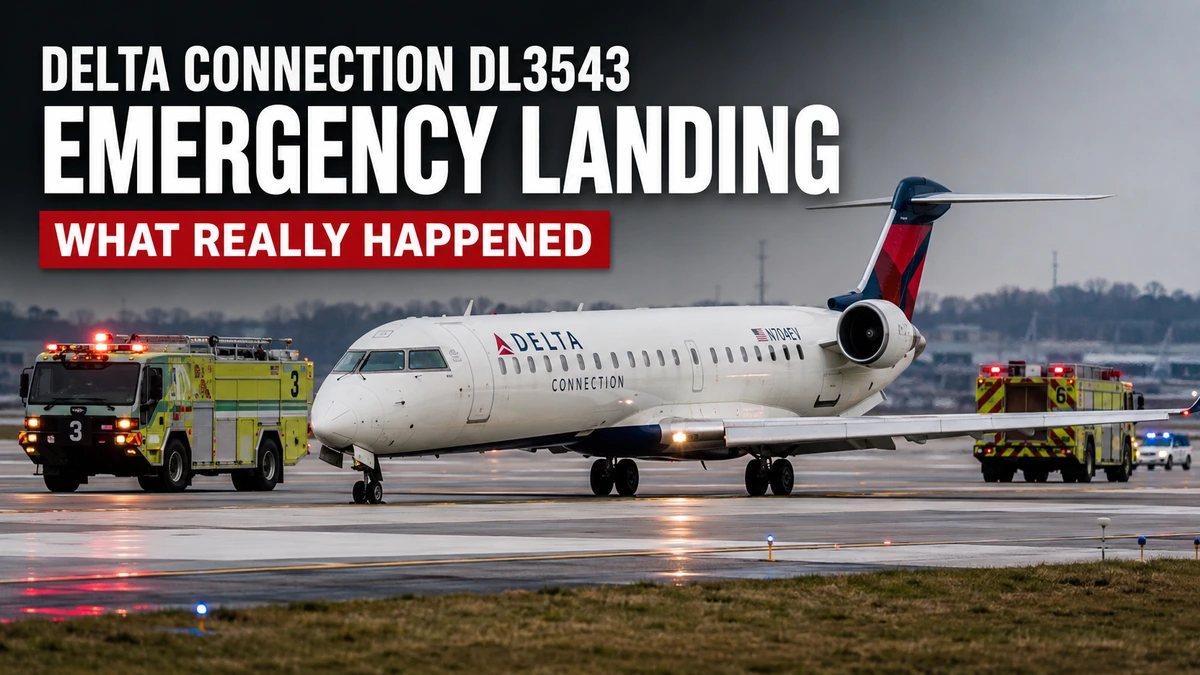
I understand why the phrase Delta Connection DL3543 Emergency Landing attracts attention. An aircraft taking off normally, stopping its climb, turning back toward its departure airport, and transmitting an emergency code naturally raises questions about what happened inside the cockpit and whether passengers were ever in serious danger. The most important part of this story, however, is separating what contemporary flight reporting actually established from technical explanations that appeared in later articles.
On July 7, 2025, Delta Connection flight DL3543 departed Minneapolis-Saint Paul International Airport for Chicago Midway International Airport. According to AIRLIVE’s report published while the event was unfolding, the Embraer regional jet stopped climbing at about 21,000 feet, turned back approximately 10 minutes after departure, and transmitted the general emergency transponder code 7700. It subsequently landed back at Minneapolis on runway 12R, about 37 minutes after departure, before proceeding to stand C12.
What I find especially important is what that report does not establish. It does not identify a pressurization failure, electrical failure, engine problem, smoke event, or other specific technical cause. Several articles published months later assign different causes and even disagree about the flight’s operator or route. I therefore think the most responsible account is one that preserves the verified sequence while clearly labeling anything that remains uncertain.
Key Takeaways From the Delta Connection DL3543 Emergency Landing
- The incident occurred on July 7, 2025.
- Flight DL3543 was operating from Minneapolis-Saint Paul International Airport (MSP) to Chicago Midway International Airport (MDW).
- The aircraft involved was N259SY, an Embraer E175LR operated by SkyWest Airlines for Delta Connection.
- The aircraft stopped its climb at approximately 21,000 feet and began returning to Minneapolis roughly 10 minutes after takeoff.
- The crew used squawk code 7700, which the FAA identifies as an emergency transponder code.
- AIRLIVE reported that the aircraft landed on runway 12R approximately 37 minutes after departure and later reached stand C12.
- Publicly accessible sources reviewed for this article do not establish the specific technical cause of the emergency.
- Later online articles mentioning pressurization problems, power interruptions, passenger counts, detailed cockpit conversations, or other technical specifics should not automatically be treated as confirmed facts unless supported by primary evidence.
What Happened During the Delta Connection DL3543 Emergency Landing?
The flight began as a routine regional service between Minneapolis and Chicago. Historical flight data confirms that DL3543 operated on the MSP to MDW route during that period, and contemporary reporting identifies N259SY as the aircraft involved in the July 7 event.
Soon after departure, the aircraft climbed to approximately 21,000 feet. AIRLIVE reported that the climb then stopped and the aircraft turned around roughly 10 minutes after takeoff. The crew subsequently transmitted squawk 7700, identifying the flight to air traffic control as an emergency requiring priority handling.
The aircraft did not continue to Chicago. Instead, it returned to Minneapolis-Saint Paul International Airport. AIRLIVE’s update reported that it landed on runway 12R 37 minutes after departure and subsequently reached stand C12.
That relatively short sequence provides the core of the incident. The aircraft departed, climbed, reversed course, declared an emergency, returned to MSP, landed, and reached a parking stand.
The word “emergency” can make that timeline sound inherently catastrophic. Aviation terminology is more nuanced. Declaring an emergency gives a crew access to priority handling and makes the aircraft’s situation unmistakable to controllers. It does not, by itself, reveal the severity or technical nature of whatever prompted the declaration. – Delta Connection DL3543 Emergency Landing.
Verified Facts About Delta Connection Flight DL3543
Because conflicting versions have circulated online, I think a fact-checking table is useful. The distinction between confirmed information and later claims is central to understanding this incident accurately.
| Detail | What the Evidence Supports | Confidence |
|---|---|---|
| Incident date | July 7, 2025 | High |
| Flight number | DL3543 | High |
| Departure airport | Minneapolis-Saint Paul International Airport | High |
| Intended destination | Chicago Midway International Airport | High |
| Aircraft | Embraer E175LR, registration N259SY | High |
| Operating carrier | SkyWest Airlines under Delta Connection | High |
| Approximate maximum reported climb altitude | 21,000 feet | High |
| Turnback timing | About 10 minutes after takeoff | High |
| Emergency transponder code | 7700 | High |
| Return airport | Minneapolis-Saint Paul International Airport | High |
| Landing runway | Runway 12R | High based on contemporaneous reporting |
| Approximate flight duration before return landing | 37 minutes | High based on contemporaneous reporting |
| Specific technical cause | Not established in the reliable public material reviewed | Unconfirmed |
| Pressurization failure | Claimed by some later websites, but not established by the contemporaneous report | Unconfirmed |
| Electrical or power interruption | Claimed by some later websites, but not established by the contemporaneous report | Unconfirmed |
The strongest evidence comes from the contemporary AIRLIVE account and aircraft tracking information rather than retrospective articles that appeared many months after the event. AIRLIVE identifies the route, aircraft registration, altitude, turnback, 7700 declaration, runway, and return duration. Flightradar24 identifies N259SY as an E175LR operated by SkyWest Airlines for Delta Connection.
This comparison is important because search results can create false confidence. When many websites repeat the same claim, readers can reasonably assume that several independent sources verified it. In reality, later pages can copy, paraphrase, or elaborate on one another without providing primary documentation. – Delta Connection DL3543 Emergency Landing.
Who Operated Delta Connection DL3543?
Delta Connection is a brand rather than the name of a single operating airline. Delta’s own website currently identifies Endeavor Air, Republic Airways, and SkyWest Airlines as Delta Connection carriers.
For the aircraft involved in this particular event, registration provides a clearer answer than generic references to the Delta Connection network. Flightradar24 identifies N259SY as an Embraer E175LR whose operator is SkyWest Airlines and whose airline branding is Delta Connection. Planespotters likewise records N259SY as being operated by SkyWest Airlines for Delta Connection.
That matters because several retrospective articles incorrectly identify Endeavor Air as the operator. The aircraft-registration evidence supports SkyWest instead.
Readers should therefore distinguish among three different labels:
- Delta Air Lines is the major airline whose DL flight code and network are involved.
- Delta Connection is the regional brand under which partner carriers operate flights.
- SkyWest Airlines was the operating carrier associated with N259SY.
This arrangement is not unusual. Regional flights throughout the United States are commonly marketed under a major airline’s brand while being operated by another certificated carrier.
What Does Squawk 7700 Mean?
The use of squawk 7700 is one of the most significant confirmed details in the DL3543 incident.
Aircraft transponders transmit identifying information that helps air traffic control track flights. Certain numerical codes have specific meanings. Code 7700 is associated with an emergency.
The FAA’s Aeronautical Information Manual gives pilots explicit guidance:
“should squawk Mode 3/A, Code 7700/Emergency”
Federal Aviation Administration
The FAA also explains that radar systems are designed so that code 7700 normally triggers an alarm or special indicator at control positions.
From my perspective, this is the most useful way to interpret the code: 7700 tells controllers that the aircraft requires emergency attention, but the four digits do not tell the public what is wrong with the airplane.
A pilot might declare an emergency for many different operational reasons. The existence of a 7700 code establishes that the situation was being treated as an emergency. It does not independently establish whether the initiating issue involved an engine, electrical system, pressurization, instrumentation, a medical event, smoke, a flight-control issue, or something else.
What Squawk 7700 Does Not Tell Us
It does not automatically mean:
- an engine failed;
- cabin pressure was lost;
- a fire occurred;
- the aircraft was uncontrollable;
- passengers needed to evacuate;
- a crash was imminent;
- the aircraft suffered structural damage.
Likewise, it should not be dismissed as meaningless simply because the aircraft subsequently landed without a dramatic outcome.
The correct interpretation lies between those extremes. It was a genuine emergency declaration, but the declaration alone does not disclose its cause or severity.
Why Would Pilots Return to Their Departure Airport?
When an abnormal condition appears soon after takeoff, returning to the departure airport can be a logical option because the crew already knows the airport, it is nearby, and suitable operational resources may be immediately available.
That does not mean a return is automatic. Pilots consider the aircraft’s condition, weather, runway requirements, fuel, traffic, terrain, available airports, maintenance support, and many other factors. The safest option may sometimes be the departure airport, while another airport may be preferable in a different emergency. – Delta Connection DL3543 Emergency Landing.
Federal regulations place substantial responsibility and authority with the pilot in command. 14 CFR 91.3 states:
“The pilot in command of an aircraft is directly responsible for, and is the final authority”
14 CFR 91.3
The same regulation allows the pilot in command, during an in-flight emergency requiring immediate action, to deviate from applicable rules to the extent necessary to meet that emergency.
In the case of DL3543, the visible result of that decision-making was straightforward: the aircraft stopped climbing, turned back toward MSP, declared an emergency, and landed there rather than proceeding to Chicago.
READ: Best Coding YouTube Channels in 2026: 12 Channels I Recommend for Learning to Code
What Caused the DL3543 Emergency?
This is where I believe readers need the most caution.
I could not locate a public Delta, SkyWest, FAA, or NTSB source in the material reviewed that identifies a definitive technical cause for the July 7, 2025 DL3543 emergency.
The original AIRLIVE report describes the turnback and emergency declaration but does not state why the crew declared the emergency.
Later websites provide several different explanations. Some say there was a pressurization-related indication. Others describe an electrical or power interruption. Some provide extremely detailed accounts of purported cockpit communication, affected systems, maintenance actions, passenger numbers, and post-flight inspections. The problem is that these details are not consistently supported by identifiable primary documentation.
The conflicting stories themselves are a warning sign.
For example, one later article calls the issue a power interruption while simultaneously identifying a different planned destination than the contemporaneous report. Other later pages identify Endeavor Air even though N259SY’s documented operator is SkyWest.
I therefore would not publish “pressurization failure caused DL3543 to make an emergency landing” as a fact.
A more defensible sentence is:
The crew declared an emergency for a reason that has not been established in the reliable public sources reviewed for this article.
That formulation may be less dramatic, but it protects the distinction between evidence and speculation.
Why Reports About DL3543 Conflict
The way this story developed online is almost as interesting as the aviation event itself.
AIRLIVE published its report on July 7, 2025, while the event was current. Months later, numerous sites began publishing articles optimized around the exact phrase “Delta Connection DL3543 Emergency Landing.”
Those retrospective articles frequently contain much more detail than the contemporary report, yet many do not show where those additional details originated.
Some describe a pressurization indication. Others describe electrical trouble. Some identify SkyWest, while others identify Endeavor. At least one account claims a different destination. These cannot all be simultaneously correct.
From what the evidence shows, search-engine repetition should therefore not be mistaken for corroboration.
How I Evaluate Conflicting Aviation Reports
I use a simple hierarchy:
- Official investigation or regulator material, when available.
- Statements from the airline, airport, operating carrier, manufacturer, or authorities.
- Contemporaneous aviation reporting and flight-tracking data.
- Established news organizations citing identifiable sources.
- Retrospective blogs that cite the sources above.
- Unsourced pages that introduce technical details without showing their origin.
For DL3543, the most useful publicly accessible evidence I found sits largely in the third category, supported by aircraft and operator records.
That means some questions must remain unanswered unless additional primary documentation becomes available.
Delta Connection DL3543 Timeline
A concise timeline helps show how quickly the event developed without inserting unsupported detail between confirmed points.
Departure From Minneapolis
DL3543 departed Minneapolis-Saint Paul International Airport for Chicago Midway International Airport on July 7, 2025. The route is also reflected in historical flight information for the DL3543 flight number.
Initial Climb
AIRLIVE reported that the Embraer regional jet climbed to about 21,000 feet.
Turnback
Approximately 10 minutes after takeoff, the aircraft stopped climbing and turned back toward Minneapolis.
Emergency Declaration
The crew transmitted squawk 7700. Under FAA guidance, 7700 is the emergency transponder code used to alert air traffic control to a distress or urgency condition.
Return to MSP
Rather than continuing toward Chicago, the aircraft returned to its departure airport.
Landing
AIRLIVE reported that DL3543 landed on Minneapolis runway 12R approximately 37 minutes after departure.
Arrival at Stand
A subsequent update placed the aircraft at stand C12.
That is the complete verified operational sequence available from the contemporary account. Claims about exactly what alarms appeared in the cockpit, what checklist the pilots performed, or which component technicians later inspected require evidence that the available contemporaneous report does not provide.
What Air Traffic Control Does After an Emergency Declaration
Once an emergency is declared, air traffic controllers have procedures designed to assist the aircraft and reduce competing demands on the pilots.
FAA controller guidance states that controllers should use available information, gather more information as necessary, and provide assistance consistent with the pilot’s requests.
A 7700 transponder code also creates a prominent indication within the air traffic system. The FAA notes that Code 7700 normally produces an alarm or special radar indicator, helping ensure controllers recognize the emergency condition.
Depending on the circumstances, controllers may coordinate priority routing, clear conflicting traffic, provide runway or weather information, communicate with airport services, and reduce unnecessary radio transmissions. – Delta Connection DL3543 Emergency Landing.
The specifics depend on what the crew needs.
This is another reason an emergency declaration should not be interpreted as evidence that control of the aircraft has been lost. Declaring an emergency can instead be a deliberate way to create additional operational margins while the crew manages an abnormal situation.
Emergency Declaration Versus Catastrophic Failure
The following table addresses several misconceptions that commonly appear when flight-tracking users see a 7700 code.
| What Was Observed | What It Means | What It Does Not Automatically Mean |
|---|---|---|
| Aircraft stopped climbing | Crew did not continue the planned climb | Engines had failed |
| Aircraft turned back | Crew chose not to continue to destination | Aircraft was uncontrollable |
| Squawk 7700 transmitted | Emergency status was communicated | A crash was imminent |
| ATC priority likely available | Controllers could prioritize the emergency aircraft | Other aircraft were necessarily in danger |
| Aircraft returned to MSP | Crew selected the departure airport for landing | The aircraft could not reach another airport |
| Aircraft landed on runway 12R | The emergency flight returned to the ground | The underlying fault is known |
| Aircraft later reached stand C12 | It moved from the runway to a parking position | Every aircraft system was necessarily normal |
The central lesson is that the observed flight path tells us a great deal about what the crew did, while revealing much less about why they needed to do it.
That distinction prevents both sensationalism and false reassurance.
Was the Aircraft an Embraer E170 or E175?
This point can look confusing because different websites describe the aircraft as an Embraer 170-200LR, ERJ-175, or E175LR.
The registration is more useful than the shorthand. Flightradar24 identifies N259SY as an Embraer E175LR, with type code E75L, operated by SkyWest Airlines for Delta Connection.
Planespotters identifies the aircraft as an Embraer ERJ-175 and records its SkyWest operating history under Delta Connection.
AIRLIVE used the description “Embraer 170-200LR-175LR” in its incident reporting.
The apparently different descriptions therefore refer to the E175 family and certification/designation conventions rather than evidence that entirely different aircraft were involved.
For a general reader, Embraer E175LR, registration N259SY is the clearest description.
What Happened to N259SY After the Emergency?
An emergency return does not automatically mean an aircraft is permanently removed from service.
Current Flightradar24 aircraft data identifies N259SY as active within the Delta Connection network under SkyWest and shows continuing flight activity well after the July 2025 event.
That tells us the aircraft subsequently returned to commercial operation.
It does not tell us what maintenance action occurred after DL3543, how long the aircraft was unavailable, what technicians found, or whether a component was replaced. Those details require maintenance or operator records that I have not found publicly documented in a reliable source for this event.
This is an important example of how carefully evidence should be interpreted. Continued later operation establishes that N259SY was not permanently withdrawn after the incident. It does not establish the original cause.
What a Safe Return Can Tell Us
The outcome does provide several meaningful facts.
The crew was able to turn the aircraft around, navigate back toward Minneapolis, conduct an approach, land on a runway, and move the aircraft to a stand.
Those facts are inconsistent with some of the most extreme interpretations people may imagine when seeing the word “emergency.” At the same time, I would not downgrade the situation to “nothing happened.” The crew declared an emergency, and the flight terminated shortly after departure instead of continuing to Chicago.
Both statements can be true:
The event was serious enough for the crew to declare an emergency, and the aircraft nevertheless completed a controlled return and landing.
That is often the most accurate way to discuss aviation incidents. Safety procedures exist precisely so that abnormal events can be managed before they become worse.
Why the Exact Cause Matters
Knowing whether an emergency involved pressurization, electrical power, flight controls, an engine indication, smoke, instrumentation, or another issue changes the technical analysis completely.
A pressurization problem would raise questions about cabin altitude, automatic and manual pressurization control, descent requirements, and oxygen procedures.
An electrical problem would involve a different set of aircraft systems, redundancy, power sources, buses, generators, batteries, and checklist procedures.
An engine problem would lead to yet another analysis involving engine indications, thrust availability, aircraft performance, and potentially single-engine procedures.
Without evidence identifying the initiating condition, blending these scenarios together produces an article that sounds technical without actually being factual.
That is why I have deliberately not selected one of those possibilities and presented it as the cause of DL3543.
A technically sophisticated article should become more cautious when the evidence is incomplete, not more imaginative.
Common Misconceptions About the DL3543 Emergency Landing
“Squawk 7700 Means the Plane Was About to Crash”
No. Code 7700 communicates an emergency condition to air traffic control. The FAA specifically identifies it as the emergency code and explains that it triggers special indications within the radar system.
The code does not contain information about the probability of a crash.
“If the Plane Landed Safely, It Was Not a Real Emergency”
That conclusion is also incorrect.
A successful outcome does not retroactively erase the need for an emergency declaration. Procedures, crew decisions, ATC assistance, aircraft redundancy, and airport resources exist to turn potentially serious situations into controlled outcomes.
“The Cause Was Definitely Pressurization”
I would not state this as fact.
Some retrospective pages use that explanation, but the contemporaneous AIRLIVE report does not identify the cause.
“Endeavor Air Operated the Flight”
Aircraft records point instead to SkyWest Airlines. Flightradar24 lists N259SY’s operator as SkyWest, while Planespotters records the same operator history under Delta Connection.
“Every Article Reporting the Same Detail Confirms It”
Not necessarily.
Ten pages can repeat one unsupported claim. Corroboration is strongest when independent sources provide evidence that can be traced to primary records, statements, data, or direct reporting.
How Passengers Should Interpret an Emergency Return
For passengers, an announcement that an aircraft is returning to the departure airport can understandably be alarming. I think the most useful response is to focus on crew instructions rather than trying to diagnose the aircraft from cabin sounds, flight-tracking applications, or social-media speculation.
Passengers should keep seat belts fastened when instructed, secure loose items, listen to the cabin crew, and avoid obstructing aisles or exits.
If an evacuation is ordered, instructions can change rapidly. Cabin crews are trained around specific aircraft procedures, which makes following their directions more useful than relying on general assumptions about emergency situations.
For people following an incident from the ground, flight-tracking data should likewise be treated as operational evidence rather than a complete diagnostic tool.
Altitude, speed, track, destination changes, and a 7700 code can show that something unusual is happening. They cannot normally reveal a component-level cause.
What the Delta Connection DL3543 Emergency Landing Shows About Aviation Reporting
For me, the broader lesson from DL3543 is not only about aviation safety. It is also about information quality.
A relatively concise contemporary report can become the foundation for a much larger internet narrative. Over time, new articles may add a cause, passenger count, cockpit quotations, technical diagrams, maintenance actions, or precise timelines.
Those additions can make later articles appear more authoritative simply because they contain more detail.
Detail is not the same as evidence.
The best reporting preserves uncertainty where uncertainty genuinely exists. In this case, we can confidently describe the route, aircraft, climb interruption, turnback, emergency code, return airport, runway, and approximate duration using available evidence.
We cannot confidently identify the initiating technical fault from the same evidence.
I believe that distinction makes the account stronger rather than weaker.
What to Check When You See a Similar Aviation Story
Readers can use the DL3543 incident as a model for evaluating future flight-emergency reports.
First, look for the publication date. A report written while the event is occurring may contain fewer details, but it can preserve the original observed facts before online retellings multiply.
Second, check the aircraft registration. Flight numbers can be reused every day, routes can change seasonally, and different aircraft may operate the same number. An N-number such as N259SY helps identify the specific aircraft.
Third, separate the marketing airline from the operating carrier. Delta Connection, American Eagle, and United Express are examples of regional brands under which different operating airlines may fly.
Fourth, treat transponder information carefully. A 7700 code is important evidence of an emergency declaration, but it is not a diagnosis.
Fifth, search for statements from the FAA, NTSB, airport, airline, operating carrier, or aircraft manufacturer before accepting technical explanations from secondary sites.
Finally, pay attention to whether a source distinguishes facts from possibilities. A sentence saying “a pressurization problem can lead to a return” is general aviation information. A sentence saying “DL3543 returned because of pressurization” is a specific factual claim and requires evidence for this particular flight.
What We Can Reasonably Conclude
Based on the available evidence, I believe the strongest reconstruction is simple.
On July 7, 2025, Delta Connection flight DL3543 was scheduled from Minneapolis-Saint Paul to Chicago Midway. The aircraft was N259SY, an Embraer E175LR operated by SkyWest Airlines under the Delta Connection brand. It climbed to approximately 21,000 feet, stopped climbing, turned back roughly 10 minutes after departure, and transmitted the emergency code 7700. The aircraft subsequently landed back at MSP on runway 12R approximately 37 minutes after departure and proceeded to stand C12.
FAA guidance confirms that 7700 is used to alert air traffic control to an emergency condition and receives special recognition within the radar system.
What we cannot reasonably conclude from the available evidence is that a particular pressurization, electrical, engine, or other technical failure definitely caused the event.
That unanswered question should remain unanswered unless stronger evidence emerges.
Conclusion
I view the Delta Connection DL3543 Emergency Landing as a good example of why aviation incidents should be explained with precision rather than drama. The confirmed facts show that DL3543 departed Minneapolis for Chicago Midway on July 7, 2025, stopped climbing at about 21,000 feet, turned back shortly after departure, transmitted squawk 7700, and landed again at Minneapolis. The aircraft involved, N259SY, is documented as a SkyWest-operated Embraer E175LR flying under the Delta Connection brand.
The part I would not turn into a certainty is the cause. Later websites provide competing technical explanations, but the contemporaneous report does not identify one. That difference matters.
My practical lesson for readers is to treat flight paths, transponder codes, registrations, and official statements as pieces of evidence rather than invitations to fill gaps with assumptions. When another aviation emergency appears in the news, check the earliest reporting and primary sources first. A responsible explanation should tell us not only what is known, but also where the verified record ends.
Frequently Asked Questions
What Happened During the Delta Connection DL3543 Emergency Landing?
Delta Connection flight DL3543 departed Minneapolis-Saint Paul International Airport for Chicago Midway on July 7, 2025, but turned back shortly after departure. AIRLIVE reported that the Embraer jet stopped its climb at around 21,000 feet, reversed course about 10 minutes after takeoff, and transmitted the emergency code 7700. It subsequently landed back at Minneapolis on runway 12R approximately 37 minutes after departure and proceeded to stand C12.
What Caused Delta Connection Flight DL3543 to Return to Minneapolis?
The specific cause has not been established by the reliable public evidence reviewed for this article. Some later websites attribute the Delta Connection DL3543 Emergency Landing to a pressurization indication, while others describe electrical or power problems. The contemporary AIRLIVE report does not identify a technical cause, so I would not present either explanation as confirmed without additional primary documentation.
What Does Squawk 7700 Mean on an Airplane?
Squawk 7700 is an emergency transponder code. FAA guidance says pilots encountering a distress or urgency condition can use Code 7700 to alert a ground radar facility, and FAA documentation explains that it normally produces an alarm or special indicator at control positions. It tells air traffic control that the aircraft requires emergency attention. It does not, by itself, identify what problem exists aboard the aircraft.
Was DL3543 Operated by Delta Air Lines, Endeavor, or SkyWest?
The aircraft evidence identifies SkyWest Airlines as the operating carrier. Flight DL3543 was marketed under the Delta Connection brand, while the aircraft involved, N259SY, is identified by Flightradar24 as an Embraer E175LR operated by SkyWest Airlines. Planespotters also records SkyWest as the aircraft’s operator under Delta Connection. Delta itself lists SkyWest among its Delta Connection carriers.
What Aircraft Was Involved in the DL3543 Emergency Landing?
The aircraft was registration N259SY, an Embraer E175LR. AIRLIVE identified N259SY in its original incident report, while Flightradar24 identifies the registration as an E175LR operated by SkyWest Airlines for Delta Connection. Some sources use related designations such as Embraer 170-200LR or ERJ-175, but these references point to the same aircraft family involved in the event.
Did DL3543 Make It to Chicago Midway?
No. The July 7, 2025 flight returned to Minneapolis instead of completing the planned journey to Chicago Midway. AIRLIVE reported that the aircraft turned back about 10 minutes after takeoff and landed again at MSP approximately 37 minutes after departure. Historical flight information also confirms DL3543 was associated with the Minneapolis to Chicago Midway route during that period.
Does an Emergency Landing Mean an Aircraft Is About to Crash?
No. An emergency declaration means a situation requires priority attention or special handling, but it does not automatically mean a crash is imminent. FAA guidance explicitly provides Code 7700 for emergency conditions and gives pilots significant authority during in-flight emergencies. The severity and cause can vary considerably. DL3543’s controlled return to Minneapolis illustrates why the emergency declaration and the eventual outcome should be considered separately.
Was Anyone Injured in the Delta Connection DL3543 Emergency Landing?
The contemporaneous AIRLIVE report reviewed for this article does not report injuries and records the aircraft landing and later reaching stand C12. Several later websites explicitly state that no injuries occurred, but because those accounts introduce other conflicting details, I would phrase the point cautiously rather than treat every retrospective claim as independently verified. The strongest documented outcome is that the aircraft landed back at MSP and proceeded to a stand.
Why Did DL3543 Return to Minneapolis Instead of Landing Somewhere Else?
The public evidence does not provide the crew’s full decision-making rationale. Minneapolis was the departure airport and the aircraft was still relatively close to it when the turnback began. In general, the pilot in command decides how to handle an in-flight emergency and has broad authority under federal regulations. For DL3543, the observable result was a return to MSP rather than continuation to Chicago.
Is N259SY Still Flying After the Emergency?
Flight-tracking data available in 2026 identifies N259SY as an active Embraer E175LR operated by SkyWest Airlines for Delta Connection and shows subsequent flight activity. That establishes that the aircraft returned to commercial service after the July 2025 incident. It does not reveal what inspection, repair, maintenance action, or troubleshooting occurred immediately after the emergency landing.
Sources and References
- AIRLIVE, contemporaneous July 7, 2025 reporting on DL3543’s Minneapolis departure, Chicago Midway destination, N259SY registration, approximately 21,000-foot climb, turnback, squawk 7700 declaration, runway 12R landing, and arrival at stand C12.
- Federal Aviation Administration Aeronautical Information Manual, guidance on Code 7700 and emergency transponder operations.
- Federal Aviation Administration Air Traffic Control guidance, explaining how emergency transponder indications are handled by controllers.
- 14 CFR 91.3, covering the responsibility and authority of the pilot in command during normal operations and in-flight emergencies.
- Flightradar24, aircraft record identifying N259SY as an Embraer E175LR operated by SkyWest Airlines for Delta Connection.
- Planespotters.net, operator-history information for N259SY identifying SkyWest Airlines and Delta Connection service.
- Delta Air Lines, current information identifying SkyWest Airlines among the carriers operating Delta Connection services.
- Airportia, historical DL3543 route information for Minneapolis to Chicago Midway.
Disclaimer
I prepared this article for informational purposes using publicly accessible aviation reporting, flight-tracking information, airline material, and FAA guidance. Details surrounding aviation incidents can change if an airline, regulator, investigator, or operating carrier later releases additional evidence. I have deliberately not presented an unverified pressurization, electrical, mechanical, or other technical issue as the confirmed cause of the Delta Connection DL3543 emergency because the reliable contemporaneous material reviewed here does not establish one. Readers seeking operational, legal, engineering, or safety conclusions about a specific aviation event should rely on official airline, FAA, NTSB, manufacturer, or investigative documentation when such material is available.
-

 Health2 weeks ago
Hemp Gummies for Soothing Relief 750mg / 30 Count: Facts, Safety, Ingredients, and Evidence
-

 Education2 weeks ago
Quizlet NC Permit Test: 2026 North Carolina Permit Study Guide
-

 AI6 days ago
vrgamegirl19/comfyui-vrgamedevgirl: Features, Setup, Installation, and Safety Guide
-

 Education2 weeks ago
Kinematic Equations: Complete Guide With Formulas, Examples, and Solutions
-

 Guide2 weeks ago
Best Laptops for Writers in 2026: 7 Top Picks for Writing, Research, and Travel
-

 Technology2 weeks ago
Best Coding YouTube Channels in 2026: 12 Channels I Recommend for Learning to Code
-

 Entertianment2 weeks ago
YarrList: What It Is, Safety, Legality, and Alternatives
-

 AI2 weeks ago
Open CoDesign: What It Is, Features, Setup, and How It Works